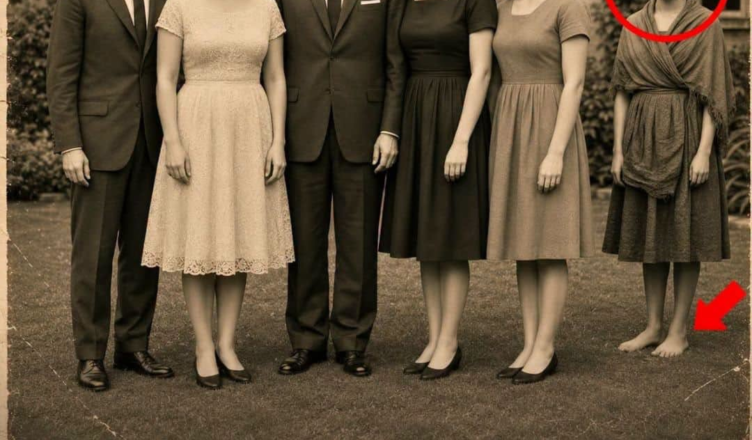
Sometimes, the most important part of a photograph is precisely where no one usually looks first. In the center of the image, the expected faces appear: father, mother, children, neat clothes, formal posture, that air of a portrait made to last. But, in the corner, almost outside the main scene, there is a young woman who completely changes the interpretation of the photo.
The image, attributed to 1961, shows a family posing in front of a house, while a maid appears further back, away from the group. At first glance, she seems to have been placed there as a secondary presence. However, according to accounts associated with the photo, her life would take a very different path from that suggested in that moment.
A photograph that reveals much about the era.
- Old family portraits were almost ceremonies. People dressed up, chose the best angle in the house, stood upright, and tried to project stability, order, and social respect. Nothing was very spontaneous.
Therefore, each person’s position in the photo said a lot.
Family members were usually placed in the center, well-lit and prominently displayed. Household staff, when they appeared, tended to occupy more discreet locations: in the background, to the side, sometimes in uniform or simpler clothing. It was a silent way of showing the hierarchy of that home.
In the 1961 image, this detail is striking. The young maid is present, but separate. She participates in the scene, but not exactly in the same way. Her body is there, her story too, although the composition tries to place her almost as part of the scenery.
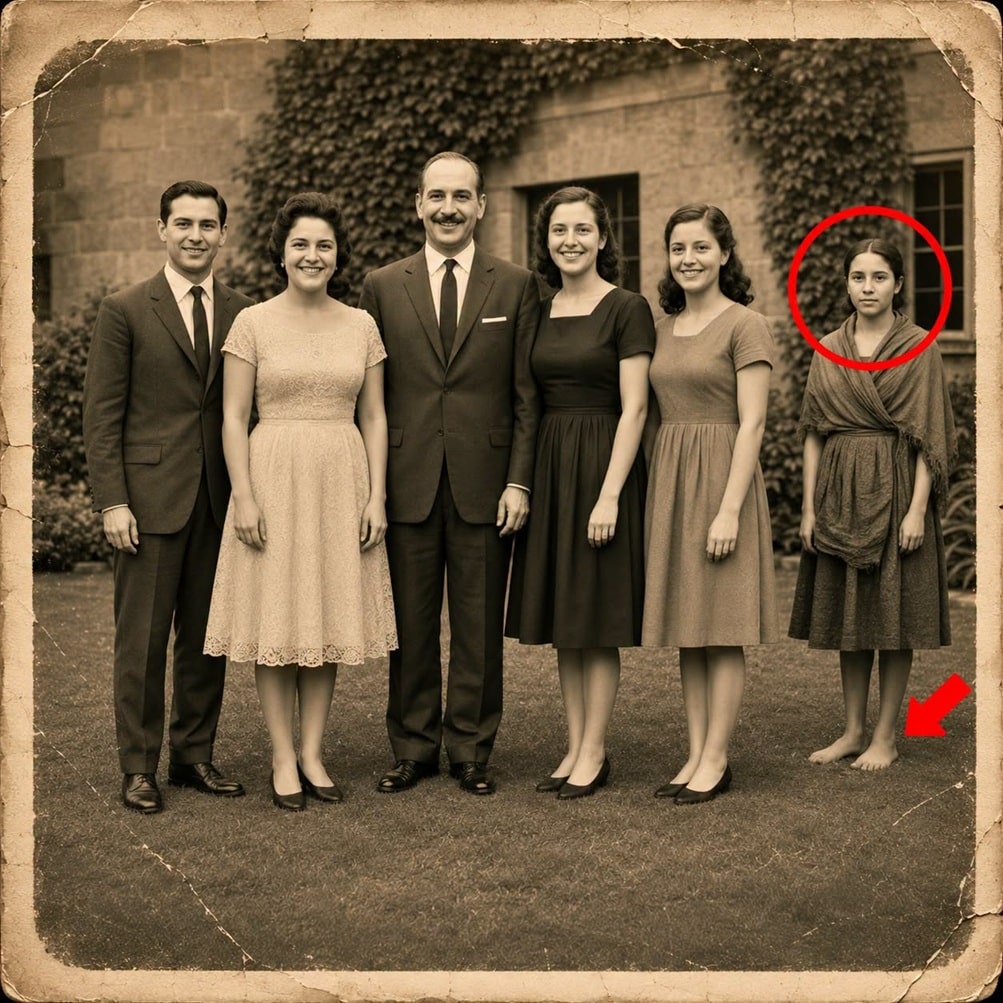
The detail in the background that changes the whole photo.
The red circle over the image draws the eye directly to it. Without this marking, many people might pass by the photograph without noticing its presence.
The young woman appears barefoot, dressed simply and with a serious expression. Unlike the other women in the photo, who wear more formal dresses and shoes, she seems to carry a different kind of routine on her body: work, tiredness, silence, and a social distance that didn’t need to be explained in words.
This contrast is what makes the image so talked about. The photograph depicts a family, but also reveals a working relationship. Does it show affection? Perhaps. Does it show inequality? Also. It shows the domestic life of a time when many women, especially young women from rural areas or poor families, found in domestic service one of the few ways to obtain housing, food, and some money.
Who was the young woman behind the family?
The source associated with the image states that the woman depicted had left her region of origin at a very young age to seek work in the city. This was a common path for many girls and women in the 20th century.
Domestic work, despite being arduous, could seem like a gateway to something better. In exchange for a modest salary, food, and a room to sleep in, many workers took on practically the entire household routine: cleaning, cooking, laundry, childcare, and small tasks that arose throughout the day.
Life started early. There wasn’t the labor rights structure that is discussed more clearly today. There was also a normalization of inequality: the maid might be treated kindly at times, but she was rarely seen as someone with the same dreams, limitations, and possibilities.
In the photo, she appears in the background. In real life, however, she wanted to leave that place.
The destiny that surprised those who looked at the photograph.
The most interesting part of the story is what happened next.
According to accounts related to the image, that young woman did not remain confined to the role that the photograph seemed to reserve for her. Over the years, she saved money, learned new skills, and began to build a life of her own, far from dependence on that employing family.
It wasn’t a simple leap. For poor women of that generation, changing their lives required a difficult combination: discipline, opportunity, emotional resilience, and often, the ability to endure unfair situations without losing sight of what they wanted for themselves.
She would have formed her own family, achieved stability, and found other ways to make a living. The woman who appears almost erased in the portrait ended up having a much greater trajectory than that background position suggested.
Why does this image affect people so much?
The photograph is unsettling because it seems too easy to understand, but it isn’t. The first glance sees a well-dressed family. The second glance finds a distant employee. The third begins to ask questions.
Why is she so far away from the others?
Why is she barefoot?
Did she want to be in that photo?
Was she treated as part of the household or as someone who merely served the household?
What was she thinking at that moment?
These questions give the image strength. Old photos have this power: they show a still scene, but open up space to think about everything that was left out of the frame.
The reunion that changed the meaning of the portrait.
Decades later, according to the story associated with the photo, some of the children who appear in the image met again the woman who had worked in their house.
This reunion would have given the portrait a different weight. For those who were children at the time, that young girl might be remembered for the food, the care, the daily presence, the small gestures that sustained the household routine. For her, the photo might represent a difficult period, but also a phase that preceded her personal transformation.
That’s where the image ceases to be merely curious. It begins to show how certain people are stored in family memory in an ambiguous way: they were present every day, but were rarely placed at the center of the narrative.
Housework and the stories that almost disappear
The lives of many domestic workers in the 20th century were recorded in this way: in the corners of photographs, in childhood memories, in family anecdotes, in names forgotten over time.
They cleaned houses, prepared meals, cared for children who were not their own, and accompanied them through illnesses, moves, birthdays, and losses. Even so, they were often treated as transient figures.
The 1961 image is noteworthy because it does the opposite: it pulls this woman into the center of the conversation.
She points out that behind social roles, there are complete biographies. The domestic worker in the photo had a past, desires, fears, plans, and the ability to transform her own story.
What to look for in old photos like this one
Old photographs often reveal details that go unnoticed. Here are a few points to help understand the context better:
Each person’s position shows who was considered the protagonist of the scene.
Clothing indicates differences in class, occasion, and social role.
Shoes — or the lack thereof — can reveal working conditions and inequality.
Facial expressions reveal discomfort, formality, shyness, or pride.
The surrounding environment helps to identify the lifestyle of the family portrayed.
In this image, the most striking detail is precisely the distance between the family and the young worker. She is close enough to be part of the household, but far enough away for her social position to be evident.
Read also : The bouquet that first catches your eye may reveal something unexpected about you.
A woman who emerged from the background of the photo.
The image’s title speaks of a different destiny because the trajectory attributed to this woman breaks the expectation created by the portrait. She appears in the background, but her life did not end there. The background of the photo was not the final place in her story.
This may be why the photograph continues to attract attention: it shows a real inequality, but also points to a life that moved forward. A woman who, even starting from a limited social position, managed to build new paths, start her family, and be remembered for something greater than the work she did in that house.