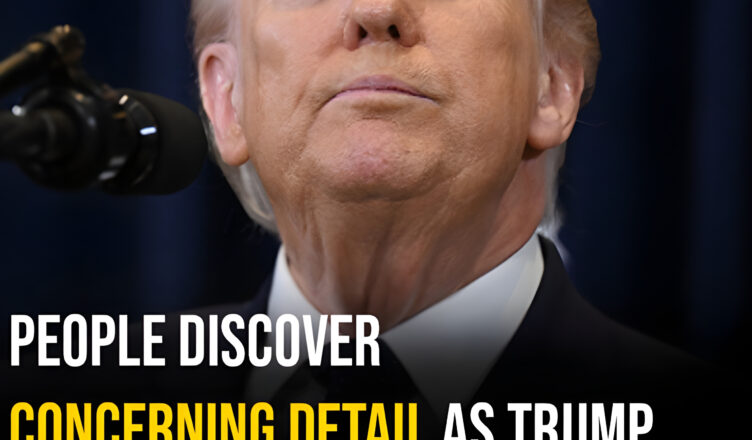
The questions began almost immediately after Donald Trump returned to public view.
Following several days away from the spotlight, his appearance inside the Oval Office was intended to reassure the public. Instead, it sparked a fresh wave of speculation. Observers quickly noticed subtle details—his posture, the positioning of one hand, his tone of voice, and the timing of his return. Within hours, social media platforms were flooded with theories, screenshots, and debates about what, if anything, might be happening behind the scenes.
For some Americans, the reaction reflected a broader concern about transparency at the highest levels of government.
The presidency has traditionally been associated with visibility, confidence, and public accountability. Whenever a president disappears from view for an extended period, questions naturally follow. In Trump’s case, those questions intensified because many critics believed the official explanations left room for uncertainty.
Online commentators dissected every second of footage.
Videos were slowed down.
Images were enlarged.
Body language was analyzed frame by frame.
What might have been dismissed as ordinary behavior under different circumstances became the focus of intense public scrutiny. Some pointed to the way Trump appeared to protect or conceal his right hand. Others focused on perceived changes in his energy, voice, or appearance.
As often happens in the digital age, speculation quickly expanded far beyond the available facts.
Theories ranging from minor health concerns to elaborate cover-up allegations circulated across social media platforms. Supporters dismissed many of these claims as politically motivated attacks, while critics argued that unanswered questions only encouraged further suspicion.
Meanwhile, official reports presented a very different picture.
Medical evaluations released by Trump’s physicians described him as healthy and capable of fulfilling the responsibilities of office. Public statements emphasized positive test results, strong cognitive performance, and overall fitness. According to those reports, there was no indication of any serious health issue that would interfere with presidential duties.
Yet for many observers, official assurances no longer carry the authority they once did.
Years of political polarization, conflicting narratives, and declining trust in institutions have created an environment where even straightforward explanations are frequently met with skepticism. In such a climate, every unexplained absence, unusual photograph, or awkward public appearance can become fertile ground for controversy.
The debate surrounding Trump’s recent appearance reflects something larger than questions about one individual’s health.
It highlights a growing divide between official information and public perception.
On one side are government statements, medical evaluations, and documented records.
On the other are millions of citizens who increasingly rely on social media analysis, independent commentators, and personal interpretations of events.
The gap between those two realities continues to widen.
For some people, the available medical reports are sufficient evidence that there is nothing unusual to investigate.
For others, the very existence of speculation is viewed as proof that important information may be missing.
Neither side appears likely to convince the other.
As a result, every public appearance becomes more than a routine event. It becomes another chapter in an ongoing struggle over trust, credibility, and who gets to define reality in a deeply divided political environment.
Ultimately, the controversy may reveal less about Donald Trump himself than about the current state of public confidence in American institutions.
When trust erodes, reassurance becomes difficult.
Facts are questioned.
Official statements are challenged.
And even ordinary moments can evolve into national debates.
Whether the concerns prove justified or not, the reaction serves as a reminder that public confidence is often far harder to restore than it is to lose.
In today’s political climate, uncertainty rarely remains empty for long.
If clear answers are not provided, speculation is almost certain to rush in and fill the space.