Engaging Introduction
Let me tell you about the night I realized my favorite sleeping position might be hurting me.
I’ve been a right-side sleeper for as long as I can remember. It’s just comfortable. I curl up on my right side, tuck my knees slightly, and drift off within minutes. I thought I was doing everything right. I wasn’t sleeping on my stomach (bad for my neck). I wasn’t sleeping on my back (snoring). I was a side sleeper – the “healthiest” position.
Then I started waking up with heartburn. Not every night, but often enough to be annoying. I adjusted my diet. I stopped eating late. Nothing helped.
At a routine checkup, I mentioned it to my doctor. She asked a question that caught me off guard: “Which side do you sleep on?”
“Right side,” I said. “Always.”
She nodded. “Try sleeping on your left side for two weeks. See what happens.”
I was skeptical. How could something as simple as which side I face change my health? But I tried it. And within a week, my nighttime heartburn had almost completely disappeared. Not from medication. Not from diet. Just from rolling over.
That experience sent me down a rabbit hole of research. It turns out that sleeping on your right side every night can affect your health in several ways—some surprising, some concerning. And while right-side sleeping isn’t “dangerous” for most people, certain individuals should be aware of the potential risks.
Let me walk you through what I learned.
First, a Quick Reality Check
Before I list potential risks, let me be clear. For the average healthy person, sleeping on your right side is not dangerous. It will not cause disease. It will not shorten your lifespan. Millions of people sleep on their right side every night and suffer no ill effects.
However, for people with certain underlying conditions – or for those who are pregnant – right-side sleeping can worsen symptoms or create avoidable health risks.
This article is not meant to scare you out of a comfortable sleep position. It’s meant to inform you, so you can make choices that support your unique health needs.
Now, let’s talk about what actually happens when you sleep on your right side.
The Anatomy: Why Side Matters
Your body is not symmetrical. Your internal organs are arranged in specific ways, and gravity affects them differently depending on which way you’re lying.
Here’s a quick anatomy refresher:
- Your stomach curves to the left side of your abdomen.
- Your esophagus (the tube connecting your mouth to your stomach) enters your stomach from the right side.
- Your liver sits on the right side of your abdomen.
- Your gallbladder is tucked under your liver on the right.
- Your heart sits slightly to the left of center in your chest.
- Your spleen is on the left.
- The inferior vena cava (the large vein that returns blood from your lower body to your heart) runs along the right side of your spine.
When you lie on your right side, gravity shifts the position of these organs. For some people, this shift causes problems.
6 Potential Health Effects of Sleeping on Your Right Side
Let me walk you through the most well-documented effects.
1. Worsened Acid Reflux and Heartburn (Most Common)
This is what I experienced. And it’s the most well-studied effect of right-side sleeping.
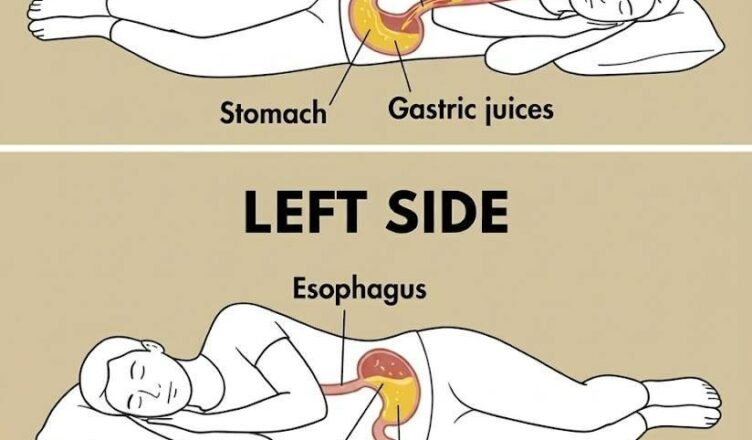
What happens: Your stomach sits on the left side of your abdomen. When you lie on your right side, your stomach is positioned above your esophagus. Gravity pulls stomach acid toward the lower esophageal sphincter (LES) – the valve that keeps acid from flowing backward into your esophagus. If your LES is weak (as it is in many people with GERD), acid easily leaks out.
The science: A landmark study published in the American Journal of Gastroenterology found that sleeping on the right side significantly increased acid exposure in the esophagus compared to left-side or back sleeping. Participants had more reflux episodes and longer clearance times.
The comparison:
- Left-side sleeping: Stomach sits below the esophagus. Acid stays put.
- Right-side sleeping: Stomach sits above the esophagus. Acid flows downward toward the LES.
Who is most at risk: People with GERD (gastroesophageal reflux disease), hiatal hernia, frequent heartburn, or anyone who eats large meals close to bedtime.
What you can do: If you have reflux, try sleeping on your left side. Elevate the head of your bed by 6-8 inches (using blocks under the bed frame, not just pillows). Stop eating 2-3 hours before bed.
2. Increased Risk of Gallbladder Discomfort or Attacks
This one surprised me, but the anatomy makes sense.
What happens: Your gallbladder sits on the right side of your abdomen, tucked under your liver. When you lie on your right side, gravity can shift gallstones (if you have them) toward the cystic duct – the narrow passage that drains bile from the gallbladder. If a stone blocks the duct, it can trigger a gallbladder attack: sudden, intense pain in the upper right abdomen, often accompanied by nausea and vomiting.
The science: While there are no large-scale studies proving that right-side sleeping causes gallbladder attacks, gastroenterologists have observed this phenomenon clinically. Patients with known gallstones often report more frequent symptoms when sleeping on their right side.
Who is most at risk: People with known gallstones (even tiny ones). People with a family history of gallbladder disease. People with a history of gallbladder “attacks” (biliary colic).
What you can do: If you have gallstones and notice pain after sleeping on your right side, try switching to your left side or back. If you have frequent attacks, talk to your doctor about gallbladder removal (cholecystectomy).
3. Potential Impact on Liver Function (Very Rare)
This risk is often overstated online, but here’s the actual science.
What happens: Your liver is a large, heavy organ on your right side. When you lie on your left side, the liver hangs away from the diaphragm. When you lie on your right side, the liver rests against the diaphragm and other abdominal organs.
The concern: In people with severe liver disease (cirrhosis, enlarged liver), lying on the right side could theoretically compress the liver or affect blood flow. However, there is no strong evidence that right-side sleeping harms a healthy liver.
Who is most at risk: People with advanced liver disease (cirrhosis, hepatomegaly/enlarged liver). The average person has nothing to worry about.
What you can do: If you have liver disease, ask your doctor about optimal sleeping positions. They may recommend left-side sleeping or slight elevation.
4. Heart Palpitations or Discomfort (For Some People)
This is the risk that gets the most attention online, but it’s not what most people think.
What happens: Your heart sits slightly to the left of center in your chest. When you lie on your left side, the heart shifts closer to the chest wall. This can make heartbeats feel more pronounced – a sensation called “palpitations” that is almost always benign.
Right-side sleeping effect: For most people, right-side sleeping does not cause palpitations. In fact, some people with palpitations on their left side find relief on their right side.
The exception: People with certain structural heart conditions (like a large pericardial effusion or severe cardiomyopathy) may experience different symptoms depending on position. This is rare.
Who is most at risk: Healthy hearts are fine. People with known heart conditions should follow their doctor’s advice.
What you can do: If you feel palpitations, note your position. Try changing sides. If palpitations are frequent or accompanied by chest pain, shortness of breath, or dizziness, see a doctor.
5. Arm Numbness, Shoulder Pain, or Thoracic Outlet Syndrome
This is less about internal organs and more about mechanics.
What happens: When you sleep on your right side, you put your full body weight on your right shoulder and arm. This can compress nerves and blood vessels, leading to:
- Numbness or tingling (“pins and needles”) in your right hand or fingers
- Shoulder pain or stiffness in the morning
- Worsening of existing rotator cuff issues
- Thoracic outlet syndrome (compression of nerves or blood vessels in the space between your collarbone and first rib)
Who is most at risk: People with existing shoulder injuries (rotator cuff tears, bursitis, impingement). People with carpal tunnel syndrome or ulnar nerve entrapment. People who sleep with their arm tucked under their head or body. People with large breasts (the weight can pull on the shoulder).
What you can do: Use a supportive pillow that keeps your neck aligned with your spine. Place a small pillow or rolled towel under your waist to reduce pressure on your shoulder. Don’t tuck your arm under your head or body – extend it forward instead. Consider a body pillow to keep you from rolling fully onto your side.
6. Increased Facial Wrinkles (For the Esthetically Minded)
This won’t hurt your health, but it might bother you.
What happens: Compressing your face against a pillow for hours creates “sleep lines” – wrinkles etched into the skin. Over years, these can become permanent. Right-side sleepers tend to develop more wrinkles on the right side of their face.
The evidence: Studies on sleep wrinkles have found that side sleepers have more facial wrinkles than back sleepers. The effect is cumulative.
Who is most at risk: Anyone who cares about facial aging. People with delicate or mature skin.
What you can do: Sleep on your back. Use a silk or satin pillowcase (reduces friction). Some people use special “beauty pillows” with cutouts for the face – but back sleeping is the most effective.
Is Left-Side Sleeping Always Better?
Now that I’ve listed potential risks of right-side sleeping, you might assume left-side sleeping is always better. It’s not that simple.
Left-side sleeping benefits:
- Reduces acid reflux and heartburn
- May improve circulation for pregnant people (relieves pressure on the inferior vena cava)
- May help the lymphatic system drain more efficiently
Left-side sleeping risks:
- Can cause heart palpitations in some people (the heart shifts closer to the chest wall)
- May worsen symptoms for certain hiatal hernia patients (rare)
- Can cause discomfort for people with enlarged spleen (rare)
- May put pressure on the stomach (if you’ve eaten recently)
For most people, the benefits of left-side sleeping outweigh the risks – especially for those with GERD. But there’s no “perfect” position for everyone.
Special Considerations for Pregnancy
If you’re pregnant, especially in the second or third trimester, sleep position matters significantly.
The concern: The growing uterus can compress the inferior vena cava – the large vein that returns blood from your lower body to your heart. Compression can reduce blood flow to your heart, which can reduce blood flow to the placenta and baby.
The recommendation: Sleep on your left side. This shifts the uterus away from the vena cava and improves circulation. Right-side sleeping is better than back sleeping, but left-side is best.
What if you wake up on your right side? Don’t panic. Simply roll to your left. The risk comes from spending most of the night on your back, not occasional position changes.
How to Switch from Right-Side to Left-Side Sleeping
Old habits are hard to break. Here’s how to retrain your body.
Use pillows as barriers: Place a body pillow or several regular pillows along your right side. They’ll physically block you from rolling onto your right side.
Try the “tennis ball trick”: Sew a tennis ball into the back of a shirt or pajama top. When you try to roll onto your right side, the ball will be uncomfortable, and you’ll roll back to your left.
Create a pillow nest: Put a pillow between your knees (aligns hips), a pillow under your belly (if pregnant), and a pillow behind your back (prevents rolling). This makes left-side sleeping more comfortable.
Start on your left: When you first get into bed, deliberately lie on your left side. Even if you roll during the night, you’ve spent some time in the preferred position.
Be patient: It takes about 2-4 weeks to form a new sleep habit. Don’t expect to change overnight.
When to See a Doctor (Don’t Ignore These Red Flags)
Most side-sleeping issues are minor annoyances, not emergencies. But certain symptoms warrant medical attention.
See a doctor if you experience:
- Chest pain that wakes you up (not just heartburn)
- Shortness of breath that improves when you sit up (possible heart failure)
- Swelling in one leg only (possible DVT – blood clot)
- Severe, persistent heartburn despite position changes and over-the-counter medications
- Arm numbness that lasts for hours after waking
- Known heart, liver, or gallbladder disease with new or worsening symptoms
Frequently Asked Questions
Is it bad to sleep on your right side every night?
For most healthy people, no. But if you have GERD, gallstones, or shoulder problems, you may notice worse symptoms on your right side.
Why do I feel heart palpitations when I sleep on my left side?
Your heart shifts closer to your chest wall when you’re on your left side. This makes heartbeats more noticeable. It’s almost always benign.
Can sleeping on your right side cause liver damage?
No. There is no evidence that right-side sleeping harms a healthy liver. People with advanced liver disease may have different positioning needs – ask your doctor.
Is it okay to sleep on my right side during pregnancy?
Left-side is best, but right-side is acceptable. Back sleeping is the position to avoid in late pregnancy (after 20 weeks). If you wake up on your right side, just roll to your left.
What’s the best sleeping position for acid reflux?
Left-side sleeping with the head of the bed elevated 6-8 inches. Do not sleep on your right side or your back (back sleeping allows acid to flow into the esophagus).
Can side sleeping cause wrinkles?
Yes. Compressing your face against a pillow for hours creates sleep lines. Over time, these can become permanent. Back sleeping is best for preventing sleep wrinkles.
Should I buy a special pillow for side sleeping?
A supportive pillow that fills the gap between your ear and shoulder is helpful. Look for a pillow with “loft” (thickness) appropriate for your shoulder width. Side sleepers generally need a thicker pillow than back sleepers.
A Balanced, Compassionate Conclusion
Here’s what I want you to take away from this article.
Sleep position matters. For some people – those with GERD, gallstones, shoulder injuries, or pregnancy – it matters a lot. But for most healthy people, the differences between left and right side are subtle. Annoyances, not emergencies.
I still sleep on my right side sometimes. Old habits. But now I know that if I wake up with heartburn, I can roll to my left and often feel better within minutes. I’ve also added a wedge pillow to elevate my head. The combination has made a noticeable difference.
You don’t have to be perfect. You don’t have to stay rigidly on your left side all night. But if you wake up with reflux, shoulder pain, or a numb arm – try flipping over. See what happens.
And if you’re perfectly happy on your right side, with no symptoms at all? Keep sleeping that way. Your body will tell you if something needs to change.
Now, if you’ll excuse me, it’s time for me to sleep – on my left side, with a pillow between my knees, and no food within three hours of bedtime.
Sweet dreams.
Now I’d love to hear from you. Are you a right-side or left-side sleeper? Have you noticed differences in your heartburn, digestion, or comfort? Drop a comment below – your experience might help someone else decide which side to choose.
And if this article helped you understand your sleeping position better, please share it with a friend who complains about