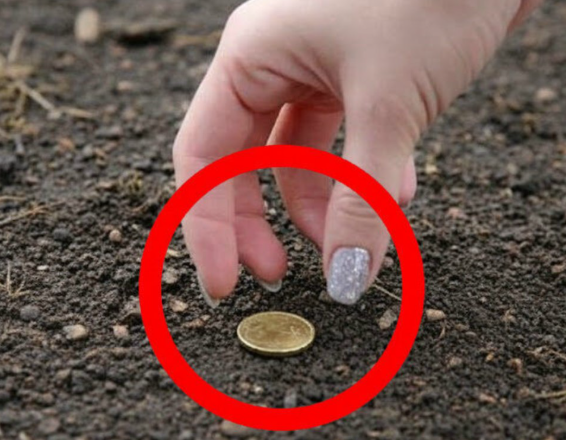
In the hyper-accelerated rhythm of the 21st century, our collective gaze is almost exclusively focused on the horizon or immersed in the digital glare of mobile screens. We navigate urban sprawl and suburban silence with rapt attention, often oblivious to the granular details of the physical world beneath our feet. Yet, every so often, a single metallic glint pierces the gray asphalt or cracks in weathered pavement. To a cynic, an abandoned coin is merely a lost fragment of devalued currency—a piece of copper or nickel that has fallen from a pocket and been deemed unworthy of the effort to retrieve. However, in the vast tapestry of global traditions, folklore, and spiritual philosophy, this small disc of metal is perceived as something far deeper: a silent, tangible conversation between the individual and the invisible forces of the universe.
The belief that finding money is a spiritual “ping” from another reality is a narrative that has persisted across centuries and cultures. In many ancestral traditions, a found coin is perceived as a physical “poke” from loved ones who have passed beyond the veil. Logic suggests that those who have passed are unable to communicate through the dense, complex medium of human language, so they use the simplest materials of our world to signal their presence. The coin, with its weight and radiance, serves as an enduring bond. It reminds us that protection, guidance, and fundamental love still surround the living, even when the silence of mourning seems absolute. It is a heavenly calling card placed along the path of someone who may wander in a moment of doubt or deep isolation.
Beyond the realm of ancestral connections, a found coin is often interpreted as a symbolic gateway or harbinger of changing fortune. In the study of synchronicity—a concept extensively explored by Carl Jung—there are no mere coincidences, but only meaningful connections between our internal states and external events. Finding a coin at a moment of transition can be seen as confirmation that the universe is in a state of flux. It suggests that a subtle shift in fate is occurring, or that a much-needed shift in perspective is manifesting. This represents the “opening” of a path. Just as a single penny is the beginning of a fortune, a single moment of unexpected good fortune is often the catalyst for a larger cascade of positive events.
But the mechanical act of finding a coin is only the first half of the equation. The true power of the event, and what truly shapes its lasting significance, is the nature of the human response. In a world defined by a “scarcity mentality”—the persistent, deep-seated fear that there’s never enough time, money, or love—most people pass by a tiny sparkle with a sense of indifference. They calculate the effort of stooping before the paltry purchasing power of a single cent and conclude the transaction is inefficient. But in doing so, they miss the psychological benefit of the interaction. When you choose to stop, smile, and pick up that coin with a feeling of sincere gratitude, you are performing a micro-ritual of receptivity.
Picking up a coin is an active affirmation to yourself and the cosmos that you are “open to receiving.” This openness isn’t limited to the financial sphere; it’s a broader emotional and spiritual attitude. By appreciating a small gift, you signal your readiness for larger forms of support, whether it’s a new professional opportunity, unexpected support in a time of crisis, or the beginning of emotional healing. In this small, physical movement of reaching for the earth, you facilitate a mental shift from scarcity to trust. You move from a state of “lack” to a state of “noticing,” a fundamental condition for any significant change in destiny.
This philosophy is especially powerful when the world feels overwhelmingly noisy and uncertain. In times of global tension, economic instability, or personal upheaval, it’s easy to feel small and overlooked. We get lost in the macro-narratives of the news cycle and the immense pressures of modern survival. In this context, the appearance of a coin at your feet acts as a gentle, grounding promise: you are seen. It’s a local miracle, a small piece of order in a world that often feels chaotic. It serves as a reminder that even when the “big” systems of the world seem broken or indifferent, the smaller, more intimate ways of life still work to your advantage.
The symbolism of a coin also alludes to the concept of value. In today’s economy, a penny or a nickel have virtually no value in a transaction; you can’t buy a loaf of bread or a gallon of gas with a single coin found in the ground. Yet its symbolic value is immense. This forces us to reconsider the definition of “value.” Is something valuable only if it can be exchanged for a commodity, or does its value lie in the emotional state it evokes? If a found penny gives someone a ten-second surge of hope or a moment of connection with a deceased grandfather, that penny has performed a service that a hundred-dollar bill in a sterile ATM can’t replicate. It provides a sense of wonder, which is the rarest currency of modern times.
Moreover, different denominations are often assigned specific meanings in the “penny from heaven” tradition. The penny, representing the number one, is often associated with new beginnings, unity, and the beginning of a new cycle. Finding a dime, which in numerology boils down to the number one (1 + 0 = 1), is seen as a reinforced message of leadership and independence. Each find represents a different syllable in a long-lasting dialogue with destiny. Whether we believe in the supernatural origins of these coins or not, the psychological benefits remain: they force a “pattern break” during a stressful day, drawing the mind away from the future or the past and firmly anchoring it in the present moment.
As we move deeper into an era characterized by digital transactions and “invisible” money, the physical coin becomes even more of a relic—and thus, takes on significance when it appears. It’s a piece of history, a piece of minted metal that passed through countless hands before finding its way to you, bearing the weight of human exchange. When you find it, you become part of that chain of history. You’re picking up a story someone else left for you, and in doing so, you’re writing another chapter of your own story.
So next time you’re amid the hustle and bustle of daily life and spot that familiar glint of copper or silver on the sidewalk, don’t dismiss it as trivial. Let it be a reason to slow down. Let it be a catalyst for a smile. When you reach for it, let the cool metal in your hand be a physical anchor, reminding you that better days are not just a distant possibility, but quietly, inexorably drawing near. In a universe as vast and complex as ours, perhaps nothing is small. Perhaps the smallest coin is actually a powerful anchor of hope, a sign that you are being guided through the noise to a place of quiet, perpetual abundance. You’re not just finding money; you’re reclaiming your place in a world that still has the power to surprise you with its quiet, metallic grace.