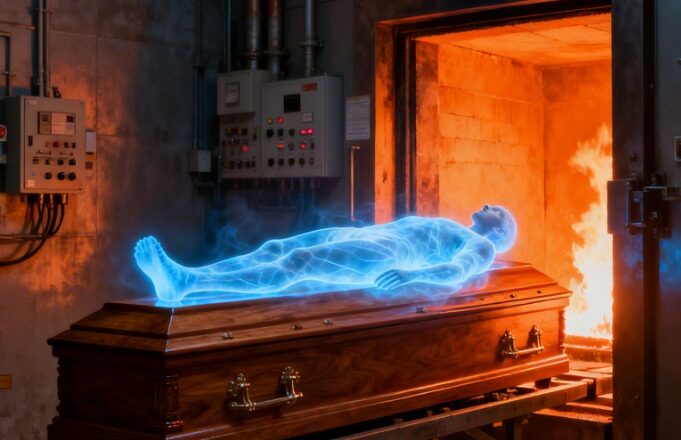
Cremation and Faith – What Does the Bible Really Say and Is There Anything to Fear?
Nowadays, cremation is becoming an increasingly common practice in many countries and cultures, and its choice is often based on both practical reasons and personal beliefs about how to give a dignified farewell to a loved one.
However, for many people of Christian faith, an important question arises, which returns especially in moments of reflection on life and death.
Is cremation consistent with Church teaching?
Could it be seen as a lack of respect for the body or even a sign of spiritual distancing from God?
To answer these questions, we need to look deeper – not only at tradition, but above all at the meaning of faith and the message contained in Holy Scripture.
Understanding this perspective begins with recognizing one fundamental truth.
God is sovereign over our entire existence – both life and death.
And it is this principle that is the key to the proper perspective on the subject of cremation.
What does the Bible say about cremation?
Contrary to what many people believe, the Bible does not contain a direct prohibition against cremation.
We will not find a fragment in it that would clearly condemn this way of saying goodbye to the body.
Indeed, the Scriptures are dominated by descriptions of traditional burials, which for centuries were the natural choice for the people of that time.
Just look at the story of Abraham, who bought a tomb for his wife Sarah, or the fate of Joseph, whose body was transferred and buried in the promised land.
For the Israelites, burial in the ground was something obvious and part of their culture.
But there is one thing worth noting.
It was a tradition – not a commandment.
The Bible describes these customs but does not impose them as the only acceptable form.
The body and the resurrection – the most important issue
For many believers, the greatest concern is whether cremation contradicts their belief in the resurrection.
Because once the body is burned and turns to ashes, the question arises: how is it to be “recreated”?
However, the answer is simpler than it seems.
Christian faith is not based on the physical state of the body, but on the power of God.
The Holy Scriptures clearly indicate that it is God who gives life and God who restores it.
It does not matter to Him whether the body rests in the ground, decays, or is burned.
For if the Creator was able to create man from dust, then he is even more able to bring him back to life in any form.
This means that cremation does not limit God’s power or plan of salvation.
Tradition versus modernity
For many centuries, Christianity preferred burial in the ground because it was a symbol of waiting for the resurrection.
The body was placed in the grave as if “falling asleep”, with the hope of a future awakening.
However, as time passed and social realities changed, attitudes towards cremation began to change.
Nowadays, many Churches allow cremation, emphasizing that it is not contrary to faith, as long as it does not result from the rejection of God or the denial of life after death.
What is crucial is not what happens to the body, but the person’s intention.
If the decision to cremate is based on practical, economic or personal reasons, and not on any rebellion against faith, it is not considered inappropriate.
Respect for the deceased
Regardless of the form of burial, the most important element remains respect for the person who has passed away.
The way we say goodbye to our loved ones should be an expression of love, remembrance and dignity.
Whether it is a traditional grave or an urn with ashes, it is important to maintain the solemnity and significance of this moment.
Because the body, although transient, was part of human life, its history and relationships.
Therefore, the way we say goodbye should reflect respect, not just a technical choice.
Final reflection
The topic of cremation evokes many emotions because it touches on the deepest questions about life, death and faith.
However, when we look at it from a spiritual perspective, it turns out that the most important thing is not the physical details, but trust in God.
It is He who decides our beginning and end.
It is He who gives hope for eternal life.
And it is He who transcends all the limitations that man sees.
Therefore, regardless of whether someone chooses burial or cremation, one thing remains most important.
Faith that does not end with death.
And the belief that ultimately everything rests in God’s hands.