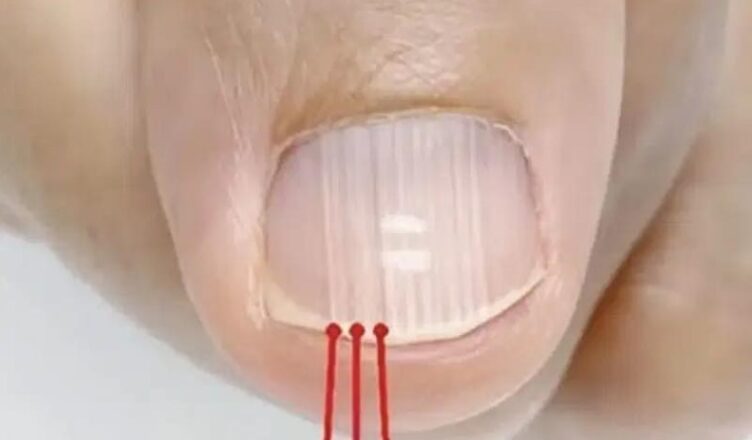
Have you noticed that as you age, your nails start to develop thin, vertical lines running from the roots to the tips?
You are not alone in this, as many people start to notice these changes after the age of forty.
Most often, they are completely harmless, but sometimes they can be a signal of health problems.
Vertical nail grooves, also called longitudinal ridges, are convex lines visible on the surface of the nail plate.
Their number and depth may vary, and they become more pronounced with age.
For most people, it is a natural symptom of aging, just like gray hair or less elastic skin.
This process is associated with a slowdown in the production of keratin, the protein responsible for the structure of nails.
The most common cause is the natural aging of the body, in which the nail matrix cells work less evenly.
Another factor is dehydration, as dry nails become more brittle and their ridges become visible.
Frequent contact with water, soap and detergents further intensifies this effect.
You also cannot forget about your diet, because deficiencies of biotin, zinc, iron or magnesium contribute to brittle and weak nails.
After the age of forty, the body absorbs nutrients less efficiently, so the risk of deficiencies increases.
In some cases, vertical lines may indicate diseases such as thyroid problems, circulatory disorders, or rheumatoid arthritis.
So if, in addition to nail changes, you notice chronic fatigue, hair loss, or skin changes, it is worth consulting a doctor.
Special attention should be paid when the ridges are accompanied by other symptoms, such as dark streaks, pain, swelling, peeling or excessive thickening of the nails.
Such symptoms may indicate a fungal infection, trauma, or in rare cases, even melanoma developing under the nail.
However, you can take care of your nails on a daily basis to make them look healthier and make the wrinkles less visible.
The most important thing is to regularly moisturize your hands and nails with an appropriate cream.
It is also worth remembering to properly hydrate your body, because dry nails break more quickly.
A healthy diet rich in vitamins A, C, B vitamins and minerals such as iron and zinc supports their condition.
It is also good to avoid excessive filing and sharp manicures, which weaken the nail plate.
Some people also choose to supplement with biotin, although it is best to consult a doctor first.