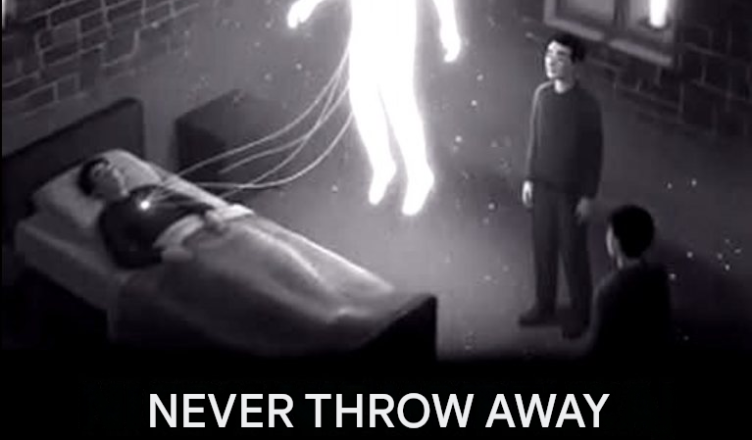
When someone close to you dies, the world begins to move differently.
Time suddenly slows down and at the same time speeds up.
The days blend into one mass, as if someone had muted most of the sounds and left only the noise in my head.
In this strange, dense silence, a need for action arises.
We want to organize something, rearrange something, throw something away – just to feel some sense of control.
It’s a reflex.
It is the heart’s way of trying to bear what the mind cannot yet accept.
But before the first bag ends up in the trash, it’s worth pausing for a moment.
Because among seemingly ordinary objects there may be things lurking that will only become priceless to you after some time.
Not materially.
Emotionally.
Sometimes even spiritually.
THEIR VOICE ON PAPER
Things written in handwriting have a trace of presence that nothing can replace.
A text message, email, or note on your phone won’t do it.
A letter, a greeting card, a yellow note with a quick “I’ll be back later” — these are evidence of someone’s existence in its purest form.
I know a woman who, after her father died, decided “not to go back to the past.”
She threw most of the papers off his desk.
It seemed right to her at the time.
After several months, she was desperately searching for even a single piece of paper with his handwriting.
She found it.
In a book, squeezed between the pages.
A small note with a short sentence: “I’m proud of you.”
Today he keeps it framed on his shelf, like his greatest treasure.
She says it’s the only thing that can sometimes support her more than photos, more than memories.
Your current emotions may be saying, “it hurts too much.”
But when time passes, such a trace can be like an anchor – stable, sure, true.
You can put them in an envelope, lock them in a box, or hide them somewhere you can return to when you feel ready.
STOPPED FOR A SPLIT SECOND – PHOTOS AND RECORDINGS
Photos, videos, a recorded voice, a random “hey, I’ll call you back” saved on voicemail—these things are painful reminders that the loss is real.
Sometimes just one click is enough and tears immediately appear in your eyes.
One man said he hadn’t opened a folder containing photos of his deceased wife for a year.
He felt like it would break him.
And when he finally took the courage, he felt something he never expected to feel again – relief.
Not just pain.
But also gratitude.
The sight of her smile.
The way she tilted her head.
That one look he knew better than his own reflection in the mirror.
Such materials are proof that your life really happened.
That it happened.
That it existed.
You can keep them even if you don’t have the strength to watch them today.
Save them to disk.
Make a backup.
Put the flash drive in a drawer.
Take your time.
The day will come when these images will no longer just hurt—they will also begin to heal.
OBJECTS THEY TOUCHED EVERY DAY
There are things that seem ordinary: a mug for your morning coffee.
A watch that someone wore every day.
Glasses.
Wallet.
An old scarf that someone wore whenever it got cold.
In the midst of emotional chaos, it’s easy to dismiss them as “junk.”
Something we should get out quickly.
But these objects have the mark of a hand in them.
Trace of a gesture.
Everyday life that suddenly takes on meaning.
In many families, such items later become heirlooms – symbols that are passed down from generation to generation.
The son wears his father’s wedding ring on a chain.
The granddaughter drinks from her grandmother’s cup only on special days.
Someone hangs an old clock on the wall because the ticking brings a strange sense of peace.
So if you’re holding something in your hands that’s “strangely hard to throw away”—listen to that feeling.
It often knows more than the head.
PAPERS THAT CARRY BOTH LAW AND HISTORY
After the loss of a loved one, documents seem like just an unpleasant duty.
Piles of papers.
Binders.
Letters from offices.
Matters to attend to.
But these papers also contain fragments of life.
Diplomas, school certificates, ID cards, old letters, military files, work records, calendars with notes.
It all tells a story that you often don’t know in its entirety.
I know a family who only discovered military documents from the times he never wanted to talk about after their grandfather died.
These files opened up a completely new picture of the man they loved.
Today, grandchildren show them to their children, saying, “This is your great-grandfather. This is what his life was like.”
Before you throw anything away, look through it.
Before you put it in the shredder, think twice.
Sometimes one document can become part of a family identity.
GIVE YOURSELF TIME. AND LET THINGS STAY.
Grief does not work quickly.
It doesn’t work logically.
It doesn’t work on schedule.
It’s a process that comes in waves—sometimes gently, sometimes brutally.
You can’t get through it by doing general cleaning over the weekend.
Throwing everything away provides some brief relief.
But it deprives you of the opportunity to return.
The possibility of seeing something that will someday give you peace.
The possibility of experiencing a memory that will one day be gentle, not painful.
It’s not about turning your home into a museum.
The idea is to leave behind a few things that might save your heart someday.
So if you are now standing over the box and don’t know what to do, this is the answer.
Do nothing.
Put anything that makes you hesitate in a separate box.
Close.
Sign.
And hide it.
You’ll come back when you’re ready.
Because sometimes the smallest thing – a card, a button, a photograph, the smell of a sweater – carries more love than all the great words you never had time to say.