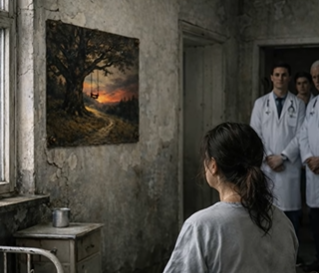
That night I couldn’t fall asleep for a long time. Her calm gaze kept appearing before my eyes again and again — far too clear for someone who had been considered hopelessly ill for eleven years.
Curiosity proved stronger than caution, and late in the evening I quietly returned to her room. The door was slightly open, the moonlight lay across the floor in a pale strip, and Elizabeth was still sitting in front of the painting.
But she did not say a word.
I took a step, and suddenly she spoke softly, without turning around:
— You do understand that I don’t talk to the dead.
I froze.
Elizabeth slowly turned her head, and there was more clarity in her eyes than in the eyes of many people outside those walls.
— Then… why? — I asked almost in a whisper.
For eleven years she had been considered the quietest patient in the clinic: once a month, on the night of the full moon, she would sit in front of a cheap painting and “talk” in whispers with her late husband and son
She smiled slightly, as if that question had already been asked of her hundreds of times.
— Because it’s easier to breathe here. When they died, the world outside became empty and чужим. People say “life goes on,” but no one explains how to keep living when all the meaning remained on that shattered highway.
She gently touched the frame of the painting with her fingers.
— The medicines here do one important thing: they dull the pain. And talking to the painting allows the doctors to think that I am hopeless. As long as they think so, they won’t discharge me.
I didn’t know what to answer.
— Remember one thing, — Elizabeth said quietly. — Sometimes madness is not a disease. Sometimes it is simply the quietest way to survive.
Years passed, but sometimes, when I see the full moon, I suddenly remember that night and realize that I will never forget that woman.