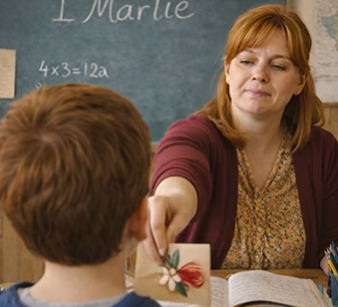
I looked at the children — they were no longer smiling. Then at the teacher.
— You saw uneven cardboard, — I said calmly. — I see two sleepless nights. You noticed a crooked flower. I see a child who decided not to ask his mother for money because he heard her worrying about the bills.
I wasn’t accusing. I was explaining. But every word was a truth that could not be brushed aside.
— He wasn’t crying because of the teasing, — I added more quietly. — He was crying because he believed that his efforts meant nothing.
Tears stood in Mark’s eyes, but he did not lower his head. For the first time in those days, he was looking straight ahead.
The teacher was silent for a long time. Then she took his gift in her hands — differently now, carefully, as if she were afraid of damaging not the cardboard, but something more fragile.

The next day, in front of the entire class, she said that she had been wrong. That the most valuable gift is the one into which a heart has been put. The children listened attentively, without giggles.
And that evening my son came home calm. He no longer hid his eyes or squeezed the pocket of his coat. He simply said:
— Mom, she put it on the table.
Sometimes adults need the courage of a child to remember why they chose their profession. Sometimes a mother has to become the voice when her son’s is taken away.
And if this story teaches anything, it teaches only one thing: a teacher’s word can wound deeper than mockery. But that same word can heal — if it carries respect.