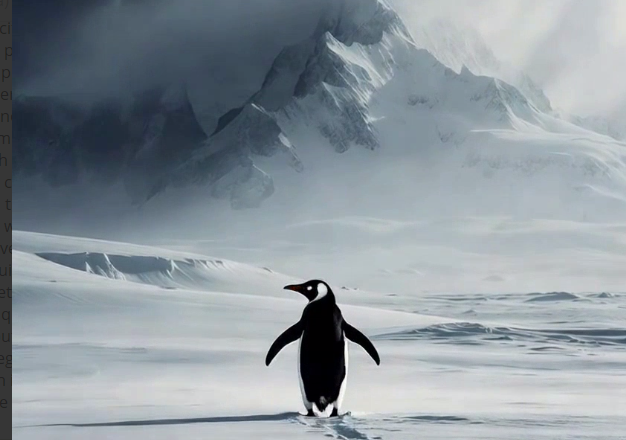
In Antarctica, the rules of survival for emperor penguins are simple and absolute. Move toward the ocean to feed, or remain with the colony to breed and endure the cold together. Every penguin follows one of these two paths. The system has sustained the species for millions of years. There is no third option.
Except once.
During the filming of a documentary near the Ross Sea, a crew captured footage of a single penguin that separated from his colony and began walking in a direction that led neither to the ocean nor back to the group. He turned toward the interior of the continent — toward the mountain range visible on the horizon. Toward a landscape of ice, wind, and absolute emptiness where no food or shelter existed.
A researcher attempted to intervene. He physically carried the penguin back toward the colony. The bird paused briefly, oriented himself, and then resumed walking in the same direction. The same pace. The same bearing. As though the decision was not a reaction but a conclusion reached long before anyone was watching.
The marine biologist observing the behavior explained that the penguin was not disoriented. He was fully aware of the location of the ocean and the colony. He had chosen neither. The scientist described the behavior as consistent with a state of deep behavioral disruption, likely triggered by the loss of a bonded mate. Emperor penguins form pair bonds of considerable depth. The death or disappearance of a partner can produce withdrawal from feeding, social isolation, and in rare cases a complete departure from the group.
The penguin walked approximately seventy kilometers into the Antarctic interior. The terrain offered nothing that could sustain life. Temperatures in the region fall below minus fifty degrees. Wind speeds can reach levels dangerous even to large mammals. For a bird evolved for coastal and marine environments, the journey constituted a march toward certain death.
The filmmaker who narrated the sequence observed that even if the penguin were captured and returned, he would immediately set out again. The decision appeared irreversible. Something fundamental had shifted inside the animal, and the ordinary imperatives of survival no longer applied.
The footage circulated widely on the internet years after the documentary was released. The response was extraordinary in its uniformity. Across cultures, languages, and platforms, the predominant reaction was not humor or detachment but recognition. Millions of viewers described an immediate and personal identification with the penguin. The comment sections beneath the video filled with variations of the same statement: I understand him.
The resonance was not accidental. The image of a solitary figure walking away from everything familiar, toward something that offered no reward and no return, touched a psychological nerve that transcended species. People who had experienced grief recognized the moment when continuing with ordinary life becomes impossible. People who had felt alienated from the paths expected of them recognized the turn toward the mountains. People carrying invisible weight recognized the steady, purposeful walk of someone who has stopped performing and started being honest about where they stand.
The penguin became a symbol not of despair but of a particular kind of clarity that arrives when loss strips away everything except the truth. He could not return to a life organized around a bond that no longer existed. He could not pretend that feeding and breeding and huddling held meaning in the absence of the one presence that had made those rituals bearable. So he walked.
Some interpreted his journey as an act of surrender. Others saw it as the most authentic decision an animal or a person could make — the refusal to continue participating in a structure that no longer reflected internal reality. The distinction between these two readings may be the most important question the footage raises, and it is a question that has no answer.
The penguin did not return. His tracks were eventually erased by wind and snowfall. Antarctica absorbed him the way it absorbs everything — without ceremony, without memory, without judgment. The continent continued as it has for millions of years, indifferent to the small life that crossed its surface and disappeared.
But the recording persists. It is rediscovered regularly by new audiences who encounter it unexpectedly and find themselves unable to look away. The penguin walking toward the mountains has become one of the most quietly powerful images the internet has produced — not because it is dramatic or shocking, but because it is still. A small dark shape against an infinite white expanse, moving steadily away from everything, toward something only he could see.
And every year, somewhere in the world, someone watches the footage for the first time, sits in silence for a moment, and writes the same words that thousands before them have written:
I am that penguin.