My husband threw his sick father out of the house, and I rented a small apartment and took care of him alone for almost eight months, working two jobs 😢
Before he died, my father-in-law gripped my hand tightly and whispered, “In my workshop there is a mirror. Break the wall behind it — and you will understand everything.” 😱
The argument started over something small. My father-in-law simply asked to have the window closed.
He was sitting in an armchair by the radiator, the blanket had slipped from his knees, and on the small table beside him were pills, drops, and syringes. After another round of chemotherapy, it was hard for him to breathe.
— It’s cold in here… — he said quietly. — Close the window.
My husband stood by the door, grimacing.
— It smells like a hospital. I can’t stand it. The smell of medicine has soaked into everything.
My father-in-law slowly lifted his eyes to him. He didn’t argue. He had almost stopped arguing altogether.
— It’s temporary, — I said. — He’s struggling. You can see that.
— I see that our house has turned into a hospital ward, — my husband replied sharply. — I’m tired. I want to live normally.
He spoke loudly. And just three weeks earlier, he had promised his father he would stay by his side.
— He’s your father, — I said quietly.
— He’s lived his life. Now it’s my turn.
That sentence hung in the air. My father-in-law turned toward the wall.
Two days later, my husband packed up his father’s things. And simply said,
— I found a care facility. There are specialists there.
But I didn’t allow him to send his father to a nursing home.
— He’s coming with me, — I said.
My husband just shrugged.
I rented a tiny room above an old garage. A narrow window, peeling walls, a creaky bed. I worked two jobs — during the day in a store, at night I took online translation orders. The money went toward medicine, treatments, and a caregiver on weekends.
My father-in-law never complained.
— You’re a good girl, — he told me once. — Better than we deserved.
I didn’t know what to say. Eight months later, he was gone.
On the night before his death, he barely spoke. He breathed heavily and held my hand. Then suddenly he pulled me closer and whispered,
— Behind the old mirror… in my workshop. Break the wall.
I didn’t have time to ask what he meant.
He closed his eyes and never woke up again.
After the funeral, I went to the workshop. My husband didn’t come. He was “too busy.”
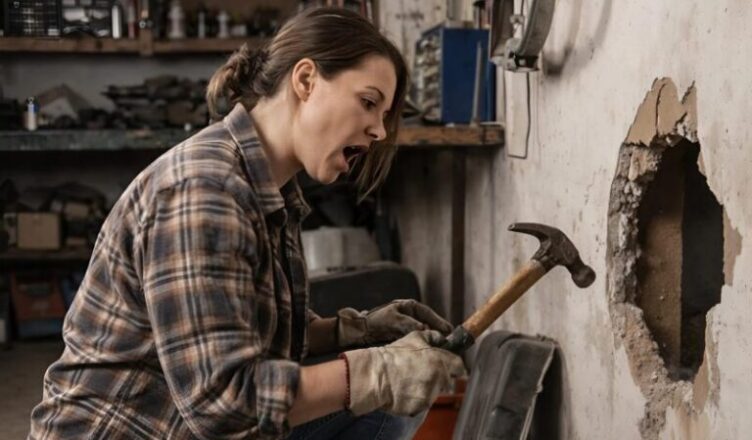
I locked the door from the inside. The mirror was still hanging in its place. I took it down. Behind it was an old section of wall, carefully plastered. Slightly smoother than the rest. I picked up a hammer. The first strike — dull. The second — a crack. The third — plaster crumbled down.
I kept hitting until a niche formed. When the wall collapsed inward, I saw it… and dropped to my knees.
I screamed. 😲😱 The continuation of the story is in the first comment 👇👇
When I finally broke through all the plaster, a long wooden case fell out of the wall. Old, worn, with brass corners. I opened it. Inside was a watch.
A pocket watch. Gold. Heavy. With enamel and tiny sapphires around the edge of the lid. On the inside — an engraving in French. And a date: 1896.
I didn’t immediately understand what I was holding. Until I saw the mark. Patek Philippe. An extremely rare limited series from the late nineteenth century. These watches aren’t worn. They’re kept in museums. Or sold at private auctions.
My father-in-law had never told anyone that his grandfather was a watchmaker at the Tsar’s court. He had never said that this piece was the only thing that survived the revolution.
I sat down on the workshop floor because I realized — it wasn’t just a valuable object.
A month later, after the expert evaluation and appraisal, they told me the amount. I wouldn’t earn that much even in ten lifetimes.
And inside the case, there was a note.
“He values the new.
Another values the old.
Then this must belong to the right person.”
I cried. Not because of the money. But because the man who was thrown out for the “smell of medicine” had quietly kept a treasure — and left it not to his son, but to the one who stayed by his side.