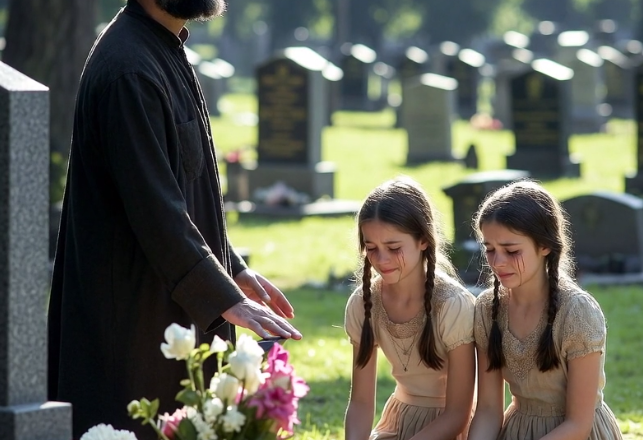
He Found Two Strangers Crying at His Wife’s Grave. What They Revealed Shattered Everything He Thought He Knew.
The morning fog had not yet lifted when the man arrived at the cemetery carrying white flowers. His wife had died only months earlier, and the weekly visits had become the only ritual that kept him grounded. He walked the familiar path toward her headstone and stopped.
Two teenage girls were kneeling on the wet ground before the grave. They were pressed together, crying openly, their hands dirty with soil and their clothes soaked through. He had never seen them before. His wife had almost no surviving family — no nieces, no godchildren, no connections that would explain the presence of two strangers grieving at her headstone.
When he spoke, asking who they were, one of the girls seized the other’s arm and whispered urgently not to say anything. But the second girl looked at him with an expression beyond her years and said quietly that the woman buried there was their mother.
The twins were sixteen years old. They had been born when his wife was seventeen — two years before she had moved to the city, rebuilt her life, and eventually met and married him. She had become pregnant as a teenager in a conservative rural community. Her parents had given her an ultimatum: surrender the babies for adoption or be disowned. Alone and without resources, she had signed the papers. She held her daughters for forty minutes in the hospital before they were taken.
She never told her husband. Throughout fourteen years of marriage she kept this locked away, driven by a deeply internalized belief that giving up her children was something shameful, something that would diminish her in the eyes of anyone who learned the truth. The people around her at the time of the adoption had reinforced this, and the shame had calcified into silence over the years.
But she maintained a hidden connection. Every year on the twins’ birthday, she made an anonymous donation to the adoption agency. Every year she sent an unsigned letter addressed simply to her girls. The letters described fragments of her life, her thoughts, her feelings. Each one ended with the same line expressing that she thought of them daily and was sorry.
When the twins turned sixteen and gained legal access to their adoption records, they found fourteen letters waiting — one for every year. They spent three months searching for the woman who had written them. They found her name and then her obituary. She had died approximately sixty days before they located her. They came to the cemetery because it was the only remaining place where proximity to her was possible.
The final letter in the file contained a request. She asked that if the girls ever found her, they not reveal themselves to her husband. She described him as the best man she had known and said she had never been brave enough to tell him the truth. She did not want her inability to share this part of herself to cause him pain after she was gone.
The man heard this and understood something that reshaped everything he believed about his marriage. His wife had not been secretive out of malice or deception. She had been carrying an enormous grief silently for the entirety of their life together because she believed — incorrectly but absolutely — that the truth would make her unworthy of love.
He looked at the two girls shivering in the damp morning air. They were orphaned in a sense that extended beyond biology. They had found their mother only to discover she was already gone. They had letters but no voice to read them aloud. They had a name on a headstone but no memory of a face.
He asked them to come home with him.
The legal process of obtaining guardianship required several months. During that time, he prepared a room in his home, furnished for two, painted in the colors his wife had preferred. A photograph of their mother was placed between the beds. The twins moved in and began the slow, uncertain process of constructing a family from fragments.
On their seventeenth birthday, he gave them all fourteen of their mother’s letters along with one he had written himself. In it he stated that their mother had not been a coward but a teenager who made an impossible decision under impossible pressure and then spent every subsequent year loving them from a distance she never chose. He wrote that she had been wrong to believe he would not understand. He wrote that he intended to spend the rest of his life ensuring they knew they had always been wanted.
That evening, for the first time, both girls addressed him as their father. The word was offered quietly, without ceremony, in the small kitchen of a house that had once belonged to two people and now held three. It was, he later said, the first time since his wife’s death that the house felt like a home.