The argument had been building for years. Dmitri was twenty-six, wealthy by inheritance, and entirely uninterested in earning anything himself. He spent money carelessly, moved through relationships without attachment, and treated every problem as something his father’s accountants would resolve. His father, a self-made industrialist who had built his fortune from nothing, watched his son waste every opportunity and every advantage with growing frustration.
One evening, after extracting Dmitri from yet another expensive embarrassment, the father issued an ultimatum. Dmitri would be stripped of all financial support. His bank accounts would be frozen, his car repossessed, and his apartment lease terminated. He would be taken to a rural village and married to an ordinary woman — a dairymaid named Mila who worked a small family farm. If Dmitri refused, he would be permanently removed from the inheritance.
The father expected the arrangement to last days at most. He anticipated that the shock of poverty and manual labor would shatter his son’s pride and send him back humbled and compliant. It was intended as a punishment, a controlled lesson in discomfort.
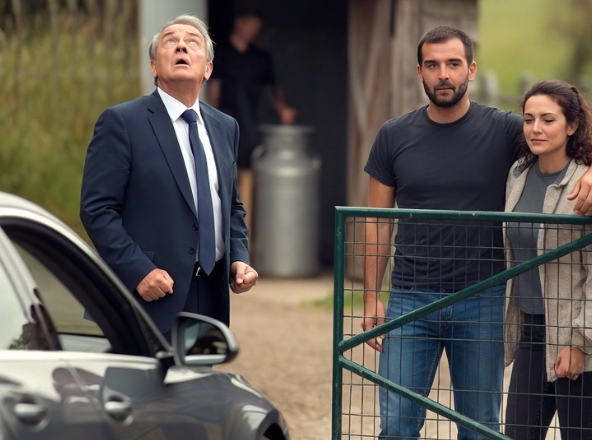
Three months later, the father drove to the village to assess the results.
What he found was not what he had prepared for. The farmhouse had been renovated. The fence was freshly painted. A vegetable garden ran neatly along one side of the property, and a hand-painted sign near the road advertised fresh dairy products, artisan cheese, and honey. Three local customers were waiting at a small wooden table near the gate.
Dmitri emerged from the house carrying buckets of fresh milk. He wore work boots and a faded shirt. His hands were rough and tanned from outdoor labor. He had lost the softness of his former life and gained something visibly different in return. He looked strong, focused, and entirely at ease.
Behind him came Mila, carrying trays of cheese she had prepared that morning. She served the waiting customers by name, and they addressed Dmitri the same way — familiarly, warmly, as a member of their community.
Over breakfast at a wooden table Dmitri had built himself, the father heard the full account. The initial weeks had been brutal. Dmitri had no practical skills, no tolerance for discomfort, and no understanding of physical work. He resented everything about the situation. But Mila did not accommodate his frustration. She rose before dawn each day and worked steadily without complaint, managing the farm alone the way she had since adolescence. She neither pitied him nor pushed him. She simply continued.
Her quiet consistency broke through his resistance in a way that no lecture or punishment ever had. Within days he began helping. Within weeks he was repairing structures around the property. Within two months he had applied the only genuinely useful element of his expensive education — his understanding of business principles — to transform their small operation. He established supply agreements with nearby restaurants, introduced new product lines including honey from hives he had acquired through barter, and built basic cold storage from salvaged materials. The farm’s income grew to exceed that of any other household in the village.
More significantly, Dmitri had fallen in love with Mila. Not as a novelty or a passing fascination, but with the deep recognition of someone whose character had fundamentally changed his understanding of value. She was the first person who measured him by his effort and actions rather than his name and account balance. That distinction reshaped him entirely.
The father sat in the small kitchen, eating bread his son had helped bake, spread with butter his son had helped churn, and confronted a realization he had not anticipated. He had designed this arrangement as a punishment intended to prove that his son could not survive without wealth. Instead, it had proven the opposite. Dmitri had not only survived without money but had built something functional, respected, and genuinely his own. The woman chosen as an instrument of humiliation had become the most important person in his son’s life.
When the father offered to restore everything — the accounts, the car, the apartment, the inheritance — Dmitri declined. He said he was already home.
The father returned to the city alone. His son, the one who supposedly had nothing, had built a life filled with purpose, partnership, and community. The father, surrounded by wealth, drove back to a large house where no one was waiting.
The lesson he had intended to teach had been delivered — but not to the person he expected. The son learned to build. The father learned what he had lost.