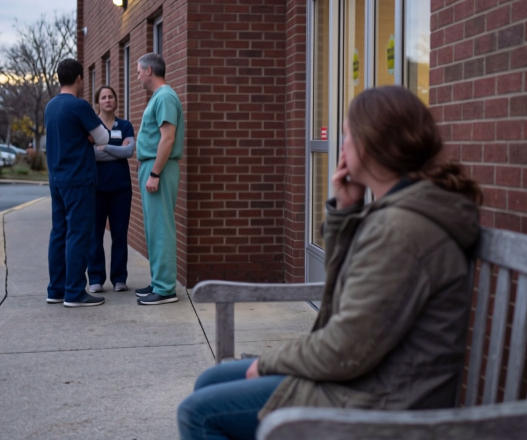
Anna left the intensive care unit slowly, barely feeling her own legs. Behind her, in room 412, her husband Mark lay connected to machines that were keeping him alive. Six months ago he had been strong, healthy, and full of plans. Now the doctors were telling her there was almost no time left. A donor organ had not been found. The disease was progressing faster than anyone expected.
She walked through the hospital corridor in a daze, not noticing the tears running down her face. Outside, it was early winter. People hurried past, cars moved through the streets, life continued as if nothing had happened. Anna sat down on a bench near the side wall of the building and buried her face in her hands.
After several minutes, she wiped her eyes and took a deep breath. She was about to stand up and walk to the bus stop when she heard voices from behind the corner of the building. Two men were talking quietly, but in the still winter air every word reached her clearly.
They were orderlies from the hospital. And they were talking about Mark.
One of them mentioned his full name and room number. Then he said something that made Anna’s entire body go rigid. A donor match had been identified three days earlier. The compatibility was nearly perfect at ninety-seven percent. But the match had been deliberately concealed.
The transplant coordinator, the man responsible for matching donors to recipients, had arranged to redirect the organ to a different patient whose family was offering a cash payment of two hundred thousand. The other patient had been on the waiting list for only two weeks. Mark had been waiting for months. But money had overruled the system. Mark’s file had been quietly pushed aside, and Anna had been told that no suitable donor existed.
Her husband was being left to die so that someone else could buy his place.
Anna sat motionless on that bench as the orderlies continued their conversation, casually discussing details as though it were office gossip. Names, amounts, and procedures spilled out into the cold air. They had no idea anyone was listening.
Something shifted inside Anna in that moment. The grief that had been paralyzing her for weeks was replaced by something harder, sharper, and far more dangerous. She pulled out her phone, opened the voice recorder, and captured nearly a minute of their conversation.
Then she stood up and began making calls. The first was to a university friend who had become an investigative journalist at a major television station. The second was to a lawyer specializing in medical malpractice litigation. The third was to the national health ministry’s anonymous hotline for reporting corruption in medical institutions.
The response was swift and overwhelming. Within twenty-four hours, the transplant coordinator was detained by authorities. An examination of his financial records revealed a deposit of forty-five thousand into an account belonging to his wife, made the same day the donor match was recorded. The hospital administration launched an emergency internal review. Two senior officials were suspended pending investigation. The story was broadcast on national evening news.
Most importantly, the donor organ was immediately reassigned. Mark was taken into surgery within thirty-six hours of Anna’s phone calls. The operation lasted nine hours. Anna waited without moving from the hospital corridor. When the chief surgeon emerged and told her the transplant had been successful, she sank to the floor and wept.
Recovery was long and grueling. Six weeks of pain, medication adjustments, and constant monitoring. But Mark survived. His body accepted the organ. Week by week, he grew stronger.
The transplant coordinator was tried and sentenced to seven years in prison. The family that had attempted to purchase priority access was charged with bribery. The hospital faced significant penalties and was required to completely restructure its transplant matching procedures under external oversight.
The journalist produced a documentary about the case that was viewed by more than four million people. It contributed to new legislative reforms aimed at increasing transparency and accountability in organ donor matching systems across the country.
Anna did not tell Mark what she had overheard until months after his recovery, on a quiet Sunday morning at their kitchen table. He listened in silence. When she finished, he looked at her for a long time and said that she had not simply saved his life — she had done something far greater. She had sat on that bench, broken and exhausted, and instead of surrendering to despair, she had fought back against an entire system.
It all began with a woman who happened to sit on the right bench at the right time. But what made the difference was not luck. It was the decision she made in her darkest moment — to turn grief into action and silence into evidence.