My father spent his entire career as a mining engineer. For thirty-five years he went deep underground — into coal shafts, gold deposits, and mineral mines across remote regions of the country. He retired with damaged lungs, a modest pension, and a quiet dignity that never asked anything from anyone.
When his health deteriorated sharply and the doctors confirmed it was serious, I brought him to live with us. My husband lasted exactly two weeks. He complained about the smell of medication, about the disrupted routine, about the cost. Eventually he told me plainly that he wanted my father gone. He suggested a state care facility. I refused.
The arguments grew worse until I made a decision. I rented a small room near the hospital and moved there with my father. From that point on, I managed everything alone. I worked two jobs — cleaning offices early in the morning and stocking shelves at a supermarket late at night. Every hour between shifts I spent caring for my dad. I washed him, prepared his food, administered his medication, and sat with him through the long painful nights. My husband never called, never visited, never sent a single ruble.
Eight months passed this way. By late winter my father had grown very weak. But one evening, he seemed strangely alert. He asked me to sit beside him and listen carefully. In a quiet but steady voice, he told me to go to his old workshop in our garage after he was gone. He said I should remove the large mirror from the back wall and break through the plaster behind it. He squeezed my hand and said nothing more. Two days later, he died in his sleep.
After the funeral, his words stayed with me constantly. A week later I drove to the house and went into the old workshop. It was exactly as my father had left it — tools hanging on the walls, blueprints stacked in the corner, and the large heavy mirror mounted on the back wall.
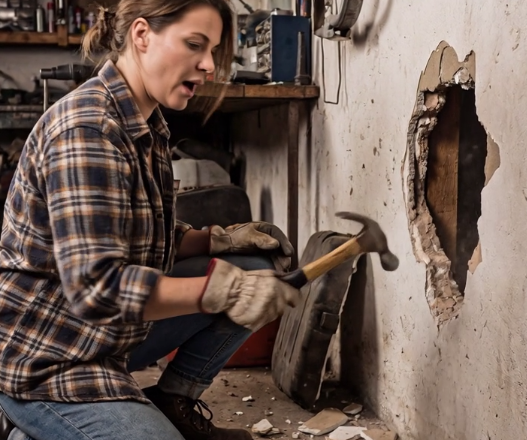
I pulled the mirror down carefully. Behind it, a section of plaster looked slightly newer than the surrounding wall. I picked up a hammer from the workbench and struck it. The plaster broke apart easily, revealing a hollow cavity roughly the size of a small suitcase. Inside sat a sealed military-grade metal lockbox, cold and heavy.
When I opened it, I stopped breathing.
The box contained dozens of raw gold nuggets of varying sizes, some remarkably large. Beneath the gold were small leather pouches holding uncut gemstones — vivid green emeralds and pale blue aquamarines. Tucked along the sides were official geological certificates documenting the authenticity, weight, and classification of each specimen.
My father had spent thirty-five years working in mines. Over those decades, he had carefully collected geological specimens — pieces that had been discarded as waste, samples written off from inventories, fragments that passed through his hands and were never counted. He never sold anything. He simply saved, quietly and patiently, for decades.
At the bottom of the box was a letter addressed to me, written on lined notebook paper in his precise handwriting. He wrote that he had never been a wealthy man and that my husband had made sure he knew it. But he had never been poor either. Every nugget, every stone had been carried out of the darkness over years of hard labor, saved for the one person who never turned her back on him. He asked me not to share any of it with a man who had discarded her own father. He told me to leave, to start fresh, and to finally live for myself.
Three independent appraisers later valued the collection at well over one hundred and twenty thousand dollars. Several of the emeralds were of exceptional quality, and one gold nugget was deemed museum-worthy.
When my husband learned what had happened, his attitude transformed overnight. He called constantly, apologized, and promised to change. I responded with divorce papers and a copy of my father’s letter.
My father spent his whole life underground, in cold and darkness, so that one day I could walk into the light. I will never forget that. And I will never go back.