Being fourteen is a minefield of insecurities. Being fourteen with a carbon-fiber prosthetic leg is a specialized kind of hell.
For Leo, the worst part wasn’t the physical struggle; it was the “click-whir.” That tiny, rhythmic mechanical sound echoed through the halls of Westridge High like a metronome for his anxiety. At fourteen, you want to be invisible. But Leo’s leg made him a spectacle. It turned every trip to the cafeteria into a performance and every staircase into a high-stakes obstacle course.
Westridge High was an elite institution of glass and prestige, but Leo had learned the hard way that high tuition doesn’t buy high character.
He was navigating the main staircase, heading to third-period biology, clutching the railing with a white-knuckled grip. That’s when Carter and his group of varsity athletes blocked the landing. Carter was seventeen, a state-ranked swimmer with a smile that never quite reached his eyes—the kind of kid who used his popularity as a blunt instrument.
“Look at this,” Carter announced, loud enough to stop the flow of students. “The Six Million Dollar Man is running late. Does your battery need a jump, Robo-Leg?”
A wave of cruel laughter rippled through the hallway. Leo kept his head down, trying to push past.
“Where’s the fire, Leo?” Carter asked, stepping into his path. “I bet your dad is embarrassed to see you walk like a glitchy video game character. Is that why he’s always ‘away’ on duty? Just to get away from the clicking?”
That was the line. Leo’s father, Nathan, was a Master Sergeant who had been deployed three times in five years. He was the man in the photo in Leo’s locker—tired, sharp-eyed, and wearing a uniform that stood for everything Leo admired.
“Move, Carter,” Leo said, his voice trembling but firm.
Carter’s eyes darkened. “Oops,” he said, a casual shrug of his shoulders as he delivered a sharp, calculated nudge.
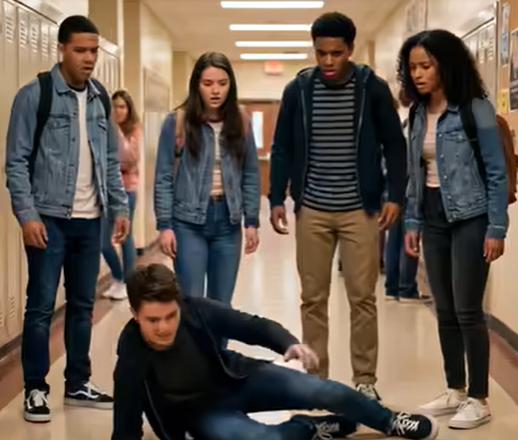
For a fourteen-year-old with a prosthetic, balance is a fragile equation. Leo’s good foot slipped on the polished marble. The world tilted. He didn’t just fall; he tumbled—shoulder, hip, and head hitting the steps until he landed in a heap at the bottom.
The silence that followed was deafening. But then came the sound that broke Leo’s heart: a sharp, metallic snap. His prosthetic had detached, sliding across the floor like a piece of discarded machinery.
“Check it out! He’s falling apart!” someone shouted.
Leo didn’t cry. He was fourteen; he refused to give them that. But as he started to crawl toward his leg, his face burning with a shame that felt like fire, the heavy oak doors of the entrance hall swung open.

THE ARRIVAL
A man walked in. He was in full Dress Blues, the silver stars and ribbons on his chest catching the light. He didn’t run. He didn’t shout. He walked with the heavy, rhythmic gait of a man who had walked through minefields.
My husband, Nathan, ignored the gasping students. He walked straight to the prosthetic leg, picked it up, and knelt beside our son.
“Systems check, Sergeant,” Nathan said softly, his voice cutting through the hum of the hallway like a blade.
Leo looked at him, his eyes red-rimmed. “It snapped at the bracket, Dad.”
“I’ve seen worse in the desert,” Nathan replied. He expertly reattached the limb, the mechanical click sounding like a victory. Then, he stood up, offering Leo a hand. He didn’t carry him; he helped him stand.
Nathan turned his gaze toward the landing. Carter was trying to look invisible. Nathan pointed a single, gloved finger at the teacher standing nearby.
“Principal’s office. Now.”
THE RECKONING
Ten minutes later, we were in the office. Principal Miller was stuttering about “teenage high spirits” and “unfortunate accidents.” Carter sat in the corner, looking small for the first time in his life. His mother had arrived, draped in expensive jewelry and a shield of indignation.
“This is an outrage!” she cried. “My son is a scholar-athlete. You can’t threaten his future over a clumsy boy’s accident. We’ll pay for the repair, but this drama is unnecessary.”
Nathan sat perfectly still. He looked at Carter’s mother, then at the Principal.
“Call his father,” Nathan said.
“My husband is the CEO of Sterling Acquisitions,” she snapped. “He doesn’t have time for—”
“Call him,” Nathan repeated. “His name is Thomas Sterling. Tell him Nathan Reed is here. Tell him I’m waiting.”
The Principal, sensing a shift in the air he couldn’t explain, dialed the number and put it on speaker.
“Hello?” a deep, tired voice answered.
“Mr. Sterling, this is Principal Miller. There’s been an incident. Your son was involved in an altercation with another student. The father is here… a Mr. Nathan Reed.”
There was a silence on the line so profound it felt like the air had been sucked out of the room.
“Nathan?” the voice whispered. “Nathan Reed? From the 1st Battalion?”
“Hello, Tom,” Nathan said.
“I’m coming,” the voice said, sounding breathless, almost frightened. “Don’t let him leave. Please, don’t let him leave.”
THE UNEXPECTED ENDING
Twenty minutes later, Thomas Sterling—a man whose face was on the cover of every business magazine in the country—practically ran into the room. He didn’t look at the Principal. He didn’t look at his wife.
He walked straight to my husband and snapped into the most disciplined, desperate salute I had ever seen. Tears were streaming down his face. Nathan stood up and returned the salute with a nod.
“Stand easy, Tom,” Nathan said.
Thomas turned to his son, his voice shaking with a rage that silenced the entire wing of the school. “Carter… look at this man. Look at him!”
Carter was shaking. “Dad, I didn’t—”
“This man,” Thomas said, his voice breaking, “carried me on his back through four miles of active mortar fire when both of my legs were shattered. He stayed with me in a hole for two days, using his own body to keep me warm when I was going into shock. I am standing here on two prosthetic legs that you can’t even see because Nathan Reed refused to let me die.”
Thomas looked at Leo, then at Leo’s carbon-fiber leg. He dropped to his knees in front of our fourteen-year-old son, ignoring his wife’s gasps.
“I am so sorry, Leo,” Thomas whispered. “I raised a boy who thought strength was about pushing people down, when the only reason he exists is because a man like your father reached down to pull people up.”
The “Unexpected Ending” wasn’t just that Carter was expelled, or that Thomas Sterling became the biggest donor to the school’s new inclusion program.
It happened a week later. Nathan and Thomas were sitting on our back porch, two veterans sharing a quiet moment. In the yard, Leo and Carter were working together. Thomas had forced his son to spend every weekend for the next year volunteering at the veteran’s prosthetic clinic.
As Leo moved, the “click-whir” sounded again. But this time, Leo didn’t flinch. He realized that the sound wasn’t a mark of being “broken.” It was the sound of a survivor. And as Carter reached down to hand Leo a wrench, the silence in our yard wasn’t the silence of shame—it was the silence of a debt finally being understood.
Everything was finally, perfectly settled.