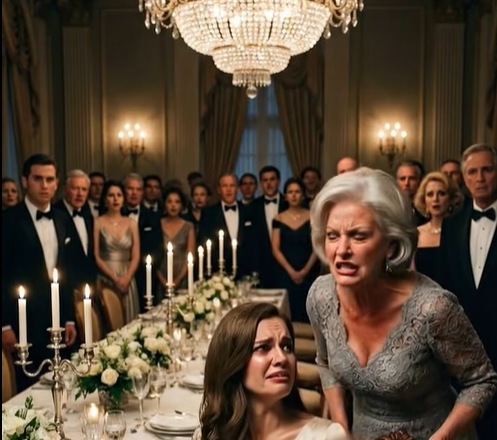
The Evans Estate was a monument to old money and even older grudges. It sat atop a manicured hill in the most exclusive enclave of the city, a sprawling fortress of limestone and cold glass that seemed to gaze down upon the world with a sense of divine entitlement. That evening, the air within the grand ballroom was thick—not just with the cloying scent of imported lilies and expensive perfume, but with the suffocating weight of expectation.
This was a chronicle of my survival within a dynasty that never wanted me. I stood before a gilded mirror in the powder room, smoothing the silk of my cream-colored gown. At eight months pregnant, the fabric stretched tight across my abdomen, a convex promise of the future that felt increasingly like a target. My name is Emily Evans, though to the woman hosting this gala, I was simply “the girl from the valley.”
My husband, Thomas Evans, was being celebrated. His recent ascent to regional director was the justification for this display of excess. He was a man of warmth and integrity, but he carried the heavy mantle of his lineage like a leaden shroud.
“You look ethereal, Em,” Thomas whispered, entering the room and placing a hand over mine on my belly. I could feel the baby kick against his palm, a rhythmic pulse of life amidst the artificiality of the mansion.
“I feel like a sheep walking into a den of lions,” I confessed, my voice barely a tremor.
“My mother is… a challenge,” he admitted, his eyes reflecting a weary sort of love. “But tonight is about us. Just stay close to me.”
But as we entered the dining hall, I knew closeness wouldn’t be enough. At the head of the table sat the matriarch, Margaret Evans. At sixty-three, she was a woman carved from obsidian—sharp, dark, and impenetrable. She didn’t greet me with a hug or a kind word. She looked at me the way a collector looks at a counterfeit coin: with a clinical, detached disdain.
The table was a sea of crystal and silver. The guests—the city’s elite, judges, CEOs, and socialites—chattered like colorful birds, their laughter ringing with the hollow sound of practiced joy. Margaret began the toast, her voice a polished blade that sliced through the ambient noise.
“A toast to my son, Thomas,” she began, her diamonds catching the light of the massive chandelier. “A man who understands that the Evans name is a legacy to be guarded. And to his wife, Emily… who has certainly brought a certain… rustic charm to our table tonight. You look so healthy, dear. My son does spoil you with the finest comforts, doesn’t he?”
The table erupted in polite, tittering laughter. It was a classic Margaret move: a compliment wrapped in a barbed wire of classism. I felt the heat rise in my cheeks, the familiar sting of being the outsider. I looked at my plate, my hand instinctively tightening over my daughter’s kick.
It’s okay, I whispered in the silence of my mind. Just breathe. We are almost home.
As the main course was served, I noticed Margaret’s gaze linger on my chair with a predatory intensity that made the hair on my arms stand up—a look that suggested the psychological warfare was about to turn physical.
Chapter 2: The Sound of Shattered Silence
The dinner progressed like a slow-motion car crash. Margaret’s “jokes” became more pointed, her critiques of my upbringing more overt. She spoke of the importance of “breeding” and “intellectual pedigree,” her eyes never leaving mine. Thomas tried to steer the conversation, his knuckles white as he gripped his wine glass, but Margaret was a master of the conversational pivot.
“I suppose in the valley, people don’t worry much about etiquette,” Margaret mused, sipping her vintage Bordeaux. “Life must be so simple when one doesn’t have a reputation to maintain.”
“Life is simple when you value people over positions, Margaret,” I finally snapped, the words out before I could censor them.
The table went silent. The clatter of silverware died an instant death. Margaret’s eyes narrowed, a flash of genuine fury breaking through her frozen mask. She didn’t respond. She simply smiled—a thin, cruel line that didn’t reach her eyes.
When the dessert was being prepared, a young waiter struggled with a heavy silver tray of coffee service near our end of the table. In a reflex born of my own years working service jobs to pay for college, I stood up to help him stabilize the swaying tray.
“Let me help you with that,” I said gently.
I leaned forward, easing the weight for the boy. As I turned back to settle into my seat, my mind was already on the exit strategy for the evening. I didn’t see Margaret’s hand. I didn’t see the calculated, silent movement as she reached out and hooked the back of my chair.
I went to sit. There was no resistance. Only empty air.
The world tilted. The screams of the guests merged into a single, high-pitched ringing in my ears. The sound of my body hitting the marble floor was a dull, sickening thud that seemed to vibrate through the very foundation of the house.
“Ahhh—my baby!”
The cry tore from my throat, raw and jagged. Pain, sharp and terrifying, radiated from my lower back through my pelvis. I lay on the cold stone, the world spinning in a kaleidoscope of blurred faces and flickering candles.
“Emily!” Thomas was there in an instant, his voice a roar of pure agony. He collapsed to the floor beside me, his hands hovering over me, afraid to touch, afraid to move. “Emily, look at me! Someone call 911! Now!”
I looked past Thomas. Through the haze of pain, I saw her. Margaret was standing, her face a mask of feigned shock, but her eyes—her eyes were dancing with a dark, triumphant satisfaction. She had done it. She had humbled the girl from the valley.
But then she saw the blood.
A dark, terrifying stain began to bloom across the hem of my cream dress, a stark contrast to the pristine marble. The smirk on Margaret’s face didn’t just fade; it disintegrated. She turned a ghostly shade of grey, her hands trembling as she clutched her pearls.
“I—I didn’t mean… it was a joke…” she stammered, her voice a pathetic wheeze.
“Get away from her!” Thomas screamed at his mother, a sound so primal it silenced the entire room. He gathered me in his arms, his shirt immediately soaking up the evidence of his mother’s cruelty. “If anything happens to them, Mother, you are dead to me. Do you hear me? Dead!”
As the sirens wailed in the distance, my vision began to fail, the last thing I felt being the terrifyingly cold sensation of the marble floor and the fading heartbeat of the daughter I was desperate to save.
Chapter 3: The Antiseptic Purgatory
The St. Jude’s Hospital emergency room was a blur of fluorescent lights and the rhythmic “thwack” of swinging doors. I was whisked away from Thomas, the cold air of the trauma bay a stark contrast to the warmth of his embrace.
“Fetal distress! We need an ultrasound now!” someone shouted.
I was drowning in a sea of blue scrubs and medical jargon. I felt the cold gel on my stomach, the frantic search for a sound I wasn’t sure I would ever hear again. Then, through the static of the monitor, came a sound.
Thump-thump. Thump-thump.
It was fast, erratic, but it was there. My daughter was fighting.
For hours, I existed in a state of suspended animation. I was poked, prodded, and stabilized. Eventually, the chaos subsided into the rhythmic hum of a private recovery room. Thomas was there, his face aged a decade in a single night. He was still wearing the blood-stained dress shirt, a gruesome reminder of the “celebration” at the mansion.
The door pushed open, and Dr. Aris, the head of obstetrics, stepped in. His face was a map of professional concern.
“The baby is stable, for now,” he said, his voice a low rumble. “But the fall caused a partial placental abruption. You’re on strict bed rest until the birth. Any stress, any further physical trauma, and we could lose her. You were incredibly lucky, Emily. Another few inches to the left, and the spinal impact would have been catastrophic.”
Thomas let out a jagged breath, his head dropping into his hands. “Thank God.”
“Don’t thank God, Thomas,” I whispered, my voice raspy. “Thank the doctors. And remember who put us here.”
As if summoned by the mention of her guilt, the door creaked open further. Margaret stood in the hallway, looking small and fragile—a calculated performance I had seen many times before. She clutched a bouquet of white roses that looked like funeral flowers.
“Thomas… Emily…” she began, her voice quivering. “I just had to see… I had to explain…”
Thomas stood up. He didn’t move toward her; he moved to block her view of me. He stood like a sentinel, his shadow falling long across the hospital floor.
“There is nothing to explain, Mother,” Thomas said, his voice a terrifying, low-frequency vibration of rage. “Everyone saw you. The servants, the guests, the cameras. You pulled that chair because your pride couldn’t handle a woman who wasn’t afraid of you.”
“It was a prank! A bit of levity!” Margaret cried, the roses shaking in her hands.
“A prank that almost killed my wife and child?” Thomas stepped into the hallway, forcing her back. “You have spent my entire life treating people like chess pieces. Well, the game is over. If you ever come near Emily again, if you even send a letter, I will hand the security footage of that dinner to the District Attorney. I will watch you trade your designer coat for a prison jumpsuit, and I won’t shed a single tear.”
He slammed the door. The sound echoed like a gunshot in the small room.
I reached out for Thomas’s hand, but as he turned back to me, I saw a flicker of something in his eyes—not just anger, but a deep, dark secret about his mother’s past that suggested the chair-pulling incident wasn’t her first brush with “accidents.”
Chapter 4: The Social Autopsy
The fallout was more explosive than any of us could have imagined. In the world of the ultra-wealthy, reputation is the only currency that matters, and Margaret Evans was suddenly bankrupt.
A guest—perhaps a disgruntled rival or a waiter with a conscience—had captured the moment on a smartphone. The video was grainy but undeniable. It showed Margaret’s hand, the precise jerk of the chair, and the subsequent horror. It went viral within forty-eight hours.
The headlines were merciless: “Evans Matriarch: The Queen of Cruelty.” “Socialite’s Prank Turns to Near-Tragedy.”
The Evans Mansion, once the center of the city’s social gravity, became a pariah. The gala invitations stopped arriving. The board positions were revoked. Margaret was effectively erased from the society she had spent forty years cultivating.
But inside the hospital, the war was internal. I spent three weeks in that room, the walls closing in on me. Thomas was a ghost of himself, juggling his new responsibilities at the firm with the constant vigil at my bedside.
Late one night, as the city lights hummed outside the window, I woke to hear Thomas speaking in the hallway. His voice was hushed, urgent.
“I don’t care about the trust fund, Uncle Peter,” Thomas said. “I want her out of the house. I want the estate sold. I can’t have her lurking in the shadows while Emily is trying to heal. She’s… she’s getting worse. She called the hospital pretending to be a nurse just to get into the room.”
I froze. The idea of Margaret, disguised and desperate, wandering the halls was a new kind of nightmare.
“She’s convinced herself she’s the victim,” Thomas continued, his voice cracking. “She told Peter that Emily ‘staged’ the fall to frame her. She’s losing her mind, and I won’t let her take us down with her.”
A week later, the labor began. It was premature, harrowing, and filled with the kind of pain that makes you forget your own name. But as the sun rose over the city, a new sound filled the room—a high, thin wail that was the most beautiful music I had ever heard.
Grace Evans was born. She was tiny, her skin a delicate porcelain, but her grip on my finger was like iron.
“She’s perfect,” Thomas whispered, tears streaming down his face.
We stayed in the hospital for another week to ensure Grace’s lungs were strong. When the day of discharge finally arrived, I felt a strange mix of triumph and dread. We were leaving the safety of the hospital, but we were going to a new home—a small cottage Thomas had bought in the valley, far from the limestone fortress on the hill.
As we walked through the lobby, Thomas pushing my wheelchair and me clutching Grace to my chest, we saw her.
Margaret sat on a bench near the exit. She looked like a different person. Her hair was unkempt, her expensive suit wrinkled. The obsidian woman had been crushed by the weight of her own actions. She stood up as we approached, her eyes hollow.
“Thomas… Emily…” she said, her voice a ghost of its former self. “Please. Just… just let me look at her. Once.”
Thomas stopped. I could feel the tension in his arms, the protective instinct warring with the remnants of his love for the woman who had raised him.
“You don’t get to see her, Margaret,” I said, my voice steady and cold. “You gave up that right the moment you moved that chair.”
Margaret reached into her bag, and for a terrifying second, Thomas stepped in front of the baby—only for her to pull out a hand-drawn letter, her eyes filling with tears as she whispered, “I found the journals, Thomas. I found what my mother did to me. I finally understand why I am the way I am.”
Chapter 5: The Humbling of the Matriarch
The letter remained unopened in my hand as we drove away, leaving Margaret standing alone in the hospital lobby. We moved into our new home, a place filled with sunlight and the smell of cedar, a world away from the oppressive grandeur of the Evans Estate.
Months passed. Grace grew, her laughter filling the house, a constant reminder of the life we had almost lost. Thomas flourished in his new role, freed from the psychological tether of his mother’s approval.
But the letter sat on our mantel, a ticking clock of unresolved history. One evening, after Grace had finally fallen asleep, I opened it.
It wasn’t an apology. Not really. It was a confession. Margaret described her own upbringing—a mirror image of the one she had tried to impose on me. She wrote of a mother who had used physical “accidents” to discipline her, a legacy of cruelty that had been passed down like a family heirloom. She didn’t excuse her behavior; she simply mapped the origin of her soul’s rot.
“I thought I was protecting the legacy,” she wrote. “I realized too late that the legacy was the very thing that was killing us.”
A year later, on Grace’s first birthday, we held a small party in our backyard. There were no chandeliers, no crystal glasses, no fake smiles. Just family—my family from the valley and a few of Thomas’s true friends.
A car pulled up at the gate. Margaret stepped out. She wasn’t wearing diamonds. She was wearing a simple cotton dress and holding a small, handmade wooden horse. She didn’t enter. She stood at the edge of the grass, waiting for permission.
I looked at Thomas. He looked at Grace, who was toddling through the grass, chasing a butterfly.
“Let her in,” I said.
Forgiveness isn’t a gift you give to the person who hurt you. It’s a gift you give to yourself so you don’t have to carry their darkness anymore.
Margaret approached slowly. She didn’t try to take over. She didn’t make a toast about pedigree. She knelt in the grass, the dirt staining her knees, and held out the toy to her granddaughter.
“Hello, Grace,” she whispered, her voice breaking. “I’m your grandmother. I… I have a lot to learn.”
Later that evening, as the sun dipped below the horizon, we gathered for cake. Margaret stood to help me settle Grace into her high chair. For a heartbeat, the memory of the dinner at the mansion flashed through my mind—the scrape of wood, the fall, the pain.
But this time, Margaret didn’t pull the chair away.
She reached out, her hands steady, and pulled the chair forward, making sure it was locked and secure before I sat down. She looked at me, a silent plea for peace in her eyes.
“Thank you, Margaret,” I said, and for the first time, I meant it.
The room—the small, warm room in our home in the valley—erupted in laughter. It wasn’t the hollow, practiced laughter of the elite. It was the sound of a family being built, one honest moment at a time.
The Evans name no longer stood for glass and stone. It stood for the woman who fell and the woman who learned how to help her stand back up.
Survival doesn’t end the story. Forgiveness begins it.
I looked at the Chicago skyline in the distance, glowing like a thousand tiny promises, and I knew that we were finally, truly, safe.