The shovel blade struck the coffin lid with a hollow, wooden thud that echoed in the marrow of my bones. It was a sound that didn’t belong in the world of the living—a sound that violated every social contract, every religious rite, and every instinct of sanity I possessed.
Less than an hour earlier, I had stood on this same patch of damp grass, watching a mahogany box disappear into the dark throat of the earth. I had thrown a handful of soil onto the lid, the dirt cold and greasy against my palm, whispering a goodbye that felt less like a parting and more like an amputation of my own soul.
But now, the afternoon sky over Ravenwood Cemetery looked like a bruise, torn between winter and grief. Heavy, slate-gray clouds pressed down on the treetops, and the faint hum of the wind wove through the headstones like a low moan. The mourners had drifted away, a sea of black coats and muted silence retreating to their cars, leaving me alone with the fresh mound of earth and a seven-year-old boy who was about to shatter my reality.
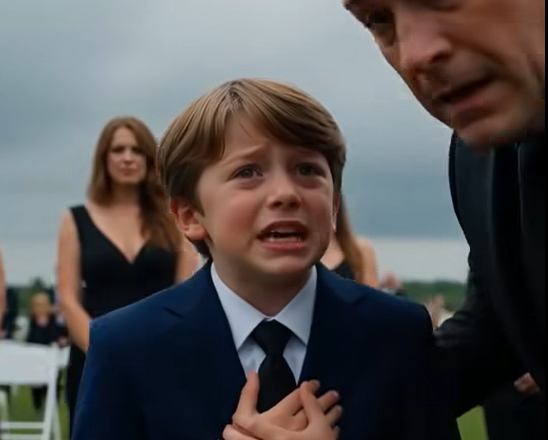
My boots were still smeared with wet clay when my son, Noah, tugged at my sleeve. His fingers, usually so sticky with candy or dirt, were clean and shaking so violently I thought he might collapse right there on the gravel path.
“Dad…”
His voice cracked, barely more than a hitch of breath in the cold air.
“Dad… Mom called me.”
I froze. The world didn’t just stop; it tilted on its axis. I crouched down, gripping his small shoulders, trying to anchor him, trying to anchor myself. “Noah, look at me. We talked about this. Mom is gone.”
His eyes—God, those eyes. They were wide, glassy, and terrified. Not the confusion of a child, but the horror of a witness.
“No,” he whispered, the tears finally spilling over. “She called my phone. Just now. From inside the box.”
I pulled my phone out to check his—he had a simple emergency cell we gave him for school. I expected to see nothing. I expected to see a glitch, or a wrong number, or a grief-stricken hallucination.
But the call log was there.
Incoming Call: Mom.
Time: 3:07 PM.
Duration: 12 seconds.
“She said she couldn’t breathe, Dad,” Noah sobbed, his voice rising to a panic that cut through the cemetery’s stillness. “She said it’s dark.”
My heart thudded painfully slow, a heavy drum in a hollow room. It was impossible. It had to be. Ariana, my wife, was dead. Cause of death: sudden cardiac failure. Declared at St. Mark’s Hospital at 4:12 AM two days ago. I had seen the flatline. I had touched her cooling hand. I had signed the papers under the sympathetic, hovering gaze of her cousin, Marcus Vell.
Yet, as I stared at the phone screen, a memory flashed in the back of my mind—a jagged shard of the past forty-eight hours that I had suppressed in my fog of shock.
A doctor whispering in the hallway.
A nurse arguing softly.
“The ECG readings are inconsistent. The decay rate doesn’t match the timeline.”
And I, drowning in the kind of sorrow that blinds you, hadn’t questioned it.
I looked back at the fresh grave. The flowers were already wilting in the cold. Something inside my chest twisted—a fear so primal, so violent, that I couldn’t swallow it down. I didn’t think. I didn’t weigh the logic. I turned to the two cemetery groundskeepers who were leaning on their truck, smoking cigarettes, waiting for us to leave.
“Dig it up,” I commanded. My voice sounded foreign, like grinding stones.
The older man frowned, dropping his cigarette. “Sir? You’re grieving. It’s time to go home.”
“I said dig it up!” I screamed, the sound ripping from my throat, raw and animalistic. “Now! Or I will do it with my bare hands!”
They saw the way I was shaking. They saw the sheer terror lining Noah’s pale face. And perhaps, they saw a madness in my eyes that they didn’t want to test. Without another word, they grabbed their shovels.
Shovel after shovel.
Breath after breath.
The wet earth giving way to something I was terrified to face.
When the coffin appeared, streaked with mud, it looked like some tragic relic being dragged from the mouth of the underworld. When they pried the lid open, the hinges creaked—a slow, agonizing screech that sliced into the silence.
Inside, wrapped in ivory satin, lay the woman I had loved since we were nineteen.
And her eyes were open.
Not dead. Not staring into the void.
Open—and frantic.
Her fingers were curled into claws, scraping weakly at the plush lining, leaving faint, desperate streaks in the fabric.
One of the workers retched and stumbled back. The other dropped his shovel, crossing himself. But all I heard was the blood slamming in my skull as I threw myself into the mud, reaching forward, whispering her name like a prayer I had never stopped reciting.
“Ariana… I’m here. I’m here.”
Her chest rose in shallow, jagged spasms. Barely there—but real.
She was alive.
Alive in a coffin.
Alive six feet underground.
She turned her head, her neck stiff, her eyes locking onto mine with a terror that no human being should ever have to know.
The chaos that followed was a blur of flashing lights and screaming sirens, a kaleidoscope of panic that seemed to belong to a different life. Paramedics descended on the cemetery like a swarm, lifting Ariana out of the earth as if she were made of glass—something fragile, sacred, half-lost to the void but clinging to existence with everything she had left.
Noah clung to my leg, burying his face in my coat, shaking. “I heard her, Dad. I told you. I didn’t make it up.”
“I know,” I choked out, pulling him tight against me, my hand cradling the back of his head. “You saved her, Noah. You saved her.”
By the time we reached Midland General, the narrative was already being written by the doctors. They called it Lazarus Syndrome—a delayed return of spontaneous circulation after CPR has ceased. They spoke of severe hypothermia mimicking death, of faulty equipment, of “one-in-a-million” probabilities.
Rare.
That was the word they kept using.
Rare sounded like a medical curiosity.
But to me, Rare meant “we almost buried a living woman because statistics said she shouldn’t wake up.”
I sat by her bedside for three days. The hum of the machines became the soundtrack of my existence. Noah refused to leave the room, sleeping curled up on two chairs pushed together, holding her hand even in his dreams. I watched the monitors, terrified that if I blinked, the lines would go flat again.
But there was something else. A shadow in the room that had nothing to do with death.
It was Marcus.
Ariana’s cousin. The man who worked in high-end insurance. The man who had been our rock during the “death.” He had handled the hospital paperwork. He had spoken to the coroner. He had insisted, gently but firmly, on a quick burial, citing “closure” and “emotional distress.”
He came to the hospital on the second day, carrying a bouquet of lilies that smelled too much like the grave. His face was a mask of relief, but his eyes—they were darting, restless.
“It’s a miracle, Elias,” he said, placing a hand on my shoulder. His palm felt hot, damp. “A genuine miracle. God was watching out for her.”
“The doctors say they missed signs,” I said, my voice flat, watching him carefully. “They said the cardiac arrest might have been… induced. Or mimicked. Toxicology is running new panels.”
I saw it then. Just for a microsecond.
A twitch in his jaw. A tightening of the skin around his eyes.
“Well,” Marcus said, his voice dropping an octave, “hospitals make mistakes. They’ll try to cover their tracks with fancy tests. The important thing is she’s back.”
He left quickly after that. Too quickly.
That night, Ariana finally woke up fully.
The sedation wore off as the sun dipped below the horizon, casting long, amber shadows across the linoleum floor. Her eyelids fluttered, and she let out a low, dry groan.
“Water,” she rasped.
I was there in an instant, holding the cup to her lips, weeping silently. “Slowly, Ari. Slowly.”
She drank, then looked at me. The fear in her eyes hadn’t faded. It had crystallized into something sharp and intelligent. She gripped my wrist with surprising strength.
“Elias,” she whispered. “It wasn’t a heart attack.”
I froze. “What do you mean? The doctors said—”
“No,” she cut me off, her voice trembling. “I heard them. Before the darkness took me completely. I was paralyzed. I couldn’t move, couldn’t open my eyes. But I could hear.”
“Who did you hear, Ari?”
She swallowed hard, her gaze darting to the door as if she expected someone to burst in.
“There were two voices. One was the doctor… Dr. Vane. The one who declared me dead.”
“And the other?”
She pulled me closer, her breath hitching.
“It was Marcus.”
The room seemed to drop ten degrees.
“He was right next to my ear,” she hissed. “I heard him say, ‘Make sure the paperwork disappears. The life insurance policy clears in forty-eight hours.’”
My blood turned to ice.
We had life insurance. A massive policy, updated only six months ago. We had been struggling financially—my architectural firm had taken a hit, and debts were mounting. It was Marcus who had convinced us to update our coverage. “For family security,” he had said. “Let me handle the premiums. I can get you a friends-and-family rate.”
I had signed it. Ariana had signed it.
$1.2 million.
“He thought I was gone,” Ariana whispered, tears leaking from her eyes. “He said, ‘It will look natural. No one questions a heart defect.’”
He wasn’t just a grieving cousin. He was an executioner.
And he was still out there.
I didn’t go to the police immediately. Instinct told me that a man who could orchestrate a fake death in a major hospital had layers of protection I couldn’t see yet. If I went to the authorities with nothing but the “hallucinations” of a woman recovering from trauma, Marcus would spin it. He would call it Lazarus psychosis. He would bury the truth just like he tried to bury my wife.
I needed mortar. I needed bricks. I needed a structure of evidence that couldn’t be knocked down.
I told the nurses Ariana was still critical, unresponsive. I bought us time. Then, I went to work.
My first stop was the hospital records department, but I didn’t go to the front desk. I went to the basement archives where the physical backups were kept. I knew the layout of St. Mark’s because my firm had consulted on their new wing renovation three years ago. I still had a contractor’s key card.
It was 2:00 AM when I slipped into the records room. The air smelled of dust and toner. I found Ariana’s file—not the digital one, but the raw notes from the ER intake.
Most of it was standard. But one page had been flagged and then crossed out in red ink.
Toxicology Screen A-7: Inconclusive. Trace alkaloids present.
Alkaloids.
I pulled out my phone and searched. Toxicology alkaloids cardiac arrest.
The results chilled me: Tetrodotoxin. Aconite. Poisons that cause paralysis and slow the heart rate to indistinguishable levels. The zombie poison.
Someone had tried to erase this page.
I took photos of everything. Then I drove to Marcus’s office.
Vell & Associates was located in a sleek glass building downtown. I knew Marcus kept a physical server in his private office—he was paranoid about cloud security. He often bragged about it at Thanksgiving dinners.
Breaking in was harder than the hospital, but grief and rage are powerful fuels. I bypassed the alarm on the service door using a magnet trick I’d learned on a job site. Inside, the office was silent, bathed in the orange glow of streetlights from below.
I found his computer unlocked. He was arrogant. He thought he had won.
I searched his emails. Nothing. He was smart enough to delete them.
But then I checked his “Drafts” folder.
And there it was. An unsent email addressed to Dr. Vane.
Subject: The Split.
Body: The wire transfer is scheduled for Friday. 60/40 as agreed. The cemetery crew is paid off. Stop worrying about the ECG readings. If she’s in the ground, the readings don’t matter.
He hadn’t sent it because he preferred to talk in person. But he had typed it out, perhaps to organize his thoughts, or perhaps because evil loves to admire its own architecture.
I printed it.
Then I saw one more file on his desktop. A folder labeled “Noah.”
My breath caught. I clicked it.
Inside were beneficiary change forms. Dated two weeks ago.
If Ariana died, the money went to me.
But there was a second set of documents, drafted but not yet filed.
Documents that would transfer guardianship of Noah to Marcus in the event of my incapacitation.
He wasn’t just going to kill my wife.
He was planning to take my son.
Because the money followed the boy.
I stared at the screen, the blue light reflecting in my eyes, and for the first time in my life, I wanted to kill a man. I wanted to drive to his house and end him.
But then I remembered Noah’s voice. “Mom called me.”
Noah had saved us with truth.
I had to do the same.
I copied the drive. I took the papers.
And then I called the detective who had interviewed us at the hospital.
The arrest happened at the funeral home.
It was poetic justice, though I doubt Marcus appreciated the irony. He was there to “finalize the bill” for the burial that didn’t stick—trying to cover his tracks with the mortuary staff, ensuring the coffin was listed as “sealed” so no one would look too closely at the scratch marks later.
I walked in with Detective Miller and four uniformed officers.
Marcus was standing by the reception desk, looking polished in his charcoal suit, laughing at something the receptionist said. When he saw me, his smile faltered, then widened into that fake, oily mask of concern.
“Elias! You should be resting. How is she?”
“She’s awake, Marcus,” I said, my voice echoing in the marble lobby.
He froze. “That’s… that’s wonderful. Does she… remember anything?”
“She remembers everything,” I lied. She remembered enough, but I wanted him to feel the fear. “She remembers the needle. She remembers the voice in her ear.”
Marcus’s face went pale, the color draining away like water down a drain. He took a step back. “Elias, you’re distraught. You’re imagining things.”
I held up the printout of the email.
“And Dr. Vane? Is he imagining the plea deal he just signed twenty minutes ago?”
It was a bluff—Vane hadn’t signed yet, he was currently being interrogated—but Marcus didn’t know that.
The air left the room. Marcus looked at the officers, then at the door. For a second, I thought he might run. But he was a coward in a suit, not a fighter.
“It was a business arrangement,” he stammered, his facade cracking, revealing the pathetic, greedy creature beneath. “We were… we were in debt. You were in debt, Elias! I was trying to help the family!”
“By burying my wife alive?” I stepped closer, my hands balled into fists, shaking not with fear, but with the restraint it took not to break his jaw. “By planning to take my son?”
“I wouldn’t have hurt the boy,” he whimpered as the officers moved in, cuffing his hands behind his back. “I just needed the payout. It was clean! It was supposed to be clean!”
“There is nothing clean about a grave,” I whispered as they dragged him away.
He screamed as they pushed him into the cruiser. He screamed about contracts, about misunderstandings, about how he was the victim.
But no one was listening.
When the story broke, it didn’t just make the news; it consumed it.
“WOMAN BURIED ALIVE IN INSURANCE SCAM SURVIVES.”
“HOSPITAL FRAUD EXPOSED AFTER SEVEN-YEAR-OLD’S CLAIM.”
The media descended on our lawn like locusts, but we didn’t come out. We stayed inside, locking the doors, turning off the phones.
Dr. Vane cracked within hours. He admitted to administering a high dose of tetrodotoxin derived from pufferfish—a paralytic that induces a state indistinguishable from death to the untrained eye. He admitted to altering the ECG logs. He admitted that Marcus had promised him enough money to pay off his gambling debts.
They had planned it for months. They had waited for a moment of weakness, a moment of stress, to strike.
But they forgot one variable.
They forgot that love doesn’t adhere to medical charts.
They forgot that a mother, even paralyzed and drifting into the void, can summon the will to make one final phone call.
Ariana had managed to move one finger. Just one. Inside that box, in the pitch black, she had fumbled with the phone she had slipped into her pocket during the “heart attack”—a reflex, a habit. She had speed-dialed her son.
She hadn’t spoken. She couldn’t. The “voice” Noah heard was her gasping, her soul vibrating against the speaker, her will to live transmitting through the static.
Months passed. The leaves turned from gray to green.
Ariana walked into the courtroom for the sentencing, frail but standing tall. She held Noah’s hand on one side and mine on the other. When Marcus saw her, he couldn’t look her in the eye. He stared at the table, defeated.
He was sentenced to life without parole. Attempted murder, fraud, conspiracy. Dr. Vane got twenty years.
But the courtroom victory wasn’t the end of the story. It was just the beginning of the healing.
We moved houses. We couldn’t stay in the place where the nightmares had started. We bought a small cottage near the coast, somewhere with wide, open skies and sandy soil that felt nothing like the heavy clay of the cemetery.
Ariana still has nightmares. Sometimes, I wake up to find her sitting on the porch at 3:00 AM, staring at the stars, gulping air as if she can’t get enough.
I sit beside her. I don’t say anything. I just hold her hand.
One Sunday morning, sunlight pooled across our kitchen table, smelling of maple syrup and coffee. Noah was giggling over his pancakes, trying to make a smiley face with the blueberries.
Ariana reached out and touched his hair. Her fingers were steady now. The scratches on her nails had grown out, replaced by new, strong growth.
“I don’t ever want to waste another heartbeat,” she whispered to me, her eyes reflecting the morning light.
“Neither do I,” I said.
This wasn’t just a story about a crime. It wasn’t just a thriller about a buried woman.
It was a story about the invisible frequency of love.
If you are reading this, let it be a lesson. The world will try to tell you what is real. Experts, doctors, officials—they will show you papers and statistics. They will tell you to accept the loss, to move on, to be reasonable.
But if something inside you screams no.
If a small voice tugs at your sleeve and tells you the truth that defies logic.
If your gut twists when it should be settling.
Listen.
Question.
Dig.
Because life is fragile, yes. But the bond between a parent and a child, between a husband and a wife, is stronger than death, stronger than greed, and certainly stronger than six feet of dirt.
Ariana is alive because a little boy refused to believe the world was as cruel as it seemed.
And every night, when I tuck Noah into bed, I leave his phone on the nightstand, fully charged. Just in case.
Because you never know when love might call.