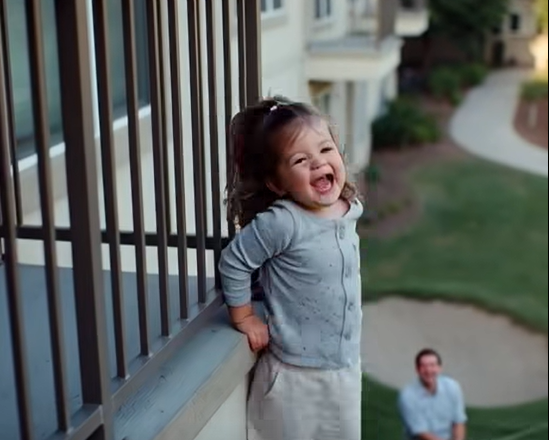
The Silence on the Balcony
My husband, Mark, had always possessed a terrifyingly casual confidence about things he barely understood. He was the type of man who would glance at a set of IKEA instructions, toss them in the recycling bin, and claim he could feel the “structural logic” of the furniture—only for the bookshelf to collapse three days later. In the early days of our marriage, I found this trait charming, a sort of roguish optimism. But when it came to our daughter, Ellie, that charm curdled into something far more dangerous.
Ellie was three years old—a fragile, chaotic, wonderful whirlwind of a toddler who needed constant eyes on her. I was the architect of her schedule, the keeper of the nap times, the snacks, and the boundaries. Mark was the “Disney Dad,” the one who swooped in for five minutes of tickle fights and then vanished the moment a diaper needed changing or a tantrum brewed.
That Saturday started with a pit in my stomach. I had an emergency strategy meeting for work—a rare weekend obligation I couldn’t dodge.
“I’ve got this, Sarah,” Mark said, leaning against the kitchen counter, sipping his coffee. “Go. Slay the dragon. Bring home the bacon. Ellie and I are going to have a boys’—well, a dad and daughter—day.”
I hesitated, my hand hovering over the doorknob. “She needs lunch at 11:30 sharp, Mark. Not snacks. Real food. And don’t let her near the balcony door; the lock is sticky.”
“Babe,” he said, rolling his eyes with a smile that was meant to be reassuring but felt dismissive. “I’m her father. I think I can handle a three-year-old for four hours. You micromanage too much.”
I swallowed the sharp retort sitting on my tongue. Maybe he was right. Maybe my anxiety was a leash I needed to loosen. I kissed Ellie’s forehead, smelling the baby shampoo in her hair, and forced myself to walk out the door.
If I had known what the silence of that house would feel like when I returned, I never would have turned the key in the ignition.
The meeting was a blur of spreadsheets and projected revenue, but my mind remained tethered to my house. I checked my phone under the conference table at 10:00 AM. Nothing. At 11:00 AM. Nothing.
Silence from Mark usually meant one of two things: total chaos that he was too busy to report, or he was ignoring his phone while playing video games.
Then, at 1:15 PM, during a brief coffee break, my phone buzzed. A text from Mark.
Took care of a little attitude problem this morning. I disciplined her, haha. Finally got some peace and quiet.
I frowned at the screen. The wording felt wrong. “Disciplined” wasn’t a word Mark used often; he usually just gave her a cookie to make her stop crying. And the “haha” at the end sent a cold shiver down my spine—a nervous tic in text form.
Before I could type a reply asking what happened, a second message came through. It was a photo.
It was a picture of our second-story balcony. The shot was framed strangely, looking down at the tiled floor and the railing. The balcony was empty. The glass door was shut. There was no Ellie in the frame. Just the gray tiles and the bright, harsh afternoon sun.
I typed back immediately: What is this? Where is she?
The bubbles appeared, then vanished.
I called him. Straight to voicemail.
I called again. Voicemail.
“Hey, Sarah, we’re starting back up,” my boss said, poking his head into the breakroom.
“I have to go,” I said, my voice sounding distant to my own ears. A cold dread was uncoiling in my gut, heavy and venomous. “Family emergency.”
I didn’t wait for permission. I grabbed my bag and ran. The drive home usually took thirty minutes. I made it in eighteen. My hands gripped the steering wheel so tight my knuckles turned white, my brain replaying that photo over and over. Why show me an empty balcony? Why the joke about peace and quiet?
I turned onto our street, my heart hammering against my ribs like a trapped bird. Mark’s car wasn’t in the driveway yet. He must have gone out. But where was Ellie?
I pulled in, threw the car into park, and was reaching for my keys when Mark’s SUV rolled up behind me. He had his golf clubs in the back. He had been golfing.
He stepped out of the car, wearing his polo shirt and sunglasses, looking for all the world like a man without a care. He was humming. Actually humming.
I scrambled out of my car, my legs shaking. “Mark!”
He looked up, startled by my intensity. “Whoa, hey. You’re home early. Meeting go okay?”
“Where is she?” I demanded, closing the distance between us. “Where is Ellie?”
He blinked, confusion clouding his relaxed features. “What? She’s… she’s at home. On the balcony.”
The world seemed to tilt on its axis. “On the balcony?”
“Yeah,” he said, adjusting his sunglasses. “Didn’t you see the text? She was throwing a massive fit about the TV. Screaming her head off. I put her out there to cool off. Time out. Fresh air.”
“You put a three-year-old on a balcony and then left?” I screamed, the sound tearing at my throat.
“I didn’t leave her on the balcony,” he stammered, his smile fading. “I left her there to calm down while I went to the range for a bit. The door was locked. She’s fine. She probably fell asleep in the sun chair.”
“You left her alone! For hours!”
I didn’t wait for his excuse. I sprinted toward the front door, fumbling with my keys. Mark trailed behind me, his footsteps heavy, finally sensing the panic radiating off me.
“Sarah, calm down, she’s safe. It’s enclosed…”
I burst into the house. Silence. The air conditioning was humming, but the house felt tomb-like.
“Ellie!” I screamed.
No answer.
I ran through the living room to the sliding glass door that led to the balcony. Through the glass, I saw the patio chair. Empty.
I ripped the door open and stepped out into the heat. “Ellie?”
I looked left. I looked right. She wasn’t there.
Mark stepped out behind me, breathless. “She… she must be hiding. Ellie? Daddy’s home!”
I rushed to the railing. We were on the second floor. Below us was the concrete patio of the downstairs unit and a strip of manicured grass.
I looked over the edge.
Time stopped. The sound of the wind, the distant traffic, Mark’s breathing—it all vanished.
Directly below us, on the gray concrete patio, was a scene from a nightmare.
Huge, violent streaks of bright red were splattered across the ground. It looked like an explosion. Pools of crimson liquid were smeared in irregular, chaotic patterns, trailing off toward the grass.
Mark, standing beside me, looked down. He made a sound I will never forget—a choked, strangled gasp that sounded like his soul leaving his body.
“Oh my God,” he whispered. “Oh my God… Ellie… what… did she…”
His knees gave out. He gripped the railing, his face draining of all color, turning a sickly shade of gray.
“Did she jump?” he wheezed. “Is that… is that…”
My brain refused to process the visual data. The red was so bright. So much of it. And Ellie was gone.
I whipped around to him, grabbing his collar, shaking him. “What did you do? Mark, what did you do to her?”
He shook his head violently, tears instantly springing to his eyes, spilling over. “I didn’t… I just… she was safe… I thought she was safe…”
Just then, a sound drifted up from the yard below.
It was soft. Shaky. A whimper.
My heart leapt into my throat, lodging there like a stone.
The red-stained concrete. The empty balcony. The whimper.
I didn’t speak. I didn’t breathe. I spun around and bolted for the stairs, terrified beyond the capacity for thought, terrified of what I was about to find at the bottom.
I flew down the stairs, skipping steps, my hand sliding down the banister so fast the friction burned my palm. Every worst-case scenario flashed through my mind like a strobe light. A broken body. A shattered skull. Life support. Funerals. Tiny coffins.
“This can’t be happening,” Mark was muttering behind me, stumbling, tripping over his own feet. “Please, God, no…”
I burst out the back door of the lower level and rounded the corner to the patio.
My momentum carried me onto the grass, and then I froze.
There, sitting in the grass about five feet away from the horrific red splatter, was Ellie.
She was curled into a tight ball, hugging her knees to her chest. Her face was buried in her arms, her small shoulders shaking. She was wearing her pink pajamas from the morning.
“Ellie!”
She looked up. Her face was streaked with tears, splotchy and red, her eyes wide with terror. But she was moving. She was whole.
“Mommy!” she wailed, the sound breaking the paralysis that held me.
I dropped to my knees and scooped her up, pulling her into my chest so hard I was afraid I might bruise her. I buried my face in her neck, inhaling the scent of sweat and tears and life.
“I’ve got you,” I sobbed, rocking her. “Mommy’s here. You’re okay. You’re okay.”
I pulled back frantically, my hands running over her arms, her legs, her head. I checked for blood, for breaks, for bruises.
Nothing. She was physically unhurt.
Mark stumbled onto the grass, his face a mask of absolute horror. He fell to his knees beside us, reaching out a trembling hand to touch her hair.
“Ellie… oh God, Ellie… are you hurt? Why is there… why is there blood?”
He pointed a shaking finger at the concrete patio.
I looked at the mess. From the balcony, it had looked like a crime scene. Up close, the red liquid was thick, sticky, and pooled around shattered plastic shards.
I held Ellie tighter, feeling her small heart beating like a trapped rabbit against my chest.
“Daddy locked me out,” she whispered into my shirt. “I got thirsty. I tried to get the drink.”
My fury, momentarily doused by relief, reignited with the heat of a supernova.
I looked at the stain again. The wind shifted, and a scent hit me. It wasn’t the metallic tang of copper and iron. It was sweet. Sickly sweet. Artificial.
“It’s not blood,” I said, my voice icy.
I stood up, holding Ellie on my hip, and walked over to the splatter. I touched the edge of the puddle with my finger and rubbed it against my thumb. Sticky. Sugary.
“It’s fruit punch,” I announced, turning to Mark.
He blinked, his brain unable to catch up. “What?”
“Fruit punch. Or cherry juice,” I spat. “Look at the plastic.”
Lying in the center of the red pool was the jagged remains of a large, economy-sized bottle of juice—the kind Mark bought for his cocktails.
The narrative assembled itself in my mind instantly:
Mark had left a bottle of mixer on the balcony table. He locked Ellie out. He left. Hours passed. She got thirsty. She tried to lift the heavy bottle. Her small hands slipped, or she tried to prop it on the railing to drink. It fell over the edge. It smashed on the concrete below, exploding upward.
Mark stared at the mess, his mouth opening and closing. “Juice? But… it looked like…”
“She could have fallen,” I said, my voice low and trembling with rage. “She dropped the bottle. But Mark… she was leaning over that railing. She was alone. She was terrified. If she had climbed up on that chair to look over… that red stain would be her.”
Mark collapsed onto a patio chair, burying his face in his hands. His shoulders heaved. “I swear… I didn’t think… it was just a tantrum… I thought she’d be safe up there.”
“You went golfing,” I said. “You locked our three-year-old on a balcony like a dog and went to play golf.”
Ellie sniffled, wiping her nose on my shirt. “The boom scared me,” she said softly. “And Daddy yelled at me before he left.”
Mark looked up, his eyes red-rimmed and hollow. He looked at Ellie, then at the balcony high above us. The reality of the distance, the height, the isolation, finally seemed to penetrate his thick skull.
“I…” he started, but his voice cracked. He had no defense. There was no defense.
“Get inside,” I said. I didn’t recognize my own voice. It was the voice of a stranger—someone hard, someone unforgiving. “We are going to have a conversation. And Mark? You better pray you have better answers than ‘I didn’t think’.”
The red stain on the concrete dried in the sun, looking less like blood and more like what it was: a monument to a father’s catastrophic negligence. But the damage was done. The trust between us had shattered just like that plastic bottle, and I wasn’t sure it could ever be put back together.
The inside of the house felt different now. The safety I used to feel within these walls had evaporated.
I sat on the couch, Ellie curled into my side, clutching her favorite stuffed bear. I had bathed her, washed the tears from her face, and given her a real lunch. She was watching cartoons now, her eyes heavy. She was exhausted from the trauma of crying for hours.
Mark stood in the doorway of the kitchen. He hadn’t taken off his sunglasses; he just held them in his hand, twisting the frames until I thought they might snap. He looked small. The arrogance was gone, replaced by a pathetic, fearful slump.
“She’s asleep?” he asked quietly.
“Almost,” I said, not looking at him. I kept my eyes on the TV screen, where a colorful cartoon tiger was learning to share. “She asked me why Daddy didn’t want her inside.”
Mark flinched as if I’d slapped him. “Sarah, please. You know I love her.”
“Love is a verb, Mark,” I said, finally turning to face him. “Love is action. Love is protection. Locking a toddler on a balcony so you can go hit balls with your buddies isn’t love. It’s neglect. It’s abuse.”
“I didn’t mean for it to be that long,” he pleaded, stepping into the room. “I lost track of time. My phone died on the course…”
“Stop,” I cut him off. “Do not blame the phone. Do not blame the golf. You made a choice. You texted me that you ‘disciplined’ her. You laughed about it. You took a picture of the empty balcony like it was an accomplishment.”
He swallowed hard, looking at the floor. “I was frustrated. She wouldn’t stop screaming. I just wanted five minutes of peace.”
“And you got it,” I said cold. “You got hours of it. While she sat out there in the heat, thirsty, scared, wondering where her father was.”
I stood up, gently disengaging from Ellie, and walked over to him. I needed him to understand the gravity of this.
“When we looked over that railing,” I whispered, pointing toward the patio door, “for ten seconds, you thought she was dead. You saw that red stain, and you thought our daughter was splattered on the concrete.”
Mark squeezed his eyes shut, a tear leaking out. “I know. It was… it was the worst feeling of my life.”
“Good,” I said. “Hold onto that. Because that is what your laziness almost bought you. That feeling? That’s the ghost of what could have happened. If she had climbed that railing. If she had dehydrated. If she had panicked.”
He nodded, shame burning his face crimson. “I messed up. I know I did. I’m so sorry, Sarah.”
“‘Sorry’ doesn’t fix this,” I said. “You have endangered her. You have terrified her. And you have terrified me.”
I took a deep breath. This was the turning point. I could sweep this under the rug, pretend it was just a ‘mistake,’ and go back to being the anxious, micromanaging wife. Or I could draw a line in the sand.
“Here is what is going to happen,” I said, my voice steady. “You are not to be alone with her until I say so. Not for five minutes. Not for a second.”
Mark looked up, hurt flashing in his eyes. “Sarah, come on. I’m her dad.”
“Then act like it,” I snapped. “We are going to counseling. Parenting classes. You need to understand child development, safety, and why isolating a crying child is psychological torture, not discipline. If you refuse, or if you ever prioritize your convenience over her safety again, you can pack your golf clubs and leave. Permanently.”
The silence stretched between us, heavy and suffocating. Mark looked at Ellie, sleeping peacefully on the couch, oblivious to the war being fought over her. He looked at me, seeing a resolve he hadn’t encountered before.
“Okay,” he whispered. “Okay. Whatever it takes. I won’t let it happen again.”
“You can’t,” I said. “Because you won’t get another chance.”
That night, after Mark had retreated to the guest bedroom—at my insistence—and Ellie was safely tucked into her crib, I walked back out onto the balcony.
The moon was full, casting a pale, ghostly light over the yard. The red stain on the concrete below had darkened to a blackish bruise in the moonlight. I gripped the railing, my hands still trembling slightly.
I replayed the moment over and over. The red splash. Mark’s gasp. The drop in my stomach.
It was a false alarm. It was juice. It was a mess that could be hosed away with water and a scrub brush.
But the fear wasn’t fake. The negligence wasn’t fake.
Parents don’t get do-overs when it comes to gravity. We don’t get rewinds when it comes to trust. We only get vigilance. We only get the heavy, exhausting, necessary burden of paying attention.
Mark had learned a lesson today, written in red sugar on the pavement. I hoped it was etched into his soul.
As for me, I stood there in the quiet night, breathing in the cool air, promising myself and my daughter that I would never silence my instincts again. If something felt off, I would turn the car around. If a silence felt too heavy, I would break it.
I looked down at the stain one last time.
It wasn’t blood. But it was a warning. And God help anyone who ignored a warning like that.
If you’re reading this, please take a moment to look at your own life. Are you ignoring small red flags because they haven’t turned into disasters yet? Don’t wait for the stain on the concrete to be real. Like and share this post if you believe safety is more important than politeness.