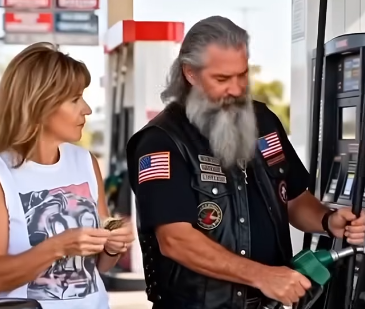
The afternoon sun beat down on the cracked asphalt of the Shell station off Highway 26, creating shimmering heat waves that made distant objects look unreal. I’d been riding for three hours straight, my 2015 Harley Road King humming beneath me like an old friend, when I decided it was time to stop. At sixty-six years old, I’d learned to listen to my body—the stiffness in my lower back, the dull ache in my knee, the way my hands slowly tightened around the handlebars. The days of riding eight hours without a break were long gone, even if I never admitted that to the younger guys in my riding club.
I pulled up to pump number four, shut off the engine, and sat for a moment in that strange quiet that follows a long ride. My ears still rang from the wind. I swung my leg over the bike, my leather chaps creaking, and stretched until my back cracked. Getting older wasn’t easy, but it was better than the alternative.
The station was one of those tired rural stops—two rows of pumps, a small convenience store with barred windows, and a handwritten sign advertising cold beer and hot pizza. A few cars were scattered around, their drivers nowhere to be seen.
I was halfway through filling my tank when I heard it—a sound that cut through everything else. A woman’s voice. Young. Shaking. The kind of sound that makes your stomach tighten before your brain even catches up.
I turned and saw her standing beside an old Honda Civic a short distance away. The car had seen better years—faded paint, a cracked taillight taped together, a bumper sagging on one side. But it was the girl who caught my attention.
She couldn’t have been more than twenty. Thin, shoulders slumped, trying to make herself small. Her blonde hair was pulled into a messy ponytail, mascara streaked down her face. She stared at something in her hands, trembling as she tried to hold back sobs.
I’ve been riding motorcycles for nearly five decades. I’ve crossed this country more times than I can count. I’ve met good people and bad ones, and I’ve learned to trust my instincts. Something about her—the way she stood there defeated and frightened—made my chest tighten.
I looked closer and saw what she was holding: a few coins. Quarters and dimes, counted and recounted like the total might change if she tried hard enough.
I didn’t think about it. I pulled my credit card out, walked over, and slid it into her pump. The machine beeped, and I selected “Fill Up.”
She noticed and looked up fast—her eyes wide, not grateful, but terrified.
“What are you doing?” she asked, her voice high with panic. “Please stop. You can’t. You don’t understand.”
“It’s already going,” I said calmly. “It’ll be okay.”
She shook her head, glancing toward the store. “My boyfriend will be back any second. If he sees this… if he thinks I asked you for help…” Her voice dropped.
“I won’t be safe.”
Up close, I noticed things I hadn’t before. A dark bruise near her shoulder she tried to hide. Red, swollen eyes from crying far longer than a few minutes. The way her body stayed tense, like she was bracing for something.
I asked quietly, “How much does he usually let you put in?”
She looked down at the coins. “Three or four dollars. Just enough to get home.”
The pump kept running. The numbers climbed. She watched them like a countdown.
“Where’s home?” I asked.
“Forty miles away.” Tears slipped down her face. “Please. He’ll think I did something wrong. He always does.”
The pump clicked off. Full tank.
She stared at it in horror. “He’s going to lose it.”
Then she froze. “He’s coming. Please—just go.”
I turned and saw him walking out of the store. Early twenties. Tank top. Tattoos. That false confidence young men wear when they think fear equals strength. His eyes locked onto us instantly.
“What’s this?” he shouted. “You begging strangers now?”
She flinched before he even touched her. “I didn’t ask him. I swear.”
He grabbed her arm hard. I stepped between them.
“She didn’t ask me,” I said. “I chose to help.”
He sized me up, then sneered. “Mind your business.”
He yanked her again. “Get in the car.”
“She doesn’t look like she wants to,” I said.
I looked at her and asked the simplest question I could think of.
“Do you feel safe with him?”
She didn’t answer at first. Then, barely above a whisper:
“Help me.”
Everything stopped after that.
He lashed out, hitting me hard enough to stagger me. I’d been hit before—worse than that. I steadied myself, redirected him, and pinned him against the car, keeping him from hurting anyone else.
People noticed. Phones came out. Someone called the police.
Sirens arrived quickly.
I stepped back, hands raised. He yelled accusations. The officers listened.
One officer knelt beside the girl and spoke gently. She showed the bruises on her arms. Not graphic. Just undeniable.
Another officer’s radio crackled. The boyfriend had outstanding warrants related to abuse.
He was handcuffed and taken away, shouting the whole time.
She sat on the curb, shaking, while a woman from the crowd held her and told her she was safe.
Later, a local advocate arrived and spoke to her quietly, explaining her options.
“I just want to go home,” the girl said. “To my mom.”
Arrangements were made.
Before she left, she came over to me.
“You asked me if I was safe,” she said. “No one had asked me that in months.”
I gave her some cash for the drive. She hugged me like she’d been holding her breath for a year.
Weeks later, I learned she made it home.
Years later, I got an email. She’d finished college. She worked helping others leave situations like hers. She sent a photo of herself beside her own car.
The message said:
“Tank’s always full now. I’ll never forget what you did.”
I still carry that photo.
And every time I stop for gas, I pay attention.
Because sometimes, all it takes is one person asking,
“Are you safe?”
And staying long enough to hear the answer.
