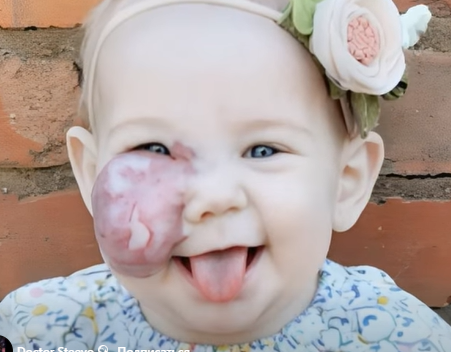
When Emilia was born, the first thing everyone noticed was her extraordinary eyes — a blue so pure it seemed to hold the sky inside them. But the room fell silent the moment the doctor leaned closer, his expression changing. Laura, exhausted yet radiant from childbirth, waited to hear her baby’s first cry, but what she heard instead was a heavy pause. The doctor finally said in a hushed voice, “There’s something on her cheek… a large growth.”
The words cut through her like ice. Laura’s hands shook as she reached out to hold her newborn daughter. On Emilia’s tiny, porcelain face was a swelling — reddish-purple, uneven, and frighteningly alive. It wasn’t a simple birthmark; it was something much larger, more alarming. Laura’s breath caught in her throat. Yet as she gazed into her daughter’s eyes, she felt love rise so fiercely inside her that fear had no choice but to step aside. She whispered, “You’re mine, and you’re perfect.”

That night, as the maternity ward slept, Laura sat awake beside the crib. The moonlight filtered through the curtains, touching the baby’s face — and that growth, so unnatural and mysterious, cast a small shadow across her delicate skin. Laura wanted to believe it was nothing, that time would take it away. But when the doctors returned the next morning, their faces carried concern instead of reassurance. One doctor explained quietly that they needed to observe it closely, that it might be something vascular, something unpredictable. Laura didn’t understand the terms — she only understood the fear behind them.
As weeks passed, the growth didn’t fade; it grew with her. Neighbors came to visit the newborn, and although they smiled and said kind words, their eyes always flickered toward Emilia’s face. In the park, children would stare; adults would whisper. Once, at the grocery store, a woman murmured, “Poor child… why doesn’t her mother do something about it?” Laura heard it, and her heart twisted, but she didn’t cry in public. She waited until she got home, then sat on the floor beside Emilia’s crib, tears falling silently as her baby slept peacefully, unaware of the world’s judgment.

The next day, Laura made a decision. She went to a small boutique and bought a headband decorated with delicate pink and white flowers. When she placed it on Emilia’s head, the flowers gently brushed against the edge of the growth. “You’re my rose,” she whispered. “And no one will ever make you feel less beautiful.”
Time passed, but the growth continued to change. It became darker, more inflamed. Some days Emilia cried in pain when Laura gently wiped her cheek. Fear became a constant companion in their home. One evening, Laura noticed the swelling had grown again — not by much, but enough to fill her with dread. She didn’t wait until morning. She wrapped her daughter in a blanket and rushed to the hospital under the dim streetlights.
Doctors ran tests, examined scans, and spoke in terms Laura could barely process. “It’s spreading internally,” one finally said. “We need to operate before it compromises deeper tissue.” The words “operate” and “before it spreads” echoed inside her mind like thunder. She nodded, pretending to understand, but the truth was unbearable: her baby — so tiny, so fragile — would have to undergo surgery.

The week before the operation felt endless. Every time Laura looked at Emilia, she was haunted by the thought that she might lose her. On the night before the surgery, Laura didn’t sleep at all. She held Emilia in her arms, humming softly, as if memorizing every sound, every breath, every heartbeat. “You’re brave,” she whispered. “Braver than anyone knows.”
The morning of the surgery arrived, and the hospital smelled of antiseptic and fear. Laura kissed Emilia’s forehead as the nurses gently carried her away. The doors of the operating room closed, and silence filled the corridor. Laura sat motionless, clutching the floral headband in her hands. Every minute stretched into eternity. Hours passed — three, then five, then seven. She prayed without words, just with trembling breaths.
Finally, the surgeon appeared. His mask was off now, his face lined with exhaustion but softened by a faint smile. “She’s awake,” he said. “It was successful.” For a moment, Laura couldn’t breathe. Then tears burst forth as she ran down the hallway toward the recovery room. There, under white sheets and soft lights, lay her baby — her face bandaged, her body small and fragile, but alive. When Emilia’s eyes fluttered open and found her mother’s face, she smiled faintly. And in that instant, every sleepless night, every whispered prayer was answered.

Recovery wasn’t easy. There were days of fevers, tears, and endless dressing changes. Laura learned to hide her pain, to smile even when her hands shook as she cleaned the wound. But gradually, the swelling disappeared. When the bandages came off, the large growth was gone. In its place was only a small pink scar — tender, soft, and strangely beautiful.
Months turned into years. Emilia grew stronger, cheerful, curious about everything. When she was three, Laura showed her an old photograph — one taken before the surgery. Emilia stared at it for a long moment. “Was that really me?” she asked. “Yes, my love,” Laura said softly. “You were very brave.” The little girl thought, then said with innocent pride, “I think I was born strong.”
When Emilia was five, they went to the beach. The sun painted her golden hair with light, and the faint scar on her cheek shimmered under the sun’s rays. Laura stood watching her play in the waves, laughing freely. She realized that the mark — the reminder of fear and pain — no longer looked like something to hide. It looked like a sign of strength, a petal of the flower her daughter had always been.

At school, Emilia became known for her kindness. One afternoon, a new classmate came crying because of a scar on her neck. Emilia walked over, sat beside her, and gently touched her own cheek. “I had something here once,” she said softly. “It made me different, but it also made me special.” The other girl stopped crying, and soon, they were laughing together. That moment would stay in Laura’s heart forever.
But behind all the light and joy, there was one truth Laura had never told anyone — not even Emilia. Before the surgery, the doctors had warned her that her daughter’s chances of surviving the procedure were only ten percent. Ten percent. Laura had signed the consent papers with shaking hands, knowing she might be signing her child’s last moments away. That night, standing by the hospital window, she whispered into the darkness, “God, if you let her live, I’ll tell the world that miracles are real.”
And Emilia lived.

Years later, Laura kept her promise. She shared their story online, not as a tragedy but as a testament to hope. Thousands of people read it. Comments flooded in from mothers, fathers, and strangers from around the world. Some wrote, “Your daughter gave me strength.” Others said, “Because of her, I believe in miracles again.”
Every evening, Laura watched her daughter — vibrant, laughing, alive — and saw not the fragile infant from that terrifying day, but the embodiment of grace and resilience. The growth that once brought fear had become the very reason they learned what love truly meant.
One quiet night, as the stars shimmered outside their window, Emilia climbed into her mother’s lap. “Mom,” she whispered, “am I all better now?” Laura kissed her cheek gently. “Yes, my love,” she said, smiling through tears.
“You’re healed — and even more than that, you’re whole.” Emilia hugged her tightly and murmured, “I love you as big as the sky.”
Laura held her close, realizing that the scar — that small pink reminder of what once was — was not a flaw but a blessing. It was proof that even in pain, beauty can bloom. It was proof that love can heal anything. And in that moment, she knew their story wasn’t just about survival; it was about transformation — the kind that turns fear into faith and wounds into wings.