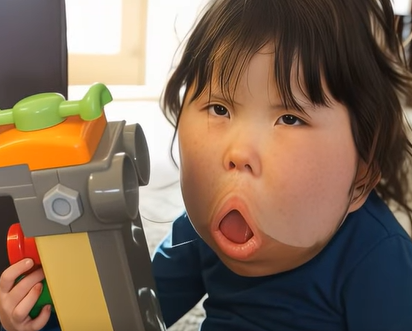
Katie Renfroe entered the world already carrying a mystery that no textbook could explain. From the moment she was born, doctors noticed that something about her development did not fit into any familiar pattern.
Her brain was larger than expected, her features soft and unusually shaped, as if nature itself had paused mid-design and chosen a different path. The official diagnosis written on her first medical papers was megalencephaly, a rare brain overgrowth condition, but even then the doctors admitted it felt incomplete. It was only the beginning of a story no one could yet name .
For her mother Angie, the waiting began long before Katie took her first breath. At six months pregnant, Angie was told that her daughter would be born with a serious condition affecting her brain. She remembers sitting in the dimly lit exam room, staring at the ultrasound screen, trying to understand how love and fear could exist so powerfully at the same time. From that moment on, Angie promised herself one thing: whatever this child faced, she would never face it alone .
As Katie grew, the questions multiplied. Doctors examined her for disorder after disorder—conditions Angie could barely pronounce, let alone understand.

Dwarfism, genetic syndromes, rare craniofacial disorders—every test came back negative. Each result ruled something out but explained nothing. Angie often joked bitterly that Katie was a medical paradox, a living question mark walking through hospital hallways .
In search of answers, the family traveled to Hollywood, Florida, to meet Dr. Roman Yusupov, a renowned specialist in pediatric genetics and craniofacial conditions. He studied Katie carefully, gently adjusting his glasses as he examined scans, measurements, and photographs taken over months and years. Finally, he spoke words Angie would never forget: he had never seen anything like her before. Katie, he said, might truly be one in a million. Perhaps she had an overgrowth syndrome, something that caused different parts of her body to grow unpredictably—but even that was only a theory, not a name .
Katie’s childhood became marked not by playgrounds, but by operating rooms.

At just nine months old, she underwent brain surgery. Over the years, she endured procedure after procedure: her tonsils removed, a feeding tube placed, her tongue reduced, her ears adjusted, her cheeks downsized multiple times, cysts carefully removed from her head. Each surgery carried fear, but also hope—that maybe this time, doctors would understand her a little more .
Despite it all, Katie’s spirit refused to shrink. She experienced seizures that temporarily stole her ability to walk or speak, and there were days when her body simply would not cooperate. Yet she attended a school for children with disabilities, where she learned to use computers and eagerly participated in circle time with the help of her favorite teacher. Her laughter often echoed louder than anyone else’s in the room, sudden and contagious .
At home, Katie was surrounded by life. Seven biological siblings, step-siblings, constant noise, movement, and love. Her older sister Megan liked to say that Katie was the wild one of the family—the one with the boldest personality. She laughed with her whole body, a sound so pure it could stop arguments mid-sentence. To Megan, Katie wasn’t rare or mysterious. She was simply unforgettable .

Angie often described her daughter as joyful and mischievous. Katie loved music, loved watching people, loved setting tiny traps around the house—placing toys in unexpected places just to see if someone would trip and laugh. If someone got hurt, she cried with them. If something amused her, she laughed until her eyes watered. Katie felt everything deeply, without filters or fear .
Yet the unknown loomed quietly in the background. Without a diagnosis, doctors could not predict Katie’s future. Would her condition progress? Would new symptoms appear? Angie learned to live without answers, measuring success not in medical terms but in smiles, calm nights, and moments of peace.
Years passed, and one afternoon during a routine appointment, something unexpected happened. A young genetic researcher, new to the hospital, reviewed Katie’s complete medical history—every scan, every test, every note written since before her birth. She noticed patterns others had missed, connections too subtle to fit into existing categories. She didn’t offer a diagnosis that day. Instead, she offered an idea.

“What if,” she said softly, “Katie doesn’t have a condition that needs a name… because she is the first example of something entirely new?”
Weeks later, Angie received a call. The medical board had reviewed the findings. They weren’t ready to publish or announce anything officially—but they agreed. Katie’s biology represented a previously undocumented genetic variation. Not an error. Not a disease in the traditional sense. A new chapter in human development.

Angie sat on the edge of Katie’s bed that night, watching her daughter sleep, her chest rising and falling steadily. For the first time in nine years, Angie didn’t feel the weight of waiting. Katie didn’t need to be fixed, defined, or labeled to matter. She was already teaching doctors something new.
And somewhere between the machines and the medical journals, the world quietly shifted—not because Katie finally received a name, but because she proved that not everything rare is broken. Some things are simply the beginning of a story no one has written yet.