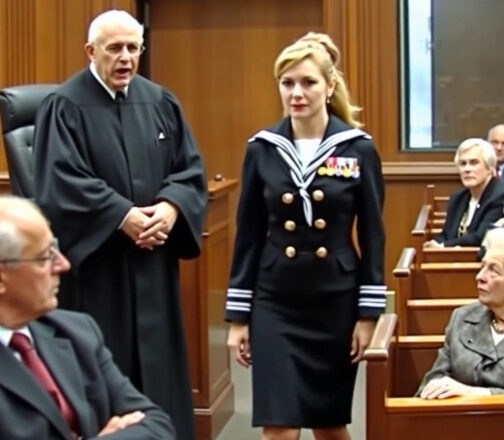
My parents believe I abandoned the property. The truth is, I never abandoned anything—I was serving my country, defending the very freedom that allows us to stand here today,” I said, my voice steady but filled with a mix of sadness and resolve.
The courtroom was silent, the weight of my words hanging in the air like a dense fog. I continued, “After my injury, I settled nearby, maintaining my connection to this land and this community. Every tax payment, every piece of mail forwarded, every memory of childhood summers spent at that farmhouse, they tie me to this place, even when my duty called me elsewhere.”
I glanced at my parents. My father’s stern expression wavered, while my mother’s eyes glistened with something unspoken—perhaps regret, perhaps pride. The judge, still processing the scene, leaned forward, his gaze softening.
“Commander Carter, your service record speaks volumes,” Judge Simmons said, his voice carrying a note of respect. “I understand the stress and separation military service can bring to families. It’s evident your commitment hasn’t wavered.”
I nodded, a small, grateful acknowledgment. “Thank you, Your Honor. I never intended for this to become a legal battle. I’ve always been willing to have a conversation with my parents, but they chose this path.”
The judge looked towards my parents, his expression now one of gentle authority. “Mr. and Mrs. Carter, it seems there has been a significant misunderstanding. I would encourage open communication beyond these walls.”
My father shifted uncomfortably, his eyes finding the floor. My mother gave a slight nod, wiping at her eyes. The judge turned back to me, “Commander, would you be open to mediation?”
I took a deep breath, considering the opportunity for reconciliation. “Yes, Your Honor. I would welcome the chance to find common ground.”
The gavel fell with a sharp sound, signaling the end of the session but perhaps the beginning of something new. As I turned to leave, a quiet voice stopped me.
“Evelyn,” my mother called softly, her voice barely above a whisper. I paused, meeting her eyes. There was a vulnerability there I hadn’t seen in years. “We didn’t know how to reach you. We…we didn’t know how to handle this.”
I approached them, my uniform still crisp, medals gleaming under the fluorescent lights. “I understand,” I replied, my voice gentle now, seeking to bridge the chasm that had grown between us. “We can talk, figure it out together.”
As we exited the courtroom, the air felt lighter, the tension beginning to dissipate. My father walked alongside me, his stride matching my own, though his face remained a mask of conflicted emotions. We stepped into the sunlight, the world outside vibrant and full of possibilities.
Knox wagged his tail, waiting patiently as I paused to breathe in the fresh air. The courthouse stood behind us, a reminder of battles fought and battles yet to be won—not with legal documents or declarations, but with understanding and compassion.
For the first time in years, I felt a sense of hope. Maybe, just maybe, the uniform I wore could serve not just as a symbol of duty fulfilled, but as a bridge to healing old wounds. Together, we walked away from the courthouse, ready to confront the past and build a future, one step at a time.