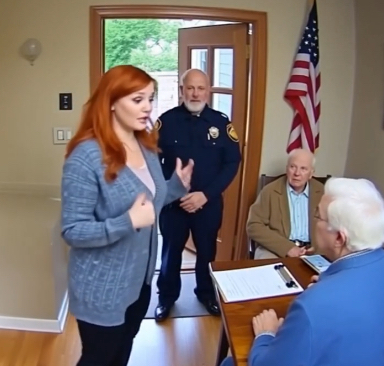
The sudden appearance of the woman with the cane, the silence that followed, and the palpable tension in the room all seemed to stretch time in a way that made every second feel heavy with consequence. She had an air of authority, and the certainty in her voice was like a lifeline thrown amidst the swirling eddies of betrayal and confusion that characterized my parents’ actions. With a nod, I gestured toward the dining table.
She laid down the parchment, carefully unfolding it with hands that exuded both gentleness and precision. “This,” she said, pointing to the document, “is an official declaration of ownership and a protective measure against further fraudulent claims. It ensures that no unauthorized activity can occur without your explicit consent.”
My parents exchanged quick, furtive glances, their earlier bravado melting away into concern and uncertainty. The woman continued, “It’s within your right, Ruth, to enforce these protections. Your parents have committed a grave violation, and while the legal system can be forgiving, it does not overlook repeated offenses.”
My father, normally so composed, was visibly disconcerted. “We didn’t mean any harm,” he said, his voice barely above a whisper. My mother nodded, her eyes downcast, perhaps finally realizing the depth of the breach of trust.
I took a deep breath, considering the years of subtle manipulations and cloaked control. This wasn’t just about the house; it was about autonomy, respect, and the invisible chains of obligation they had tried to fashion into a familial bond. “I understand that you thought this was for the best,” I said, my voice steady, “but this is my life, my choices.”
The woman, whose presence felt almost like a guardian angel, offered me a reassuring smile. “Ruth, you have the power here. This is your decision now. The document can be a clean slate—a chance to redefine the boundaries.”
I nodded, taking the pen she offered. As I signed my name, I felt a weight lift from my shoulders. It wasn’t just ink on parchment; it was a declaration of independence. An assertion that my life was mine to shape, free from the reins of those who confused love with possession.
The quiet that settled after the signing was different. It wasn’t the charged silence of before but rather a calm that signaled new beginnings. My parents seemed smaller, humbled perhaps by the realization that they could no longer direct my life as they saw fit.
The woman collected the documents, ensuring each was duly signed and witnessed. “You’ll receive official copies by the end of the week,” she assured me. As she turned to leave, she paused, looking at my parents with a mix of understanding and admonition. “Family is important,” she said softly, “but respect is paramount.”
When the door closed behind her, the room felt larger, more open. My parents lingered, unsure of what to say. Perhaps there were no words left for them in this new dynamic. As they stood to leave, I offered a tentative smile, hoping it conveyed some semblance of forgiveness.
“Let’s take this one step at a time,” I said gently. They nodded, and as they walked out into the night, I was left standing in my home—a place that was finally, unequivocally, my own.