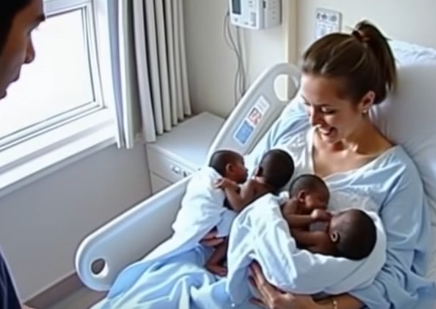
A long-standing family mystery reached a decisive turning point when the results of a long-awaited test confirmed the identity of a father, bringing clarity to questions that had lingered for more than three decades.
The moment unfolded quietly but carried profound significance for a mother and her children, who had lived for years under the weight of uncertainty, rumor, and unresolved history.
The confirmation came in the form of a document sealed inside an envelope, opened in the presence of the siblings and their mother, Olivia. Gathered closely together, the family braced themselves for an answer that would formally connect their past to their present. Olivia watched as her children stood shoulder to shoulder, fully aware that the outcome—whatever it might be—would shape their understanding of identity but not diminish their bond.
The responsibility of reading the document fell to the eldest sibling, Marcus. With deliberate care, he unfolded the paper as silence settled over the room. The stillness reflected the gravity of the moment: years of speculation, community whispers, and private doubt converged into a single, definitive statement.
“Mom,” Marcus said after reading, his voice calm but resolute, “Jacob is our father.”
The statement confirmed what Olivia had believed for years. She responded quietly, her expression marked by relief rather than surprise. “I always knew,” she whispered, addressing her children with visible pride and affection. For her, the result was not only validation but the closing of a chapter that had been shaped by perseverance and resilience.
While the test result represented a personal resolution for the family, its impact extended beyond the walls of their home. Word spread quickly throughout the local community, where speculation about the children’s paternity had circulated for decades. The narrative that replaced those rumors focused not on doubt but on endurance, highlighting a mother’s determination and the unity of her family in the face of prolonged scrutiny.
The confirmed father, Jacob, learned of the result separately. At the time, he was living alone across town, removed both physically and emotionally from the family he had left behind years earlier. The confirmation forced him to confront choices rooted in prejudice and fear, particularly his inability to look past differences in skin color, which had influenced his decision to withdraw from Olivia and their children.
For Jacob, the realization was accompanied by a reckoning. The years spent attempting to erase the family from his life now stood in stark contrast to what had been lost. His children had grown into accomplished individuals, each establishing themselves in their respective paths without his involvement. Their milestones passed without his presence, forming a history he could neither reclaim nor rewrite.
In response, Jacob took a step he had avoided for years. He wrote a letter addressed to Olivia, expressing remorse and a desire to reconnect. The letter acknowledged his absence and conveyed hope for a conversation, offering an explanation and seeking the possibility of forgiveness. While the attempt carried no guarantee of acceptance, it marked his first direct effort to engage with the family since his departure.
Olivia received the letter with conflicting emotions. Time had softened some of the pain, but her priority remained the well-being of her children. Recognizing that the decision would affect them most directly, she chose not to act unilaterally. Instead, she shared the letter with her children, making it clear that the choice to respond—or not—rested entirely with them.
The siblings read the letter carefully, evaluating both its tone and its implications. Their discussion extended late into the night as they weighed the potential consequences of reopening a relationship marked by absence. The conversation balanced caution with the recognition that understanding the past might offer a form of closure.
The youngest sibling, Emma, ultimately voiced a perspective that resonated with the others. Drawing on the lessons instilled by their mother, she framed the decision as an opportunity rather than an obligation. “He made a huge mistake, and it changed our lives forever. But if we have a chance to understand him, maybe even forgive him, it’s worth considering. After all, look at what Mom taught us about strength and love.”
Her words helped crystallize a shared conclusion. The siblings agreed to respond to Jacob and arranged a meeting, viewing it as a step toward confronting unresolved history rather than erasing it. The decision reflected both caution and openness, grounded in their shared experiences and mutual support.
On the day of the meeting, Olivia accompanied her children, walking alongside them as they prepared to face a man who had been absent for most of their lives. For her, the moment symbolized not only accountability but the outcome of years spent raising her children independently, guided by principles of integrity and compassion.
The family’s journey underscores broader themes that resonate beyond a single household. Issues of identity, prejudice, and reconciliation often unfold privately but carry lasting social implications. In this case, the resolution emerged not through confrontation alone but through patience, dialogue, and the willingness to acknowledge truth.
As the family moved forward together, the focus shifted from what had been lost to what might still be possible. Regardless of how the relationship with Jacob would evolve, Olivia and her children entered the next chapter united, confident that their shared history and mutual trust would guide them. The confirmation of paternity closed one chapter, but it also opened space for understanding, accountability, and the possibility of healing grounded in honesty and choice.