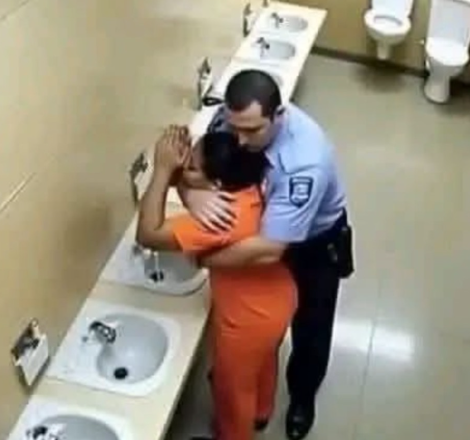
A scene unfolded in a detention center on the outskirts of Lyon that momentarily halted the daily rhythm of bars, procedures and commands issued in a dry tone.
This place usually leaves no room for spontaneous emotions.
Regulations, distance and the coldness of professional routine dominate.
However, something happened that no law foresees that day.
One of the inmates, Marie, received news of her mother’s death.
The news hit her suddenly, without the opportunity to say goodbye, without the presence of her loved ones.
Her hands began to tremble and her voice caught in her throat.
A silence fell in the cramped room, heavier than any words.
The officer who delivered the message could have limited himself to formalities.
He could have turned and walked away, leaving her alone to despair.
Instead, he took a step towards her.
He placed his hand on her shoulder, and then – for a brief moment – embraced her in a gesture of purely human support.
No speeches.
Without unnecessary words.
Just a simple gesture of presence.
In a place where touch most often signifies inspection, search or escort, this embrace had a completely different meaning.
The other inmates watched the scene in silence.
Some of the guards lowered their gaze, as if they felt they were participating in something intimate and special.
For a few seconds the divisions between “prisoner” and “officer” disappeared.
Only two people left.
A gesture stronger than the regulations
Prisons operate according to strictly defined rules.
Every minute of the day is planned, every contact has its limits.
Empathy is not found in operating instructions.
And yet it is precisely this that can change the atmosphere of a place the most.
Marie, initially stiff and surprised, let the tears flow.
After a moment she looked at the officer with gratitude that could not be expressed in words.
This one gesture did not undo the mother’s death.
He did not reduce the sentence.
But he gave her back something very important – the feeling that she was still human.
When Empathy Restores Dignity
Isolation can weaken even the strongest.
A long-term prison sentence often means not only being cut off from the world, but also the gradual disappearance of relationships and support.
In such conditions, every signal of sympathy carries enormous weight.
News of this incident spread quickly through the corridors of the center.
Some prisoners later admitted that they felt something they had not experienced for a long time – hope.
Some of the staff spoke of a feeling of emotion they did not expect in a place so strict and disciplined.
This embrace was not an act of rebellion against the system.
It was a reminder that even in structures based on rules and punishment, there remains room for humanity.
Sometimes an outstretched arm is enough to dispel even a little of the darkness.
Because even behind the highest walls, people still carry pain, loss and the need for closeness.
And empathy – though silent and brief – can restore dignity faster than any words.