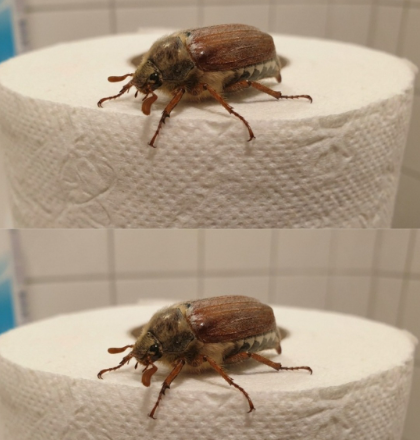
Thank you for sharing that vivid (and completely relatable) late-night bathroom encounter! That “whap” against the light is unmistakable—and yes, it absolutely makes you jump.
You’ve done half the work already by figuring out it’s not a June bug. Let me confirm your identification, explain why it was in your bathroom, and—most importantly—tell you what you should (and shouldn’t) do if you find another one.
✅ Good News First: The Cockchafer Is Harmless to You
First, take a breath. The cockchafer (Melolontha melolontha), sometimes called a “May bug” or “doodlebug,” is not dangerous to humans or pets .
It does not bite or sting. Those pincers on its head? They’re for eating plant leaves, not for pinching people.
It is not poisonous. No venom, no irritation.
It does not infest homes. It’s an outdoor insect that accidentally flew inside because it was attracted to your bathroom light .
So why did it pick your bathroom? You already figured it out: light.
🪲 Why Was It in Your Bathroom?
Cockchafers are nocturnal and strongly attracted to light sources—especially white or bright lights. Your bathroom light, reflected off shiny tiles and porcelain, acted like a beacon.
They also emerge in late spring (April–May) for their short adult flying season, which lasts only 4–6 weeks . During this time, males fly around noisily at dusk and into the night looking for mates. This is when they’re most likely to accidentally fly through an open window or even down a chimney toward a lit room .
Your bathroom had all the right conditions:
A bright light on at night ✅
An open window or gap around a vent ✅
Warm, humid air (which they find inviting) ✅
He wasn’t looking for a new home. He was just lost.
🔍 Cockchafer vs. June Bug: How to Tell