That little red spot that appears on your body without warning can be intriguing.
A dermatologist sheds light on ruby hemangioma, a benign skin condition that occurs with age.
He arrives alone or in a team on his stomach, on his back, sometimes in another place.
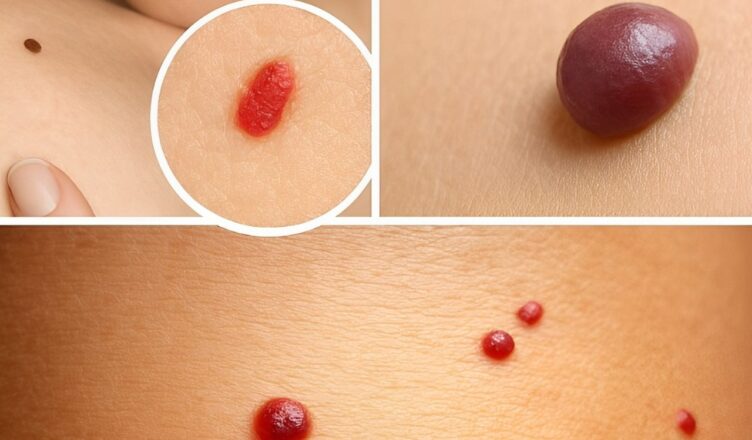
At first glance, it might be mistaken for a birthmark. But it’s not. “It’s a ruby spot, also clinically called a ‘ruby angioma.'” “It has nothing to do with a birthmark, which is a cluster of melanocytes—the skin’s pigment cells,” says Professor Gaëlle Quéreux, dermatologist, president of the French Society of Dermatology (SFD) and head of the Dermatology Department at Nantes University Hospital. “A ruby angioma is caused by the dilation of a blood vessel in the skin. This causes a characteristic small red spot,” explains the specialist.
Beauty Bulletin
“There is often a genetic component.”
There are several clues that can help recognize this condition and distinguish it from other skin lesions. “A ruby angioma measures 1 to 3 millimeters. Its color varies greatly, ranging from pinkish-red to bright red or even purple,” describes a dermatologist. “Often, when it appears, it is quite flat, then over time it develops a small, perfectly circumscribed relief. When lightly pressed, it fades slightly and changes color.”
It can appear discreetly—one or two here and there—or multiply. “There’s often a genetic component,” adds Professor Quéreux.
No danger, just a temporary effect
Not enough to raise a red flag. “Ruby angioma is completely benign and painless. It’s not alarming and will never develop into cancer. There’s no need for a biopsy, the expert reassures. It’s something physiological that occurs with age. It very often appears after the age of 30.”
If there is no discomfort, treatment is not necessary. “However, if the hemangioma is causing cosmetic problems due to its location or size, topical treatments can be used to make it disappear, although this is not necessarily recommended,” he warns. Then, the doctor may perform electrocautery. “It’s a very simple procedure that involves sending a small electric current into the dilated vessel. This ‘burns’ it, and thus the hemangioma disappears,” he says. However, it’s important to note that “this does not prevent other ruby spots from appearing later.”
However, if you have any doubts, do not hesitate to show the small lesion to your doctor or dermatologist for a professional diagnosis.