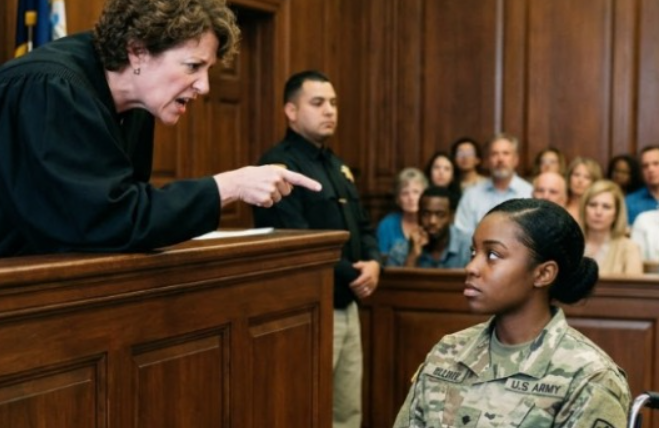
Over the years, Talia Monroe had learned to move silently through the world, almost like a visitor to places never intended for her. At thirty-seven, she moved with poise and awareness, always calculating where she could sit, how long she could stand, and how much pain she could conceal before it became visible to others.
Most people never noticed the prosthetic leg hidden beneath her clothes—until something went wrong, or someone expected her to do something her body simply couldn’t do.
That Tuesday morning, she entered the Jefferson County Courthouse clutching a briefcase filled with medical records and three unresolved parking tickets. The situation was irritating, but normal. Between rehabilitation, visits to the Veterans Affairs clinic, and the unpredictability of her health, small matters sometimes spiraled out of control.
She expected a routine hearing—a fine, a warning, and a quiet return home.
Instead, everything turned out differently.
When her name was called, Talia gingerly stood, leaning on a cane to maintain balance. Judge Marlene Keating barely glanced up before ordering her to “stand tall,” as if her posture alone could erase her body’s limitations.
Talia tried to explain. She told the court that she was standing as best she could.
But the command came again—this time in a harsher tone.

So she adjusted herself, forcing her body into a position it couldn’t hold.
And then she fell.
The sound of her body hitting the floor wasn’t loud, but it was enough to instantly fall silent—the kind of silence that carries shock, discomfort, and something even deeper—understanding.
As she tried to rise, something slipped out of her bag and slid across the polished floor: her Bronze Star medal.
The atmosphere in the room changed immediately.
What had been considered an inconvenience moments earlier suddenly took on significance.
The young lawyer, Evan Brooks, noticed this immediately. He rose, not on impulse but out of a sense of duty, and addressed the court with a calm but decisive urgency that cut through the tension hanging in the air.”WHAT JUST HAPPENED,” HE EXPLAINED, “WASN’T JUST A FALL. IT WAS THE RESULT OF SOMETHING DEEPER—A LACK OF LISTENING, UNDERSTANDING, AND RESPECT.”
They helped Talia up, but this moment could not be undone.
When asked about the medal, she hesitated. The story behind it wasn’t something she shared easily. It belonged to another world—a world of chaos, fear, and sacrifice.
Nevertheless, she told the story.
She described her service as a military medic in Kandahar, pulling wounded soldiers from a burning vehicle after an explosion, and the long, painful journey that followed—a journey that ultimately led to the loss of her leg.
She made it clear that she was not looking for sympathy.
She was there only because life—even after surviving the war—still consists of everyday problems.
The judge changed her tone, softened slightly, and moved on to ending the case, reducing the penalties.BUT SOMETHING HAS ALREADY CHANGED.
Talia didn’t raise her voice, yet when she spoke again, every word carried weight.
She explained that she did not fall through carelessness, but because she was asked to prove something she had already said—that her body had its limits.
And in that moment, the courtroom was forced to confront a quiet truth: harm isn’t always born of malicious intent. Sometimes it’s born of assumptions.
What happened next was not a sudden drama, but a consequence that unfolded slowly.
Talia sought medical attention, documenting her injuries not out of anger but out of necessity. Meanwhile, a video of the incident began circulating online, sparking a debate that extended far beyond that single courtroom.
Questions began to arise.
Not just about one judge, but about a certain pattern.A COURT EMPLOYEE WHO HAD SEEN SIMILAR SITUATIONS BEFORE CAME PRIVATELY WITH DOCUMENTS — CASES IN WHICH PEOPLE WITH VISIBLE AND INVISIBLE DISABILITIES WERE PRESSURED, IGNORED OR HUMILIATED IN SUBTLE WAYS THAT RARELY MADE NEWSPAPER FRONT PAGES.
This time, however, someone did not allow the matter to remain silent.
With Evan’s help, Talia filed a formal complaint—not for revenge, but to establish accountability. That distinction mattered. She didn’t want to destroy the system—she wanted it to function as it should.
Public interest grew, and with it the pressure.
Veterans, activists, and ordinary people began to speak out—not just out of outrage but out of a sense of understanding. Many had experienced something similar, though few had the opportunity or support to speak out.
Finally, Judge Keating requested a formal meeting.
Without a bench between them, without a gown, she looked different—less severe, more human. She admitted her mistake, not as a legal error, but as an error of judgment and a lack of empathy.

IT WASN’T A PERFECT ENDING.
But it was a beginning.
The judicial system has implemented changes: better accessibility procedures, mandatory disability training, and new rules to ensure accommodations are not the exception, but the norm.
The court employee who spoke was given protection.
And Talia—though she never planned it—found herself taking on a new role.
She began helping others navigate the systems that had once overwhelmed her. She spoke not as a symbol but as someone who understood both strength and limitation, both resilience and fatigue.
A year later, she stood—steadily and confidently—at the opening of the new entrance to the courthouse, designed with accessibility in mind.
This time no one asked her to prove where she stood.THEY SIMPLY MADE ROOM FOR SHE TO STAND AS SHE CAN.
When asked if she felt she had won, Talia was silent for a moment before answering.
Because what happened was never about winning.
The idea was for someone to see her.

Perhaps even more importantly, from now on, others would be seen too.
Because dignity is not something a person should have to prove, and respect should not depend on whether someone finally decides to notice it.