Lera had managed her household with care and intention for years. She selected her tools deliberately, stocked her kitchen precisely, and maintained her space the way she wanted. Her husband Alex was supportive in most respects but consistently unwilling to address the one issue that had been eroding their home life for years — his mother Valentina’s uninvited interventions.
Valentina lived in the neighboring building and held a spare key to their apartment. She used it frequently when the couple was absent, entering their home to rearrange cabinets, discard food she deemed suspicious, and replace Lera’s choices with her own. Expensive ingredients were thrown away. Specialized cookware was damaged through misuse. Containers of prepared food were opened, sampled, and returned to the refrigerator. Each time Lera raised the issue, Alex deflected with the same response. His mother was trying to help. She meant well. Lera was overreacting.
The breaking point arrived on Alex’s birthday. Lera had purchased seafood and wine for a planned romantic dinner. She returned home early to find Valentina and several of her friends seated at the kitchen table. The shrimp had been fried with mayonnaise. The wine bottle was empty. Valentina greeted her cheerfully and announced they had prepared a surprise.
Lera said nothing that evening. Over the following three weeks, she executed a detailed plan. She installed two small cameras in the kitchen disguised as ordinary wall chargers. Over fourteen days of recording, she documented eight separate unauthorized visits by Valentina. The footage captured the full range of behaviors — discarding food, misusing equipment, tasting from sealed containers, and disposing of expensive products she did not recognize or approve of.
Simultaneously, Lera compiled a financial accounting of all items destroyed, consumed, or discarded without permission over the preceding six months. Using receipts and bank statements, she documented each loss with dates and replacement costs. The total exceeded two thousand three hundred dollars.
She then had the apartment locks changed without informing anyone.
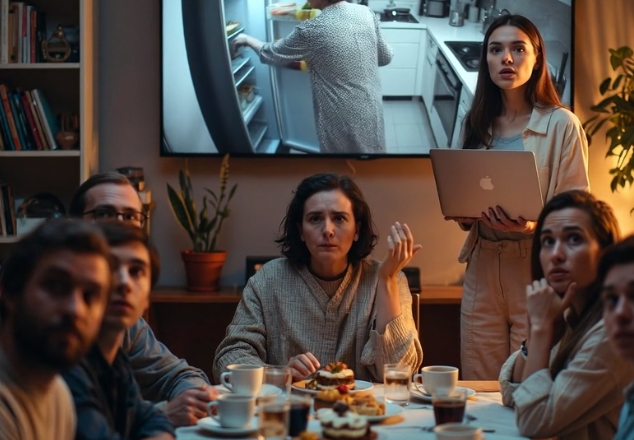
The final element was the venue. Lera organized a family dinner, inviting Alex’s mother, aunt, uncle, cousins, and grandmother. She presented the gathering as a special announcement. Once the meal was complete, she connected her laptop to the television and played a carefully edited compilation of the surveillance footage, narrating each incident with specific dates and costs.
The family watched in silence. The footage was unambiguous. Valentina was recorded entering the apartment with her key, systematically going through kitchen contents, discarding items, damaging cookware, and consuming food from sealed containers. The visual evidence directly contradicted years of characterizing the behavior as helpful or well-intentioned.
Following the screening, Lera presented the printed financial summary. She stated explicitly that she was not requesting reimbursement. The purpose was to establish before the entire family what had actually been occurring, given that her private complaints had been consistently dismissed.
Family members responded with visible shock. One relative questioned specific items shown in the footage. The grandmother addressed Valentina directly with an expression of disappointment that carried more weight than any confrontation could have.
Lera then placed the old spare key on the table and announced that the locks had been changed. She established clear conditions for future visits. Valentina would call in advance. She would not enter the kitchen unsupervised. She would not handle or dispose of any items. She was welcome as a guest on terms that respected the boundaries of the household she was entering.
Lera addressed Alex separately, telling him that continued dismissal of her concerns after viewing the evidence would result in repeat screenings at future family gatherings. Alex apologized that evening with a specificity and sincerity he had never previously demonstrated.
Valentina withdrew from contact for two weeks. When she eventually returned, she arrived by invitation, rang the doorbell, and brought a small cake. She did not enter the kitchen. Seven months later, this pattern has not changed.
The resolution required no raised voices, no threats, and no ultimatums. It required documentation, patience, and the willingness to present the truth in a setting where denial was impossible. The cameras provided evidence. The spreadsheet provided scale. The family dinner provided witnesses. And the lock change provided enforcement.
Lera describes the approach simply. She stopped asking to be believed and started making it impossible not to be.