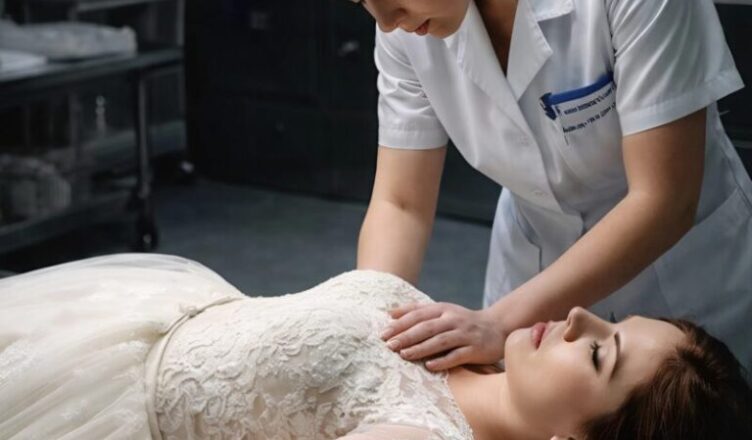
The bride died right in the middle of the wedding and was taken to the morgue, but a morgue attendant noticed something strange: the bride had rosy cheeks like a living person, and her heart was beating 😱
Then something happened that filled everyone with horror 😯
In the morning, an ambulance pulled up to the building. The siren abruptly went silent, and cars decorated with white ribbons and flowers drove into the courtyard. A real wedding procession stopped at the entrance to the morgue. People in formal clothes stood there in confusion; some were crying, others simply stared into space.
The bride was carried in on a stretcher. She was wearing a lace dress, her hair carefully styled. The bouquet still rested on her chest. The groom walked beside her. He was not shouting or sobbing. He looked at her as if everything happening was a mistake.
The attendant watched from the corridor. She had only recently started working at the morgue. At first, she was afraid; at night she dreamed of corridors and cold walls. Once, the chief doctor had told her:
— You shouldn’t be afraid of the dead. The dangerous ones are those who walk around and smile.
Since then, she had treated the bodies calmly. They could no longer harm anyone.
When the relatives were led away, the body was left in the room. The doctor quickly checked the documents and said:
— The autopsy is tomorrow. End your shift today and don’t stay late.
— Is the cause of death confirmed? — the attendant asked.
— Poisoning. Everything is clear, signed. Don’t worry.
He left. The room fell silent.
The attendant remained alone. She stepped closer to the table. The bride looked too peaceful. Her skin was not gray. Her lips were not blue. Her cheeks seemed to glow with a faint blush.
She frowned. It is always cold in the morgue. Bodies turn icy very quickly.
The attendant touched the girl’s hand and jerked her fingers back. The skin was warm.
She touched her again — carefully, as if afraid of being mistaken. Under her fingers she felt the softness of a living body. It seemed to her that the chest barely rose.
— That can’t be… — she whispered.
She pressed her ear to the chest. In the silence of the morgue, a faint, barely audible sound could be heard.
A heartbeat.
The attendant stepped back and covered her mouth with her hand. If she was right, the girl would be buried alive.
She didn’t wait — she ran into the corridor and almost sprinted to the doctor’s office.
— Hurry, come with me. She’s alive. Look at her.
The doctor looked up from his papers with obvious irritation.
— Who is alive?
— The bride. Her body is warm and her heart is beating. I heard it.
He sighed heavily, put down his pen, and reluctantly stood up.
— Let’s go. But if this is imagination again, I’ll write a report about your condition.
They entered the room. The girl lay the same way, motionless, her eyes closed.
The doctor approached, put on gloves, and began the examination. He felt her neck, checked her pupils, placed the stethoscope on her chest.
The attendant watched his face.
— Well? — she asked quietly.
He straightened up.
— The body retains heat during the first hours. That’s normal. You could have confused a pulse with a muscle contraction. After certain poisonings, postmortem reactions occur.
— But I heard her heart.
— You imagined it. We examined her in the admission room. There’s no cardiac activity.
He removed his gloves and threw them into the container.
— Don’t work yourself up. That’s the job. In time, you’ll get used to it.
He left. The attendant remained alone.
She stepped closer to the table again. The girl looked too alive.
A few minutes later, it seemed to her that the bride’s fingers moved slightly.
The attendant leaned down abruptly.
— If you can hear me, give me a sign, — she whispered.
No reaction.
She stood there, trying to convince herself that the doctor was right. That she had really imagined it.
But inside, she felt something different.
That night, she did not go home right away. She returned to the room and checked again — the skin remained warm longer than it should have.
Then she made a decision.
She installed a small camera in the corner of the room, pointing it at the table. She told no one.
In the morning, she arrived earlier than everyone else and locked herself in the storage room. She started the recording.
The first two hours — silence. Then she saw something that filled her with real horror 😱😯 Continued in the first comment 👇👇
Then — movement. The bride took a deep breath. Sharp, as if surfacing from water. Her fingers clenched. Her eyes slowly opened.
The attendant froze in front of the screen. A few minutes later, the doctor entered the room. He wasn’t alone — the groom was with him.
On the recording, the doctor could be heard saying:
— Everything is in order. The dose is calculated precisely. Officially — clinical death. The documents are already prepared.
The groom looked around nervously.
— Hurry. No one must see us.
They helped the girl to her feet. She was weak but conscious. They led her out through the service exit. The attendant sat there without blinking.
Now she understood everything.
There had been no accidental poisoning. The bride had been placed into a deep medically induced coma. Her pulse had slowed to almost imperceptible. For a superficial examination — dead.
Why?
A few days before the wedding, a large life insurance policy had been taken out in the bride’s name. In case of her death, the money would go to her husband.
But most importantly — the girl owned a share in her father’s business. While she was officially alive, no transactions could take place without her signature. After her official death, control would pass to a trusted person — the groom.
The plan was double: collect the insurance payout and transfer the assets. Then the “body” would be cremated without additional examinations.
Judging by the recording, the bride knew about the plan. She agreed to disappear in order to start a new life abroad and escape family pressure.
But they hadn’t taken one thing into account — the attendant who didn’t believe the words “you imagined it.”
She saved a copy of the recording.
And this time, she entered the doctor’s office not alone.