Her Toddler Met the Newborn for the First Time. The Six Words She Said Left the Entire Room in Tears.
When I learned I was expecting a boy, the joy was immediate but quickly followed by a familiar parental anxiety.
Our daughter was only a year and a half old. Everything I had read warned about sibling jealousy in young children — the tantrums, the regression, the feeling of being replaced by someone newer and smaller. I worried constantly about how she would react to no longer being the center of our world.
Throughout the pregnancy I did everything the experts recommended. I talked to her daily about the baby growing inside me
. I told her she was going to be a big sister and that she would have someone to love and protect. She would listen quietly, sometimes touching my belly, sometimes ignoring me entirely to play with her blocks. She was eighteen months old. I could never be sure how much she actually understood.
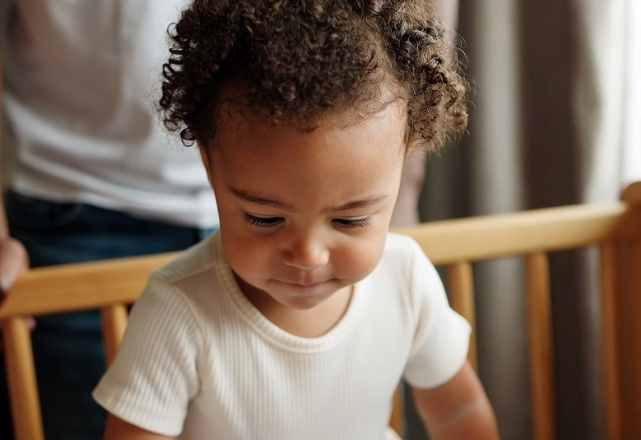
The day came sooner than expected. After the delivery I lay in the hospital room with the newborn bundled in a blue blanket, exhausted but awake. My husband arrived with our daughter. She walked in holding his hand and stopped at the edge of the bed. For a long time she simply stared at the small wrapped shape in my arms. Her expression shifted through several phases — curiosity, confusion, concentration. She scrunched her nose, puffed her cheeks, and furrowed her brow in the way small children do when they are processing something bigger than their vocabulary allows.
Then she spoke. In her small, serious voice, with the careful pronunciation of a child who has only recently learned to assemble words into sentences, she said: don’t worry baby, I’ll teach you everything.
My husband and I were unable to respond. The nurse standing near the doorway quietly left the room. I held both children and cried, not from sadness or relief but from something I still struggle to name — perhaps the sudden understanding that this tiny person had already decided who she was going to be in her brother’s life.
In the weeks that followed she confirmed the declaration with consistent and startling sincerity. When the baby cried at night she would get out of bed and bring her own pacifier to his crib. During feedings she sat beside me and pretended to feed her stuffed animal so her brother would not eat alone. She lay next to him on his blanket and whispered to him. When I asked what she was telling him she answered simply that she was telling him about the world.
She brought him her most treasured toys, including items she had never voluntarily shared with anyone. She attempted to dress him, resulting in socks placed on his hands and mittens on his feet. She invented stories from picture books held upside down and narrated them to him with full conviction. Once I found her standing at his crib, reaching through the bars, patting his stomach and singing a melody she had composed herself. The words were a single repeated phrase: you are small but you are mine.
Every parenting resource I had consulted had prepared me for difficulty. None had prepared me for a child who responded to the arrival of a sibling not with jealousy but with an instinct to protect and to teach. At eighteen months old she could not dress herself or climb stairs unassisted, yet she had independently assigned herself the role of guardian.
She is now four years old and her brother is two and a half. Their relationship includes every expected element of sibling life. They argue over possessions, compete for attention, and engage in the small territorial disputes that define childhood cohabitation. They are loud, messy, and utterly normal.
But every evening, without exception, she enters her brother’s room before he falls asleep. She adjusts his blanket, leans close to his ear, and whispers something I cannot hear. When I asked her what she says to him each night, she looked at me with mild surprise and explained that she tells him not to be scared because she is there.
She cannot tie her shoes. She still asks for help reaching the sink. She occasionally cries when her toast is cut the wrong way. But she has not missed a single night of reassuring her brother since he was born. The devotion is automatic, unforced, and entirely her own.
It began with six words spoken in a hospital room by a girl barely old enough to form complete sentences. She looked at a newborn she had never met and decided, instantly and without instruction, that her purpose was to help him understand the world. She has not wavered from that decision once.
I had spent months afraid she would feel replaced. Instead, she became the most constant, tender, and reliable presence in her brother’s life. We spend so much time worrying about what children will struggle with that we sometimes forget to consider what they are already capable of. They understand love earlier and more completely than we expect. We simply have to stand back and let them show us.