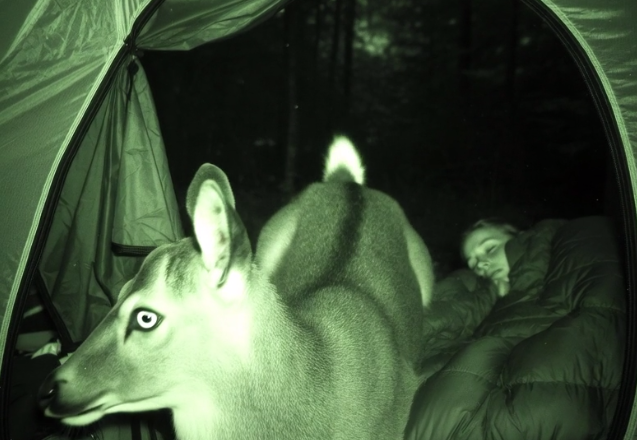
I have always loved extreme activities. Skydiving, mountain climbing, winter camping deep in the wilderness — all of it was never a source of fear for me, only excitement. I loved being alone with nature, testing my limits, and experiencing those moments when the world falls completely silent around you. But what happened on one particular night in the forest changed the way I think about the wild forever.
My friends and I decided to spend a night camping in a remote forest during winter. Snow covered everything. The silence was so complete that the only sounds were the crunch of branches and the occasional gust of wind through the trees. We set up our tents directly on the frozen ground — no platform, no comforts, just sleeping bags and layers of warm clothing. Exactly the kind of experience I always searched for.
Before going to sleep, I decided to set up a night-vision camera near the entrance of my tent. I left the tent flap slightly open, angled the camera to capture both the interior and the area outside, and crawled into my sleeping bag. I was hoping to capture some interesting wildlife footage, perhaps a fox or an owl. Something to share with friends later.
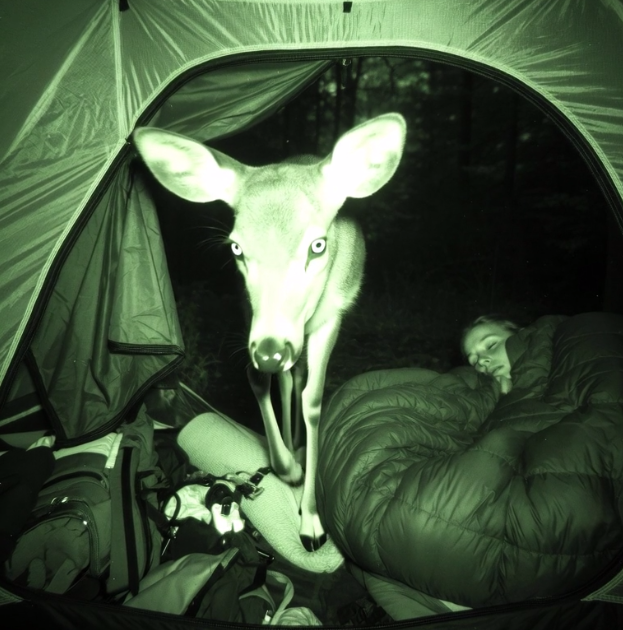
I fell asleep quickly. The next morning, already back at home, I sat down to review the recording. The first several hours showed nothing remarkable — wind, moving branches, the occasional distant sound. I was about to stop watching entirely when the timestamp reached approximately three in the morning.
A small shape appeared at the edge of the frame. A fawn.
Young, thin, alone, with wide cautious eyes that reflected brightly in the night vision. It stood motionless near the tent for nearly a minute, sniffing the air and studying the unfamiliar structure. Then it stepped closer. It paused at the open entrance and seemed to sense that something alive was inside — something large and warm but not moving or threatening.
The fawn stepped through the opening and into the tent.
What happened next was captured in extraordinary detail by the camera. The fawn stood directly beside me, its face centimeters from mine. I could see its breath forming small clouds in the freezing air. It studied my face for what felt like an impossibly long time. Then, with careful deliberate movements, it folded its legs beneath itself and lay down directly beside my sleeping bag. It pressed its body firmly against mine, tucked its head against my chest, and within minutes it was asleep.
It remained there for over three hours. The footage shows it shifting occasionally, nestling closer, and at one point resting its chin on my arm. It was sleeping deeply and peacefully — as though it had found the safest place in the entire forest.
But the recording captured something else. At approximately four thirty in the morning, pairs of glowing eyes appeared among the trees surrounding the tent. At least two animals, possibly three, were circling the campsite at a distance of roughly fifteen meters. Their movement was slow and deliberate, characteristic of predators tracking prey. One approached closer, paused, and then retreated. They circled the area for nearly forty minutes before disappearing into the darkness.
I later showed the footage to a friend who works as a wildlife biologist. His assessment was immediate and sobering. The fawn was almost certainly orphaned or had become separated from its mother. Alone in winter, a young deer of that size would be extremely vulnerable to predators, particularly at night. The fawn had detected a large warm body inside the tent and made what amounted to a survival decision. By lying against a human, inside an unfamiliar structure that smelled of people, the fawn created a deterrent that predators would not risk approaching. It was not an accident or simple curiosity. It was a calculated choice to trust an unknown creature in exchange for protection.
The predators visible in the footage were almost certainly tracking the fawn. Their path led directly to the tent. But the presence of a human and the unfamiliar scent and structure of the camp kept them at a distance. The fawn survived the night because it chose to lie beside me.
At six twelve in the morning, just before dawn broke through the trees, the fawn raised its head. It stood slowly, looked directly into the camera lens for a single brief moment, then turned and walked out of the tent into the gray morning light. It disappeared between the trees without looking back.
I slept through everything. The predators circling my tent. The fawn pressing against my body for warmth and safety. All of it. I had no awareness that a small, frightened animal had chosen me as its protector and that my presence alone had kept it alive through the most dangerous hours of the night.
I returned to the same location two weeks later. I brought food and set up the camera again. The fawn never appeared. I have been back three times since, and each time the forest is empty and silent. I do not know whether the fawn survived. I hope that it did — that somewhere in that forest it found another source of warmth and safety.
But I will never forget that single moment captured on camera — the second before it left, when it looked directly into the lens as if it understood that something important had happened between us in the dark.