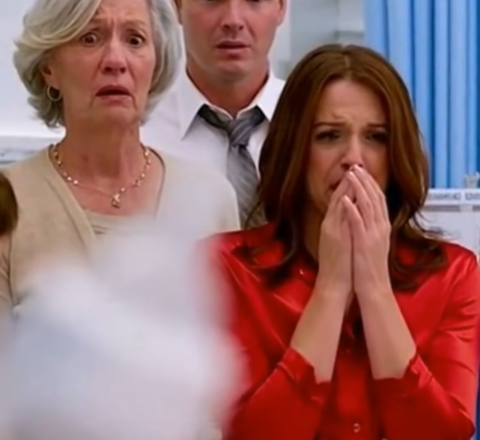
The atmosphere within St. Jude’s Maternity Ward didn’t just change; it curdled. One moment, the air was thick with the cloying, stagnant weight of a grief so profound it felt like drowning. The next, it was pierced by a sterile, rhythmic urgency. It was a symphony of friction—the squeak of rubber soles on linoleum, the distant, frantic trill of a receptionist’s phone, the heavy thud of the security bolts engaging at the ward’s entrance.
I sat perched on the edge of the adjustable hospital bed, my body feeling like an intricate sculpture made of glass and old bruises. My heart thrummed against my ribs, a trapped starling desperate for exit. In the corner, a police officer stood, his uniform a jarring, obsidian blot against the pastel-colored walls. Another arrived, then a third.
Outside in the hallway, the world was fracturing. I could hear Margaret’s voice—sharp, clarion, and terrifyingly certain. She wasn’t weeping for her grandson. She was chanting, a mixture of psalms and venomous indictments, her words echoing through the corridor like a herald of the apocalypse. Following her was Claire, my sister-in-law, whose lamentations were high and thin, a dissonant whine claiming it was all a catastrophic misunderstanding, a trick of the light, a figment of a child’s imagination.
And then there was Daniel. My husband.
He stood framed in the doorway for a heartbeat, his hands trembling so violently he had to shove them into his pockets. He was whispering my name, over and over, but the syllables sounded foreign to him, as if he were trying to recall the name of a stranger he’d met in a dream. I didn’t answer. I couldn’t. I was looking at the nurse’s cart.
The investigators moved with a cold, surgical precision. They seized the feeding bottle—the one that had been resting so innocently on the bedside table. They wheeled away the cart. They took my statement, my voice a dry rattle that felt like it was being scraped from the bottom of an empty well.
I didn’t know then that the milk wasn’t just milk, and the family I had married into wasn’t just a family—it was a cult of genetic purity that had just claimed its first victim.
The toxicology results arrived with a speed that felt like a secondary assault. Usually, the wheels of hospital bureaucracy grind slow, but when a newborn dies under a cloud of suspicion, the world moves at the speed of a lightning strike.
The lead investigator, a woman named Detective Miller with eyes like flint, walked into my room three hours later. She didn’t offer a platitude. She offered a revelation.
“The substance we found in the infant’s formula,” she began, her voice a low, steady hum. “It’s a high-potency calcium channel blocker. In a healthy adult, it regulates a heartbeat. In a six-pound newborn, it’s a shutdown switch.”
I felt the blood drain from my face, a cold numbness spreading from my scalp to my toes. It was Margaret’s medication. I had seen the amber vials in her purse for years. She had taken those pills for her “fluttering heart”—the heart she claimed was the only thing keeping the Vane Family legacy alive.
She hadn’t just been careless. She hadn’t left a pill on the floor. The lab report indicated the tablets had been meticulously pulverized. It was a recipe. A deliberate, measured titration of death.
“I was protecting the bloodline,” Margaret had shrieked as they led her toward the elevator in handcuffs. I heard it through the thin walls. “Elena is weak! She carries the rot of her mother’s melancholia! I would not have another Vane raised in the shadow of a broken mind! God will see the mercy in my hands!”
The utter conviction in her voice was the most terrifying part. She wasn’t a woman who had snapped; she was a woman who had performed a duty. She viewed my history with postpartum struggle not as a hurdle to be cleared with love, but as a “taint” that needed to be pruned from the family tree before it could take root.
Before the sun had even begun to bleed over the horizon, Margaret Vane was processed and charged with first-degree murder. The matriarch had fallen, but the rubble she left behind was still shifting.
I looked at the empty bassinet, the plastic sides reflecting the harsh fluorescent lights, and realized that my son had been executed by his own grandmother before he had even learned the shape of her face.
While Margaret was being fingerprinted, Claire was sequestered in an interview room two floors down. For hours, she clung to her “misunderstanding” narrative until the weight of the evidence began to crush her resolve.
I stood behind the one-way mirror in the observation deck, a ghost watching the living. Claire finally broke. She admitted she had seen her mother hovering over the cart. She had watched Margaret’s hands—those manicured, lethal hands—fumbling with the bottle while the nurse was occupied with a patient in the next bay.
“I thought she was just… checking the temperature,” Claire stammered, her mascara running in jagged black rivers down her cheeks. “Mother always knows best. I didn’t want to cause a scene. I didn’t want to ruin the christening plans.”
Her silence had a price. Five minutes of quiet had bought her a charge of accessory after the fact. Her vanity and fear of maternal disapproval had been the silent partner in Evan’s death.
Then came Daniel.
He sat in the interrogation chair, looking smaller than I had ever seen him. He wept, but they weren’t the tears of a grieving father; they were the tears of a man who realized his cowardice had finally caught up to him. He confessed that Margaret had been whispering in his ear for months. She had warned him about “tainted genetics.” She had told him that marrying me was a mistake that would “dilute the strength” of the Vane name.
“I thought it was just her being… old-fashioned,” Daniel choked out, his voice cracking. “I never thought she’d… I knew she was capable of being cruel, but I didn’t think she was capable of being a monster. I should have stopped her. I should have stayed in the room.”
Listening to him, I felt a terrible, cold clarity. The betrayal wasn’t just the pill in the milk. The betrayal was the years of quiet compliance, the way he had allowed his mother’s poison to seep into our marriage long before it ever touched our son.
My eight-year-old, Noah, was sitting in the waiting area with a social worker. When I finally went to him, he didn’t ask for his father. He didn’t ask for his grandmother. He looked up at me with eyes that had seen too much for a child of his age.
“Is the baby cold, Mommy?” he whispered. “Grandma said he was going to sleep, but he looked so cold when they took him away.”
I held him, my tears finally breaking through the ice, and I knew that while Margaret had killed Evan, the entire family had built the scaffold.
The week that followed was a blur of headlines and flashbulbs. The story of the “High Society Poisoning” at St. Jude’s was exactly the kind of tragedy the media fed upon. News vans lined the street outside our home like scavengers. The comment sections of every major outlet became a digital coliseum where strangers debated our lives, our “genetics,” and the intersection of religious fervor and homicide.
Daniel moved his things out of the house on a Tuesday. I didn’t help him, but I didn’t hinder him either. I watched him pack his bags with the same detached interest one might give to a documentary about a disappearing species.
“Can you ever… do you think there’s a world where you forgive me?” he asked, standing by the front door with a suitcase in each hand.
I looked at him, and all I could see was the moment he had turned his back to me in the hospital room, his posture one of avoidance while our son’s life was being extinguished.
“Forgiveness is a spiritual matter, Daniel,” I said, my voice like steel. “Trust is a matter of safety. And I will never be safe with you again. Our son isn’t here to forgive you, so don’t ask me to do it for him.”
The hospital’s internal review was equally damning. The nurse had been away from the cart for exactly eighty-seven seconds. A minute and twenty-seven seconds—the total time required to destroy a lifetime. The hospital administration offered me a formal apology and a settlement offer that contained more zeros than I could count. I shoved it into a drawer. No amount of currency could buy back the sound of Evan’s first cry.
Noah became my anchor, but even he was drifting. He stopped playing with his Lego sets. He started carrying a small blue blanket that had been meant for his brother. He told me he would have taught Evan how to ride a bike. He told me he would have protected him from the “bad milk.”
Every time he spoke, I felt a fresh wave of guilt. I had brought him into this family. I had ignored the red flags of Margaret’s obsession with “purity” because I wanted to believe in the fairy tale of a stable, wealthy dynasty.
The trial was set for the autumn, and as the leaves began to turn into the colors of bruised fruit, I realized I was the only person left who was willing to tell the truth without a script.
The trial lasted eight grueling months. The courtroom was a theater of the macabre. Margaret Vane sat at the defense table like a fallen queen, her hair perfectly coiffed, her expression one of wounded dignity. She didn’t shed a single tear when the autopsy photos were displayed. She didn’t flinch when the audio of the 911 call was played.
She only cried once: when the prosecution detailed the loss of the “family’s reputation” and the seizure of her assets to pay for her legal defense. She wept for the marble and the name, but never for the flesh and blood.
The jury took less than four hours to deliberate. The verdict for Margaret was unanimous: Guilty of first-degree murder. She was sentenced to life without the possibility of parole. As they led her away, she looked at me—not with remorse, but with a cold, lingering hatred, as if I were the one who had failed her.
Claire took a plea deal, trading her testimony against her mother for a reduced sentence of five years for child endangerment and accessory. She went to prison a shell of a woman, her vanity stripped away by the harsh reality of a jumpsuit.
The divorce from Daniel was finalized in a quiet office with a notary who didn’t look us in the eye. He signed the papers with a hollow gaze, his signature a shaky scrawl. He moved to a different city, sending birthday cards for Noah that remained on the kitchen counter for a week before being moved to a box in the attic.
Noah and I left the state. We moved to Oregon, to a small town where the trees were tall enough to hide us and the air didn’t smell like hospital disinfectant. We bought a house with a backyard where the afternoon sun hit the grass in a way that felt like a warm hand on our shoulders.
I began volunteering with hospital advocacy groups. I didn’t want a settlement; I wanted a change. I pushed for stricter access controls in maternity wards, for biometric locks on nurse’s carts, for the end of the “eighty-seven-second” window. Today, there is a safety protocol in three major hospital chains named the Evan Vane Policy.
People see me at conferences or in the news and call me “strong.”
They are wrong.
I am not strong. I am simply awake. And the wakefulness is a heavy burden to carry when you know exactly what the world is capable of doing to the innocent.
Life in Oregon is quiet, but it is not silent.
Noah is sixteen now. He’s tall, with none of the Vane features—he looks like my side of the family, a fact that brings me a fierce, private joy. He still talks about Evan. He talks about him as a presence, a brother who grew up in his mind even if he didn’t in the world.
“Do you think he knows I’m the one who told the truth, Mom?” he asked me recently, while we were planting a dogwood tree in the garden.
“I think he knows you were his hero, Noah,” I said, leaning on my shovel. “You were the only one who had the courage to speak when everyone else was trying to hide the shadows.”
I still get letters from prison. Margaret sends them once a month. I can tell by the handwriting on the envelope—the elegant, archaic loops of a woman who refuses to believe she is no longer a queen. I don’t open them. I have a small metal bin in the garage where I burn them, watching the smoke rise into the crisp mountain air.
Daniel’s cards still arrive, too. He’s remarried now, I hear. I hope his new wife doesn’t have a mother with a “fluttering heart.” I hope he’s learned how to stand with his face to the wind.
Sometimes, late at night, I find myself standing in the kitchen, staring at the gallon of milk in the refrigerator. I think about how fragile life is, how easily a legacy can be turned into a weapon, and how a family’s pride can become a child’s tomb.
But then I hear Noah laughing in the other room, or I feel the solid, honest weight of the floor beneath my feet, and I remember the moment the truth was saved. It was saved by a little boy who saw a grandmother reach for a bottle and knew, even then, that love shouldn’t look like that.
Evan is gone, but the truth remains, unvarnished and jagged. It is the only thing Margaret couldn’t crush. It is the only thing Daniel couldn’t hide.
I am not a victim. I am a witness.
And as the sun sets over the Cascade Mountains, I realize that I am finally, truly, free of the Vane bloodline. My son’s name is on a policy that saves lives, and my other son’s heart is full of the truth.
That is the only dynasty I ever needed to build.
I look at the nurse’s cart in my memory one last time and then, finally, I close my eyes and sleep.