The Sunday Everything Changed: A Mother’s Reckoning
I never imagined that the darkest chapter of my life would begin on a calm, sun-drenched Sunday afternoon, right outside the manicured lawn of my own daughter’s home.
The sky was a piercing, innocent blue. The kind of blue that belongs in children’s drawings, not in a nightmare. I had only come to drop off paperwork—a sheaf of insurance documents my daughter, Megan, had requested with urgent, impatient texts weeks earlier. The street felt aggressively peaceful: children were weaving circles on bicycles, their laughter drifting on the breeze; neighbors were tending their hydrangeas, the rhythmic snip-snip of shears the only real sound. Everything looked perfectly, deceptively ordinary.
I adjusted the folder in my hands, taking a breath to steady my nerves. My relationship with Megan and her husband, Jason, had been strained for months, a tightrope walk over a chasm of unspoken grievances. But I was a mother. I told myself that showing up, being helpful, was the bridge I needed to build.
That sense of normalcy vanished the instant I crossed the threshold.
I didn’t even have time to adjust my eyes to the dim interior before the atmosphere hit me—thick, heavy, and smelling of stale alcohol and aggression.
“You shouldn’t be here,” Jason snapped. He didn’t greet me. He didn’t look up from the kitchen island where he stood, gripping a glass so tight his knuckles were white.
“I’m just returning these,” I said, my voice sounding too loud in the tense silence. I lifted the manila folder, offering it like a peace offering. “Megan asked me to—”
I didn’t get another word out.
Jason moved with a speed that defied his size. His fist struck without warning, a blur of motion that I couldn’t process until the impact exploded against the side of my face. The blow sent me crashing to the floor, my head slamming against the cold ceramic tile.
My vision flashed white, a silent supernova of pain. For a second, the world tilted on its axis. I gasped, trying to fill my lungs, but the air seemed to have been sucked out of the room.
Before I could cry out, before I could even comprehend that my son-in-law had just assaulted me, hands grabbed me. Not to help.
Megan. My daughter. The girl I had nursed through fevers, the woman I had walked down the aisle. She grabbed me by the hair, her fingers twisting into the roots with a viciousness that felt personal. She dragged me across the living room carpet, my scalp burning, my fingernails scraping helplessly along the floorboards as I tried to find purchase.
“Get her out,” Jason ordered, his voice terrifyingly calm.
Megan pulled me toward the front door as I begged her to stop, my voice trembling and barely sounding like my own. “Megan, please! It’s Mom!” I wheezed, the words bubbling up through a throat constricted by terror.
She didn’t stop. She didn’t even look at me. She yanked the door open, and the sudden influx of bright sunlight blinded me. But the light brought something else with it—witnesses.
Neighbors stood frozen on the sidewalk. Mrs. Halloway, who was watering her petunias, dropped her hose. A man walking his dog stopped mid-step. Someone gasped. Another person lifted a phone.
Megan bent down close to my ear. I expected an apology, a moment of realization. Instead, her voice was flat, emotionless, and colder than the grave.
“Leave. It’s three million,” she hissed, the venom dripping from every syllable. “You’re not getting a single dollar of Dad’s money.”
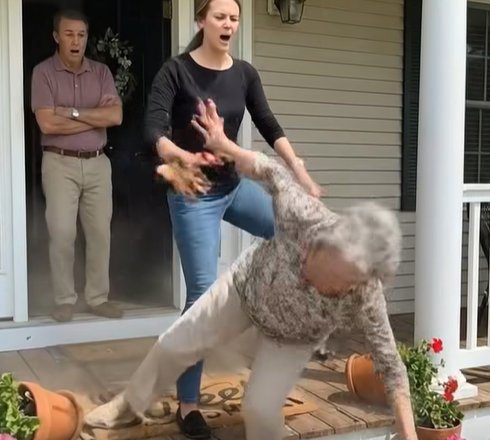
Then, with a final, violent shove, she pushed me off the porch.
I hit the concrete walkway hard, pain tearing through my ribs like a jagged knife. The breath left my body in a pained whoosh. Behind me, the heavy oak door slammed shut, the deadbolt clicking into place with a sound of finality.
I lay there on the ground—bleeding, humiliated, wrapped in a stunned silence that felt louder than a scream. I tasted copper in my mouth. My cheek throbbed in time with my racing heart.
Jason and Megan believed fear would keep everyone quiet. They were banking on the suburban code of silence—that people would look away, mind their own business, and let the “family dispute” resolve itself behind closed doors. They thought I was done. They thought I was broken.
They were wrong.
Because behind me, Mrs. Halloway had already dialed 911.
As I lay there trembling, staring at the cracks in the pavement, I had no idea that sirens were already racing toward a moment that would tear apart the life my daughter and her husband believed was untouchable.
The sound grew louder with every beat of my heart, a rising wail that cut through the humid afternoon air.
By the time the patrol cars screeched to a halt, lights flashing red and blue against the serene suburban backdrop, I was sitting on the curb. Someone had draped a fleece jacket over my shoulders. My hands were shaking uncontrollably, vibrating with the shock. A woman I barely knew—a young mother from three houses down—was holding my arm, whispering, “You’re safe now. Don’t worry, you’re safe,” again and again, like a mantra.
The police officers didn’t hesitate. They were professionals, trained to read the chaotic language of violence. They took in my bruised face, which was already swelling into a grotesque mask of purple and blue. They noted the strands of grey hair stuck to the wool of my coat. They saw the blood on my mouth.
They marched up the walkway and knocked firmly on the door.
Jason answered. I watched from the curb, a strange detachment settling over me. His confidence, usually so impenetrable, evaporated the instant he saw the uniforms.
“What’s going on?” he asked, forcing a casual calm into his voice, though his eyes darted nervously toward the gathered crowd. “We were just having a disagreement with my mother-in-law. She’s… she’s not well.”
He didn’t get far with that narrative.
“I saw him hit her,” Mrs. Halloway said, stepping forward from the edge of her lawn. Her voice was shaking, but clear. “I was right there. He struck her down, and the daughter dragged her out by her hair like an animal.”
“I saw it too,” the man with the dog added, stepping closer to the officers. “She didn’t do anything. They threw her onto the concrete.”
Another voice confirmed it. Then another. The wall of silence Jason had counted on had crumbled.
The officers stepped inside.
I heard Megan begin to cry almost immediately. It was a sound I knew well—the same practiced, high-pitched sobbing she had used since childhood whenever she was caught in a lie. It was a performance designed to elicit sympathy, to paint herself as the victim.
“She fell!” Megan wailed, her voice carrying out to the street. “She attacked us! We were just trying to get her out of the house for her own safety!”
But lies don’t survive when the truth has witnesses. And in the modern world, the truth often has video evidence.
The police separated them, questioned everyone, and reviewed cell phone videos neighbors had already recorded. The footage was damning. Jason striking me. Megan pulling my hair, her face twisted in rage. My body hitting the ground, limp and defenseless.
Minutes later, Jason was led out of the house.
His hands were cuffed behind his back. His head was ducked low, but I caught his eye for a fleeting second. There was no remorse there—only fury that his plan had been interrupted.
Megan screamed as they led him away—not out of sorrow, but out of fear. She stood in the doorway, pale and shaking, realizing her shield was gone.
An ambulance arrived shortly after. As the paramedics loaded me onto the stretcher, an officer leaned in, his expression grim but kind.
“Ma’am,” he said gently. “We have enough here for felony assault. Do you want to press charges?”
I looked at the house. The home I had helped them buy. I thought of the little girl I used to read bedtime stories to, the girl who was now screaming about “three million dollars” while I bled on the pavement.
“Yes,” I answered, my voice raspy but resolute. “I want to press charges.”
The hospital was a blur of fluorescent lights and sterile smells. Doctors confirmed a severe concussion, three cracked ribs, and extensive soft tissue injuries to my neck and scalp.
But as I lay there staring at the tiled ceiling, waiting for the pain medication to dull the throbbing in my skull, the physical pain felt distant. What hurt more was the clarity.
The “three million” Megan had screamed about—it wasn’t a random number. It was my late husband’s estate. It was money intended for my retirement, for my care, and eventually, for them. But they hadn’t wanted to wait.
The days that followed blurred into a procession of police statements, medical reports, and court appearances. But what surfaced during the investigation stunned even me.
The assault was just the tip of the iceberg.
Detectives, digging into the motive behind the attack, uncovered a web of financial deceit that took my breath away. The “three million” wasn’t just an inheritance they were waiting for; it was money they had already tried to access.
They found forged documents. My signature, copied with practicing precision, on loan applications. Attempts to access my retirement accounts. They had been trying to have me declared incompetent—using the very “medical issues” Jason had hinted at to the police—to seize power of attorney.
The investigation expanded. The District Attorney’s office took an interest. This wasn’t just a domestic dispute anymore; it was fraud, elder abuse, and conspiracy.
Their accounts were frozen. Their home—the stage of my humiliation—was flagged as an asset in a criminal investigation. Jason lost his high-paying job in finance the moment the arrest record went public. In his industry, trust is currency, and he was now bankrupt in every sense of the word.
Megan’s carefully crafted image collapsed overnight. The “perfect mother,” the “devoted daughter”—it all dissolved.
She called me three weeks after the incident. I was staying in a temporary apartment, recovering. The phone rang from a blocked number.
I answered, wary.
“Mom?” Her voice was small, trembling. “Mom, please. You have to stop this. Jason… they’re talking about prison time. We’re losing the house. Please, just tell them it was a misunderstanding. Tell them you fell.”
She was crying, begging me to make it go away. Just like she always had. Fix it, Mom. Make the bad thing go away.
For forty years, that had been my job. To absorb the pain. To smooth over the cracks. To pay the debts.
I held the phone to my ear, listening to her sobs, and I felt… nothing. The well of maternal guilt had finally run dry, drained by the memory of her hands dragging me across the floor.
“I didn’t fall, Megan,” I said quietly.
“Mom, please! Don’t do this to family!”
“I’m not doing this to you,” I replied, my voice gaining strength. “You did this to yourself. You chose money over your mother. Now you can keep the consequences.”
I hung up.
For the first time in my life, I wasn’t shielding her. I was choosing myself.
The trial moved quickly.
In the face of video evidence and neighbor testimony, there was nowhere for them to hide. Jason’s high-priced lawyer tried to paint me as an aggressor, an intruder in their home, but the jury saw the photos of my bruised face. They saw the video of Megan shoving me off the porch.
Jason was convicted of aggravated assault and attempted fraud. He was sentenced to five years in state prison.
Megan was charged as an accomplice to the assault and a primary conspirator in the financial fraud. She avoided prison time only by taking a plea deal that left her with a felony record, five years of probation, and a mountain of restitution she would be paying off for the rest of her life.
The lifestyle they had flaunted—the luxury cars, the tropical trips, the expensive Italian furniture—had been built on a foundation of debt, intimidation, and deceit. When the truth came out, it all fell apart like a house of cards in a hurricane.
The bank foreclosed on the house. The neighbors who had witnessed the attack watched as the moving trucks came—not to move them to a bigger mansion, but to clear out the remnants of a shattered life.
I didn’t go to watch. I didn’t need to see it.
I moved into a small, quiet apartment on the other side of town, far from that street, far from the door that once slammed in my face. It has a balcony with a view of the park, and in the mornings, I drink my coffee and listen to the birds.
Healing wasn’t easy. My ribs mended within months, but the cracks in my heart are permanent. Some nights, I still wake up in a cold sweat, hearing my daughter’s voice—cold, distant, unrecognizable—hissing about money. I still flinch when a door slams too hard.
But I also wake up breathing freely.
People often ask me the difficult question, usually in hushed tones over tea: How could your own child do that to you?
I don’t have an easy answer. I don’t think I ever will. But I’ve learned a hard, necessary truth—love without boundaries is not love. It is permission for cruelty.
I loved my daughter so deeply that I ignored the warning signs for years. I excused her rage as “stress.” I softened her lies to protect her potential. I told myself that family was worth any amount of pain, that a mother’s job was to endure.
Until enduring nearly destroyed me.
If Mrs. Halloway hadn’t called 911 that day, I don’t know where I’d be now. Maybe still silent. Maybe still afraid, signing papers I didn’t understand just to keep the peace. Maybe I wouldn’t be here at all.
That’s why I tell this story. Not for pity, but for the woman who might be reading this right now—the woman who is walking on eggshells in her own home, the man who is making excuses for a partner’s rage, the parent who is afraid of their own child.
If someone you love hurts you, humiliates you, or puts your safety at risk, asking for help is not betrayal. It is survival.
We are taught that blood is thicker than water, but sometimes, blood is just a stain that needs to be washed away so you can finally heal.
If this story made you pause or recognize something familiar in your own life, please share your thoughts. Somewhere, someone may be lying on a metaphorical sidewalk right now, wondering if anyone will step in. Sometimes, one phone call—or one moment of courage—is all it takes to end a lifetime of abuse and reclaim your life.