My parents once labeled me as “untrustworthy,” a word that cut through me like shards of glass, leaving an indelible mark. For seventeen years, their verdict hung over my life like a shadow, dictating my choices, fueling my resolve. But when the invitation to my brother’s wedding arrived, I saw an opportunity to redefine the narrative they had written for me.
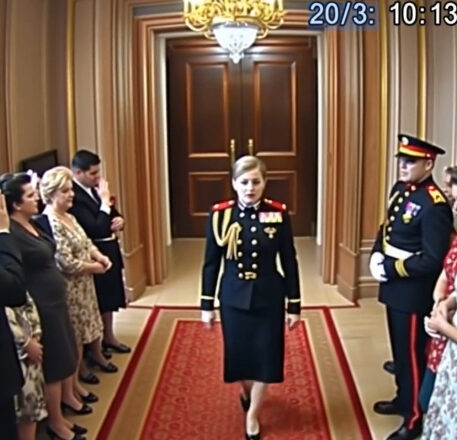
The countryside estate that hosted the wedding was a monument to their world—a world of white columns, manicured lawns, and social niceties. It was a world that had never suited me, a world that seemed to demand perfection while silencing anything that fell short of its ideals. As I stood at the entrance, my dress uniform pressed and pristine, I knew this was the moment to reveal the truth they had ignored.
Inside, the festivities were in full swing. Laughter danced across the room, blending with the soft notes of a string quartet gliding through a Sinatra classic. I watched from the threshold, my presence unnoticed, my name absent from any seating chart, program, or slideshow. In their curated display of family perfection, there was no room for the daughter they once deemed untrustworthy.
Their ignorance of my presence was almost palpable. As they toasted my brother’s accomplishments, I thought of the years I’d spent building my own. While they polished their social graces, I had honed my voice to carry over the chaos of a battlefield. While they cast me aside, I had risen through the ranks, earning the respect that comes unbidden, conveyed through salutes rather than introductions.
I hadn’t come to disrupt their celebration. I was there to assert my place in a family that had attempted to erase me. I was there to be recognized—not for vengeance, but for vindication.
The room quieted as the host stepped up to the microphone, an envelope in hand. His tone shifted, trading celebration for solemnity. “Before the next toast, we have a special recognition from the U.S. Army for a guest here this evening…”
The atmosphere changed immediately. Glasses hovered in mid-air, and whispers stilled. My father frowned, perceiving the announcement as an intrusion, unaware of the significance that would soon unfold. An officer entered, his movements precise and deliberate, a presentation case held with reverence. Our eyes met, and in that moment, I felt the weight of seventeen silent years solidify into something unbreakable.
This wasn’t a spectacle; it was a testament. Not an interruption, but an acknowledgment. The officer halted in front of me, and as the host’s eyes met mine, realization dawned. The story had shifted. The narrative they had clung to for so long was unraveling.
There are moments that define a collective memory—a cork’s pop, a fork’s clatter, the sudden stillness of anticipation. This was such a moment. As I stepped forward, the room seemed to hold its breath, the air heavy with expectation.
The violinist’s bow paused on the string, and in that silence, the truth stood unyielding. I wasn’t there to seek an apology or offer explanations. I was there to have my name spoken, with all the honor it deserved. And when it finally came, it was not just a name—it was a declaration that transformed the very air of the room.