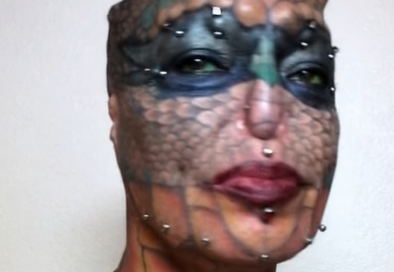
When Tiamat Medusa walks through a crowd, the air always changes. Heads turn, conversations pause, and eyes widen in disbelief. Her skin glows with scales of green and blue, her tongue moves in two directions, and horn-like implants crown her forehead. Some call her a demon, others call her divine. But Tiamat doesn’t mind any of it. For her, this body is not a costume — it is freedom, truth, and rebirth.
Long before she became Tiamat Medusa, she was Richard Hernandez, a banker in a dark suit who lived an invisible life behind glass doors and fluorescent lights. Every day began with the same coffee, the same tie, the same polite smiles. To everyone else, Richard was successful, stable, predictable. Inside, however, a storm grew louder. The face in the mirror felt like a lie, a mask the world forced upon a soul that was dying in silence.
One night, after working late, Richard sat alone in the parking lot, staring at the city lights flickering against the windshield. That was when the thought arrived — sharp and unstoppable: “If I died tonight, the world would never know who I truly was.” The next morning, he didn’t go to work. Instead, he went to a tattoo studio downtown. It was the first step of a transformation that would erase Richard forever.

The first tattoo was small, a serpent winding along the wrist. But once the needle touched skin, something awakened. The pain felt like honesty. Soon one tattoo became ten, then twenty. The banker’s skin turned into a map of symbols — each one a confession, a scar, a rebirth. Friends laughed. Coworkers whispered. His boss called it “a phase.” Richard only smiled. They have no idea, he thought. The phase is life itself.
Then came the accident. A car crash that left him broken in a hospital bed for months. He said later that during those nights, floating between life and death, he heard a voice — soft but ancient — whispering his new name: Tiamat. The primordial goddess of chaos and creation. When he finally opened his eyes, he knew the man named Richard was gone.
What followed was a decade-long metamorphosis. Tattoos covered every inch of skin. Subdermal implants created ridges that looked like scales. The nose was reshaped, the ears modified, the eyes tinted. The tongue was split in two, like a serpent’s. Each procedure brought more stares, more judgment, but also more peace. “Every cut,” she said later, “was a doorway back to myself.”.

Neighbors avoided her. Children pointed. Photographers chased her through festivals. The internet labeled her The Dragon Lady. She smiled at the name — dragons are symbols of power, not monsters. She had become exactly what she once feared: unforgettable.
Yet behind the fierce exterior, Tiamat kept one secret close to her heart. Long before the transformation, Richard had a son — a quiet boy who loved to draw dragons in notebooks. When Richard began to change, he lost contact with him. The child’s mother moved away, and letters went unanswered. Tiamat carried that silence like a stone, pretending it didn’t hurt.
Years later, after dozens of surgeries and interviews, she became a symbol for those who lived between worlds — between genders, between realities, between expectations. People traveled across oceans to meet her, seeking courage to transform their own lives. “Be who you are,” she would tell them. “Even if the world calls you impossible.”
During one public talk, a journalist asked, “Do you ever miss the old Richard?” The audience fell silent. Tiamat’s reptilian eyes softened. “Richard isn’t gone,” she said slowly. “He simply shed his skin.” The crowd applauded, but inside her chest, an ache pulsed — an old wound that no surgery could erase.

That night, after everyone left, she sat alone in her dressing room. The mirror reflected her scaled face under the cold light. On the table lay a faded photograph she kept hidden — Richard in a park, holding the hand of a small boy. Tears welled up. “Would you even recognize me now?” she whispered.
Months passed. One afternoon, while attending an art event, a young man approached her nervously. He held that same photograph. “Are you… my father?” he asked. Tiamat froze. The room went silent. Cameras clicked. Her heart, the same human heart beneath the tattoos, began to race.
“I was your father once,” she whispered. “But now I’m something else.”
The young man smiled through tears. “Then maybe you’re the mother I never had.”
In that instant, years of pain melted away. They embraced — the serpent and the child — and the crowd around them began to clap, unaware that they were witnessing the real miracle of transformation.
After that day, Tiamat spoke less about rebellion and more about reconciliation. She often said that transformation was not about running from who you were, but learning to love every version of yourself — even the broken ones. Her social media posts turned softer: photos of sunsets, poems about rebirth, drawings of dragons coiled around hearts.
Still, whispers followed her everywhere. Some accused her of madness, others praised her bravery. But she had stopped caring. “The world fears what it doesn’t understand,” she told her son one evening. “But fear is only the first step toward wonder.”
Years later, when Tiamat’s story was adapted into a documentary, she agreed to show the world her journey — from the banker’s office to the operating room, from fear to freedom. The film ended with a close-up of her face, the scales glistening under soft light, as she spoke the final words: “I became what I was always meant to be — a creature of love disguised as chaos.”

After the premiere, she disappeared from the public eye for a while, moving to a quiet desert town. Locals say she still walks at dawn, her silhouette glowing under the rising sun, the sand reflecting off her emerald tattoos. Some believe she meditates beside an old stone altar, whispering to the wind. Others claim they’ve seen a young man visit her every spring, carrying flowers and a sketchbook.
No one knows exactly what happened after that, but one rumor persists: that Tiamat, after years of searching, finally found peace — not in changing her body, but in understanding that love itself is the ultimate transformation.
Today, her photographs continue to circulate online. Some viewers react with horror, others with awe. But those who look closely say they can see it in her eyes — a quiet warmth beneath the scales, proof that even the most radical metamorphosis begins with a single, fragile human heartbeat.
And if you ever find that old picture of Richard Hernandez, smiling beside his son, look carefully. In the background, reflected faintly in the park fountain, is a serpentine shadow watching over them. Perhaps that is Tiamat Medusa herself — half-myth, half-mother — reminding the world that beauty can be terrifying, and freedom sometimes looks like a dragon’s smile.