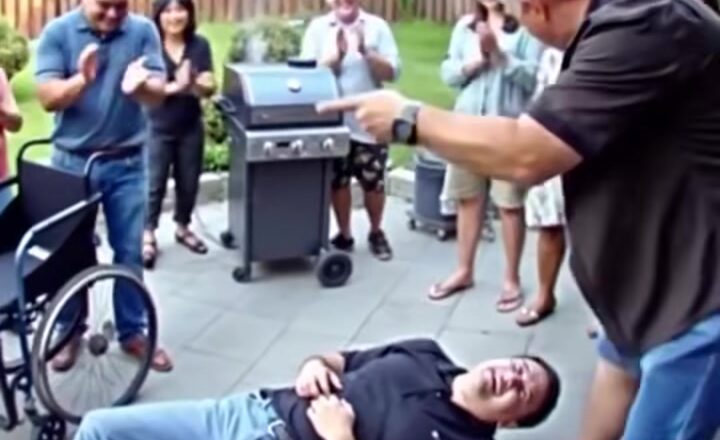
The voice cut through the chaos like a knife through butter. In the midst of the swirling confusion, the loud, accusing shouts, and the restless shuffling of feet.
One sound anchored the moment with an almost surgical precision. Dr. Harris, my physician and the one person who had been with me through the darkest and most grueling moments of my recovery.
Stood there, framed by the stark fluorescent lights of the community center. His expression was calm, yet carried a weight that could silence storms. The room, packed with neighbors, family members, and acquaintances who had come out of curiosity—or perhaps to judge—fell into an uneasy silence.
The earlier enthusiasm for what they assumed would be a spectacle of drama waned almost immediately under the presence of someone who carried the authority of truth.
My brother, Tyler, who had been gripping the collar of my shirt with a mixture of anger and disbelief, felt his hold loosen as he turned slowly to face the doctor.
Confusion was etched deep into the lines of his face, his eyebrows knit together in a way that betrayed his uncertainty. For once, the bravado he wielded so naturally seemed to evaporate, leaving only a shadow of the person I had grown up with.
“Dr. Harris?” Tyler mumbled, his voice barely above a whisper, betraying both fear and the faintest trace of shame.
“Yes,” Dr. Harris said firmly, taking a deliberate step forward. His voice, calm but commanding, carried over the room and cut through the lingering murmurs. “And I’ve been treating Marcus since his accident.
I can assure you, his condition is not a fabrication.” There was no hint of doubt in his tone, no room for speculation. It was a statement of fact, not opinion.
The crowd shifted awkwardly, their eyes darting between the doctor and me, as if trying to reconcile the narrative they had constructed in their minds with the reality being laid out in front of them.
Tyler, usually so quick to speak and dominate conversations, took a step back. His arrogance and aggression seemed to drain from him, slipping away like sand through clenched fists.
I could feel a strange mixture of relief and lingering anxiety wash over me as I watched him struggle to comprehend the shift in energy.
The wheel of my fallen wheelchair, still spinning gently on the cracked concrete floor, became a silent reflection of my own swirling emotions—fear, pain, frustration, and the quiet, simmering pride of having endured so much.

“No one saw the accident because it happened early in the morning,” Dr. Harris continued, addressing the group with steady authority. “Marcus sustained significant injuries that day, and the recovery has been challenging.
He has been working incredibly hard to regain mobility. You may have seen him standing or even taking a few steps, but that is due to extensive physical therapy and tireless rehabilitation. His progress is real, but it does not negate the reality of his condition.”
A ripple of murmur spread through the onlookers. The confidence they had exhibited just moments before wavered, replaced by tentative glances, lowered heads, and small gestures of reconsideration.
People began to realize that their assumptions had been built on incomplete understanding.
My mother, who had been standing silently at the edge of the crowd, her hands twisting together in anxious knots, finally took a tentative step forward.
Her eyes glistened with unshed tears, her lips trembling slightly as if trying to shape the right words. “I didn’t know, Marcus,” she whispered, her voice breaking like fine china being dropped to the floor. “I thought maybe… maybe you’d given up.”
To her, and to everyone else present, I wanted to shout—to describe the endless hours spent in therapy, the sharp, persistent pain that coursed through my muscles and joints, and the small victories that were so hard-won they seemed monumental.
But I remained silent, my gaze fixed on the rough texture of the concrete beneath me, grounding myself amid the emotional turbulence of the moment.
Dr. Harris’s voice softened, but remained imbued with authority. “The disability checks aren’t a free ride,” he explained, directing the information not just at the crowd, but perhaps more pointedly at my brother and others who had assumed my life was easy.
“They barely cover Marcus’s medical expenses, therapy sessions, adaptive equipment, and the additional care he requires daily. Living with your mother is a decision made out of necessity and practicality, not convenience or laziness.”
The words hung in the air like a tangible presence. Uncle Richard, who had been recording the confrontation on his phone, finally lowered it awkwardly, his fingers fumbling as he realized the gravity of what he had been doing.
My cousin Jake shifted his weight uncomfortably, his eyes cast downward, as if the simple act of facing reality was a burden too heavy to lift.
Tyler opened his mouth, presumably to respond, but no words came out. The anger that had fueled him moments earlier was gone, replaced by the dawning realization of the hurt and damage caused by his words and actions.
For the first time, he seemed to understand that the narrative he had believed—or wanted to believe—was incomplete, perhaps even harmful.
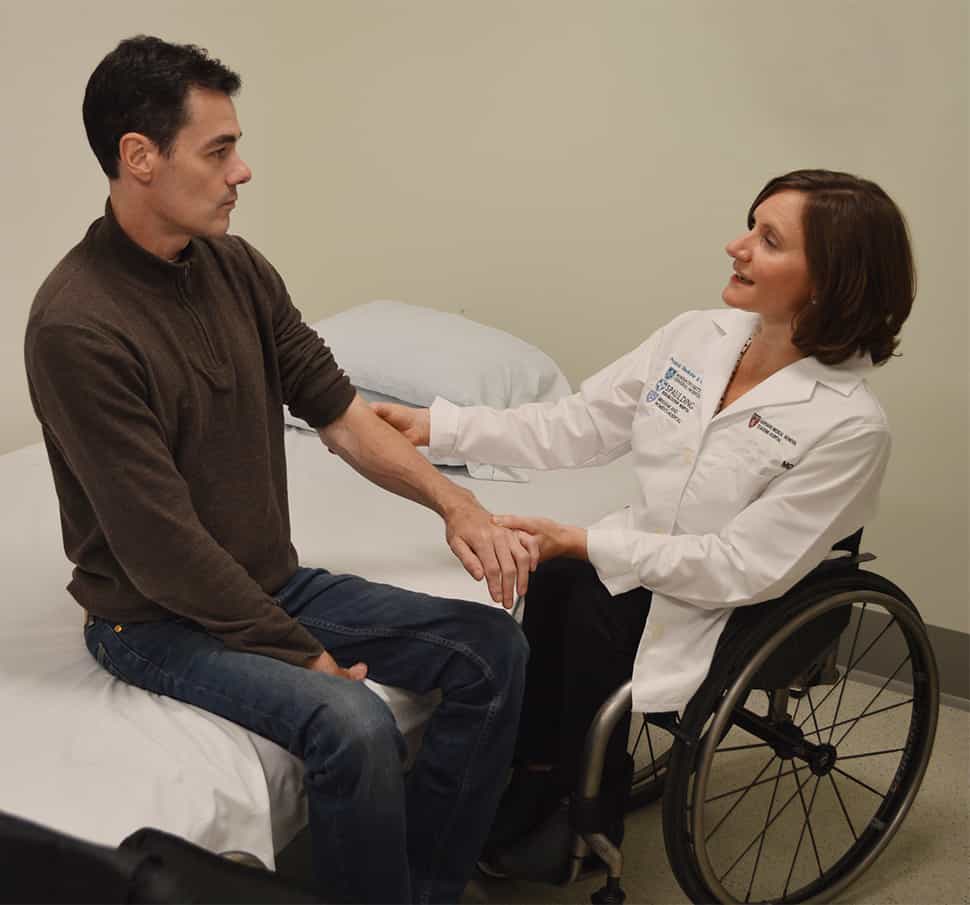
Dr. Harris knelt beside me, careful in his movements, and gently helped me into a more comfortable sitting position.
The touch was professional, yet carried the warmth of someone who had witnessed the full spectrum of human struggle, from pain to perseverance. “Are you all right, Marcus?” he asked softly, his concern genuine, radiating through his tone.
“Yeah,” I replied, though the pain in my leg still throbbed like a constant reminder of my reality. “Thanks.”
The room was quiet now, the only sounds the subtle creak of the chair against the concrete and the faint rustle of clothing as people shifted uncomfortably.
Eyes that had been skeptical now looked with something approaching understanding, though perhaps not fully. Dr. Harris stood slowly, giving the crowd a final, firm glance. “I’ve said what needs to be said.
Marcus’s journey is real, and his achievements are the product of dedication, not deception. Let that be the understanding you carry forward.”
It was a moment suspended in time, a convergence of truth, emotion, and revelation. The gravity of it pressed on everyone present.
I could see my mother inch closer, tears spilling freely now, a soft hand resting lightly on my shoulder. She didn’t need words; the bond we shared communicated more than anything anyone could say.
Tyler, still hesitant, finally lowered his gaze entirely, his chest rising and falling with uncertain breaths.
I allowed myself a small, tentative sense of relief, knowing that while the physical challenges would persist, at least the truth of my struggle was now visible to those who had doubted it.

The wheelchair, once a symbol of limitation, now seemed almost like a quiet testament to the strength and resilience I had cultivated over months of relentless effort.
The crowd began to disperse slowly, leaving behind the echo of realization, shame, and perhaps the faintest spark of empathy.
The conversation had shifted—from ridicule to recognition, from doubt to understanding—and in that shift, I felt an almost imperceptible but profound change.
The room had quieted, but the weight of what had just transpired lingered heavily in the air. My mother remained close, her hand warm against my arm, providing a physical tether to calm me in the midst of lingering emotional turbulence.
Her eyes, glistening with tears, reflected a mixture of relief, sorrow, and pride. The enormity of her love became tangible in that moment, a silent acknowledgment of the countless early mornings she had spent helping me with therapy, the long nights worrying about my progress, and the countless small acts of care that often went unnoticed by others.
Tyler stood a few feet away, awkwardly shifting from one foot to the other. His anger had evaporated, replaced by a visible sense of remorse and confusion. I could see it in the subtle tension of his jaw, the nervous way he avoided eye contact, and the faint trembling in his hands.
For someone so accustomed to asserting dominance, to wield words like weapons, the confrontation with truth had been jarring. His silence was louder than any argument he might have made.
Uncle Richard, now thoroughly aware of the seriousness of the situation, lowered his phone completely. The small device, which a few minutes earlier had represented voyeurism and judgment, now lay inert in his hands.
Even Jake, who had been a passive observer, seemed to absorb the gravity of what had been revealed, his body language transformed from casual detachment to uncomfortable attentiveness.
Dr. Harris remained by my side, kneeling with quiet authority, yet giving the space needed for the family to process.
His presence was a reminder of the years of dedication, therapy, and perseverance that had gone into my recovery—elements invisible to casual observers but monumental in shaping the reality of my condition. “It’s okay,” he murmured softly, “let them process it. You’ve done nothing wrong, Marcus.”
As the room slowly emptied, leaving behind the faint echoes of murmurs and shifting feet, a deeper sense of reflection settled over me. This was not merely about Tyler’s accusations or the skepticism of distant relatives.
It was about validation, recognition, and the complex reality of living with an injury that often goes unseen by those who expect visible signs of struggle.

The Physical Reality of Recovery
Even now, the physical pain throbbed through my leg and lower back, a constant reminder of what I had endured.
Months of intensive physical therapy, muscle retraining, and balance exercises had brought me to a place where I could take a few steps unaided—but every step came with effort, concentration, and often, excruciating discomfort. The progress was real, but the hardship behind it was invisible to anyone who did not witness it daily.
I reflected on the countless mornings of waking before dawn, forcing muscles to comply with movements that my body resisted; the endless repetition of exercises that left me shaking and drenched in sweat; the frustration and discouragement of plateauing, followed by the incremental joy of a step forward.
Recovery was not linear; it was an ongoing cycle of pain, effort, setbacks, and small victories, each moment a testament to resilience and determination.
Dr. Harris had been there through all of it, guiding, encouraging, and sometimes scolding me when I faltered. His presence in the room now reinforced the legitimacy of my journey, providing a tangible witness to the invisible struggle that so many assumed was exaggerated or fabricated.