After years of failed fertility treatments, my husband, Marcus, and I had made the difficult but hopeful decision to adopt.
We were desperate for a child but wary after countless rounds of medications, procedures, and disappointments. When we met Lila, a quiet, observant four-year-old with wide brown eyes, it felt like the universe had finally granted us a chance to become a family.
The adoption agency warned us that Lila had a “complicated early life,” but they assured us there was nothing to fear. We believed them.
We brought her home on a rainy Tuesday, promising to be the steady, loving ground she had been denied. Lila clutched her small backpack tightly as she surveyed our apartment, then shyly peeked around us as if testing the waters. “I like it here,” she whispered, and my heart swelled.
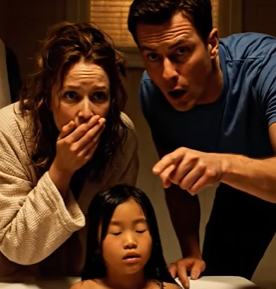
A week later, Marcus offered to give Lila a bath while I unpacked boxes in the hallway. I heard the soft splashing of water and her tiny humming drifting toward me. It was ordinary, comforting—until it wasn’t. The splashing stopped abruptly. Seconds later, Marcus’s voice cut sharply through the apartment, “Get in here! Now!”
I ran into the bathroom and froze. Marcus was pale, almost shaking, standing rigid beside the tub. Lila sat calmly in the warm water, clutching a plastic duck, completely unaware of the storm around her. Marcus’s voice trembled as he whispered, “We have to call the police.”
I followed his gaze. Partially hidden beneath the faint soap suds on Lila’s upper thigh was a small symbol—a series of numbers etched into her skin. It wasn’t a birthmark or an accidental scratch. The lines were deliberate, clean, precise. A scar left by someone else, someone with purpose.
“What… what is that?” I whispered, my throat dry.

Marcus swallowed hard. “It’s an ID scar. I’ve seen this before.”
He had been an emergency physician for over a decade and had once done a rotation with a federal task force that treated children rescued from illegal labor rings. Some children, he explained, had been marked as a way to track them when official documents were unreliable—a horrifying method of control and identification.
I knelt beside Lila, my hands trembling. “Does that hurt, sweetheart?”
She shook her head, eyes wide but calm. “No… it’s from before.”
“Before what, honey?” I asked gently.
“Before the blue house,” she said simply, almost matter-of-factly.
Marcus’s jaw tightened. “We need to report this immediately,” he said. “If she was marked, someone might still be looking for her.”
The phone in his hand seemed heavier than usual as we called the authorities. Lila looked up at us, her small voice steady but uncertain. “Am I in trouble?”
“No,” I said quickly, fighting back tears. “You’re safe.”
Within minutes, police sirens filled the air. A detective from the child protection unit arrived, followed by a social worker. They photographed the scar and asked Marcus and me questions about its shape, placement, and when we first noticed it. Lila sat between us on the couch, wrapped in a towel, swinging her legs as though we were attending some routine appointment rather than uncovering a nightmare.
At first, the adoption agency claimed they knew nothing. Lila’s file described neglect, not trafficking. Some of her early foster records were incomplete or missing entirely. The detective explained that some children passed through informal networks before entering the official system, leaving gaps that could hide dangerous truths.
Lila answered questions with alarming clarity. “The blue house had lots of kids. We sorted things there. If anyone cried, we got locked in a room. Men came and went. We weren’t allowed names.” Her voice was steady, her words simple—but chilling in their implication.
The investigation escalated quickly. Federal authorities became involved. Our home was placed under temporary protection. We were warned not to post any photos online or share Lila’s name with anyone outside the approved list. It felt surreal, like stepping into a story that should belong in a thriller, not our living room.
Two weeks later, the truth emerged. Lila had been removed years earlier from an unlicensed operation posing as a group home. Several adults connected to it were under federal investigation, but the case had stalled due to insufficient evidence. Lila’s scar matched the ID system used by that group. Even more terrifying—a suspect had recently inquired, unofficially, about adoption records involving a girl Lila’s age.
The authorities assured us she was safe. Arrests followed, charges were filed, and slowly the tension in our home began to ease, though the fear never fully disappeared. Lila started preschool, discovered the joy of laughter, and began requesting bedtime stories—small signs of healing.
Months later, one quiet evening, she crawled into my lap. “The blue house feels far away now,” she whispered. I kissed her hair, realizing that adoption had transformed us—not just into parents, but into witnesses and protectors of a world few see.
Life didn’t return to “normal.” Court dates, therapy sessions, and long discussions with counselors became part of our routine. Marcus and I learned how trauma can hide in plain sight, how easily adults assume a child’s past ends once the paperwork is signed.
Eventually, Lila’s case concluded with multiple convictions, and the adoption agency overhauled its screening and documentation processes. Officials quietly admitted that if Marcus hadn’t recognized the scar, her history might have remained buried.
Sometimes, I replay that moment in the bathroom: the still water, Marcus’s trembling voice, Lila’s calm gaze. It’s a reminder of how fragile the boundary between safety and danger can be—and how often children cross it alone.
Today, Lila is nine. She loves soccer, corrects my grammar with smug delight, and hates broccoli with a passion. She knows she was adopted and understands that the people who hurt children in her past were never her fault. What she no longer carries is the weight of being unseen.
We chose adoption hoping to bring a child into our lives. The truth was humbling: Lila didn’t need rescuers. She needed attentive, compassionate adults willing to see, question, and act when something felt wrong.
If this story made you pause, let it be more than a tale—it’s a reminder. Real-life danger rarely arrives with warnings. Sometimes it whispers. Sometimes it hides in plain sight. But silence is never safe. If you notice something that doesn’t add up, speak. Ask questions. Intervene. It could change a life forever.